Uncategorized

Poetry Ahoy! Upcoming Workshops

National Poetry Month is still more than a month away, but I’m already in planning mode. (Meanwhile, did you know February is Library Lover’s Month? Go hug your favorite librarian!)
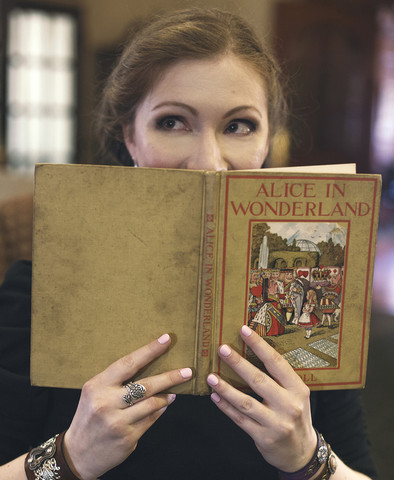
meg for emporium32 2015
‘Found poetry’ from old books! Playing with scale in literature and art! April is going to be awesome. (Photo by Nate Buchman, http://www.natebuchman.com/ for Emporium 32, http://emporium32.com/ Go check them out if you like the jewelry I’m wearing in this photo.)

I’m very pleased to announce that I’ll be leading three poetry workshops in April!  If you’re in the driving-distance-from-Boston area, I hope you’ll stop by and join me for some playing with words and art.

Something New, Something Strange: Found Poetry
April 7, 6:30 pm, Longfellow National Historic Site, Cambridge

In Longfellow’s poem “Keramos,” a potter at his wheel says, “All things must change/To Something new, to something strange.” Recombine, illustrate, and give shape to old forms using found poetry techniques with poet and educator Meg Winikates as part of our celebration of National Poetry Month. Please call (617)876-4491 or email reservationsat105@gmail.com to reserve your spot!
Grace Unto Every Art: Poetry from Visual Art
April 16, 2:00 pm, Longfellow National Historic Site, Cambridge

Whether it was shipbuilding, smithing, sculpting, or singing, Henry Longfellow found poetry in all forms of art. Join poet and educator Meg Winikates to explore ekphrastic poetry, enjoy the Longfellows’ art collection, and write your own art-inspired pieces as part of our celebration of National Poetry Month. Please call (617)876-4491 or email reservationsat105@gmail.com to reserve your spot!

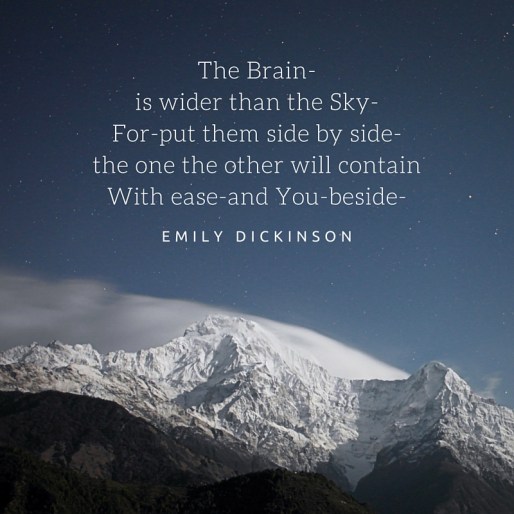
The Brain-is wider than the Sky-For-put them side by side-the one the other will containWith ease-and You-beside-

The World in a Grain of Sand – Incorporating Scale in Poetry and Art
Massachusetts Poetry Festival (April 29, 30 or May 1), Peabody Essex Museum, Salem

Galaxies and exoplanets, scanning electron microscopes, 4 million queries per minute on Google: in our ever expanding universe, is the human brain still ‘wider than the sky’ as Emily Dickinson said? What is the role of poet or artist in helping us understand how and where humans fit? Join poet and museum professional Meg Winikates to explore the use of scale in poetry and art in PEM’s Sizing It Up exhibition, experiment with physical and mental scale in your writing, and generate a poem idea (or three!) inspired by the artworks on view.
Buttons for the festival are not yet on sale, so keep checking the MassPoetry site for updates on button sales and scheduling!
 

Uncategorized

Arisia 2016 Wrap-up

So Arisia was a big, busy, beautiful mess of a weekend. I didn’t make it to all the panels I intended, I accidentally ended up in sessions that were awesome, and John Scalzi made me cry (in the good way).

I am not going to even try to cover everything, but here are a few highlights from this past weekend:

Nonstandard Paths to Magic
Honestly, I thought there would be more discussion of cool non-Latinate, non-Hogwarts, non-Western magic systems, but it was mostly a series of thought-provoking questions about the assumptions we make about magic, how it works, and who uses it. Some of my favorites:

  • Is magic transformative? If so, how does it change the user? How big are the changes, and how much of that depends on where in society the magic user starts?
  • Magic as ‘spiritual technology’ – do you have to believe in the tools to make them work?
  • How does magic-as-mystery (Tolkien) stack up against magic-as-textbook (Sanderson) and what are the strengths and weaknesses of each? When can you get a magical solution to a non-magical problem, or a non-magical solution to a magical problem (haul that ring to the volcano and throw it in, ’cause nothing else will unmake it!)?
  • Do you always need the good/evil dichotomy, when referring either to magic or to the people that use it? Where is the line between them, and is it the same for all people in that system?
  • Standard magic almost always comes with a price; should it? Is it a human thing, to feel like things ought to have a price attached? [and a corollary not discussed in the panel, but which I want to explore now: what if magic were an exhaustible resource, like fossil fuels, rather than renewable/constant/growing like the Force?]
cities in the caves beneath the ocean
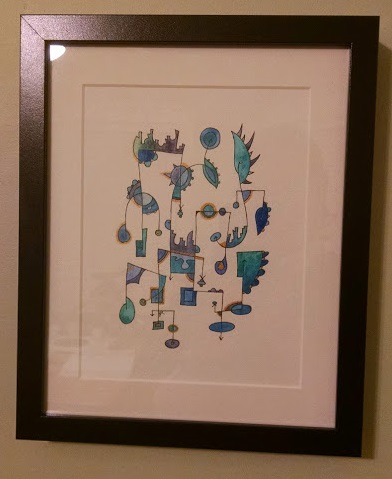
My new watercolor by Julia of Pelagiella Designs (link below)

Shifting the Language of SF
If you’re not super into the geekiness of language, scroll on. I *am* into the super geekiness of language, and there were points when I wanted to just throw up my hands and ask what the Klingon word for ‘surrender’ was. (I don’t actually think there is one, come to that. Klingons are not into surrender.)

This panel ranged wildly all over the discussion of language, from why you shouldn’t try to write dialect out phonetically, to the poetics of rhythm in language from different time periods, to what English might sound like if the Normans had never invaded (apparently you should read ‘Uncleftish Beholding‘ if you want to find out).

Here are a few of the panelists’ suggested ‘shortcuts’ to making your language not sound like 21st century English (with or without Tumblr-speak, a variation on netlanguage they didn’t get around to discussing, but I heard used by panelists in other sessions, because language):

  • Take an element of your speculative fiction (McDonald’s takes over the Western world and thus this fiction is all about fast food and consumer culture) and incorporate the ticks of that existing ‘language’ to create your new McPolitics, McFashion, and McTech.
  • Make it sound like a historical period instead. Have your aliens speak like Shakespeare, or your warp field engineers write reports like Fitzwilliam Darcy.
  • Use a poetic meter not standard to English (hexameter instead of pentameter). Caveat: Do not ever make your characters speak in rhyme, or your audience will hunt you down, if your editor doesn’t do it first.
  • Consider what the street slang of your alien/future tongue sounds like, as well as the cultured spaceship captain’s commands.
  • Mess around with the ‘easy’ grammar; change up prepositions, use synonyms not common in daily speech, use similes that don’t exist yet (“Your hair smells like freeze-dried rheolene fibers”). Use only the 1000 top words in the language and build the words you need additively like German does (‘glove’ translates to ‘hand-shoe,’ and no, I am not making that up).

Complexities of Voice
This built really nicely off the above language panel, and also one I went to on character interactions, which was a little basic but still interesting. (One did get the feeling that some of the folks in the audience asking questions were young, and as interested in getting ideas on how to interact in real life as they were trying to get their characters to talk to each other.) The best tips from this panel:

  • Read your work aloud. Have someone else read it aloud. Can you tell the characters apart?
  • Use styles that suit the kind of character you’re building. Think about levels of formality, slang and syntax, long sentences or short ones, incomplete thoughts or run-ons and tangents. Put all that info in your character cheat sheets with eye color, favorite food, and all that other background you need.
  • ‘Borrow’ a real-world person for your voice (may want/need to ask permission, if you know them personally!) or ‘fancast’ your characters with appropriate actors. Does your character sound like Alan Rickman? Maggie Smith? Will Smith?
  • Avoid infodumps and mansplaining. Even if it ‘sounds’ like your character, very few people get away with talking in paragraphs.
  • Find and then listen to/read the stories and conversations of people who come from the background you’re trying to write. The Smithsonian, NPR’s StoryCorps, and the Library of Congress are all good places to start for free oral history sources.


scalzi
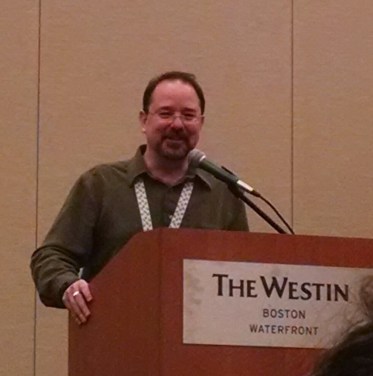
John Scalzi at his Guest of Honor reading.

Other random bits of awesome:

  • Hearing the geek-folk group Murder Ballads sing “The Ballad of Captain America’s Disapproving Face”
  • Listening to John Scalzi read hilarious excerpts from some cool new projects we’re forbidden to talk about, and then hearing him read “Raising Strong Women,” which is the part where I cried. (So did he.)
  • I bought one of Julia Burns Liberman‘s beautiful abstract story/watercolor paintings (looks awesome in my dining room!)
  • Saw an incredibly cool wood-turning demo by artist guest of honor Johnna Klukas
  • Got a great list of recommendations for places to read speculative poetry (and some specific poems/poets to follow) from the folks on the “Speculative Poetry is Awesome!” panel. You can find a bunch of those recommendations collated on Twitter under the hashtag #poetrypanel (though some of the tweets seem to have disappeared? If you click through to AJ Odasso’s individual feed, they’re still there)

So how did you spend your long weekend?


Uncategorized

Looking forward to Arisia 2016

For the last several years I’ve tried to make it to either Arisia or Boskone, to get a full weekend’s worth of geekery, inspiration, and writing research. Last year’s trip to Boskone got a little dicey thanks to the blizzard (1 of…14 or so, thanks, global warming). I’m keeping my fingers crossed for more beneficent weather this time around.

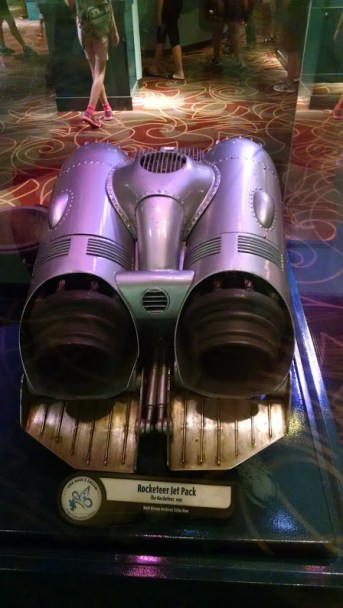
rocketeer
Maybe I can borrow this to get to the con? (Jet pack from The Rocketeer, as seen in One Man’s Dream at Walt Disney World. Photo by me, Nov. 2015)

As always, there seem to be more options than time, but here’s where you’ll likely find me if you too happen to be at the con this weekend:

Friday

7 pm: “How Lord of the Rings Stunted Fantasy’s Growth” (Interesting premise, fairly sure I disagree, but I want to hear why they think so)

8 pm: “Mrs. Hawking: A Steampunk Play” (Sounds like fun, and I’m always up for a good performance. If I miss it on Friday I think it repeats later in the weekend)

Saturday

10 am: Oh, who knows. It will either be “The Founding Mothers of SF/F,” “Constructing Languages,” or watching the artist guest of honor make wood-turned rocketships on a lathe, which sounds awesome.

11: 30 am: “Nonstandard Paths to Magic” (If you didn’t know I was a fantasy writer, would you assume that this was ‘how to sneak into Hogwarts?’ Because I might)

1 pm: Short Story Contest

4 pm: John Scalzi Reading (there were a few other good looking sessions in this block, but I can’t *not* go to the Scalzi reading.)

Evening: Who knows (part 2)? Depends on how much energy I have left and how far I have to go to find food.

Sunday

10 am: Broad Universe rapid-fire reading (though “Headcanon and SF/F” looks good too, so I may end up there if the BU panel is full)

11:30 am: “Complexities of Voice” most likely, though I have the art director’s tour of the art show and NASA documentary films as back-up options.

1 pm: “Vivat Regina: Mrs. Hawking Part II”

2:30 pm: “Science Year in Review” (with “Themes of Afrofuturism in SF” as backup)

4 pm: “Everything I say is a lie” ie. the unreliable narrator panel, not a declaration of intent or challenge.

5:30 pm: “Worldbuilding with the Soft Sciences” unless I get in a mood, in which case I may end up in “Lesser Known Tropes v. Women in SF/F”

Evening: Ditto from Saturday. Might go swing dancing at 7:30?

Monday

10 am: “Inside Out: Pixar Gets Smart”

11:30 am: “Speculative Poetry is Awesome” or “Humor in Writing” No idea how I’m going to pick on that one.

2:30 pm: “The Story within the Story” or “Don’t Quit Your Day Job” (good advice, I like my day job!)

Chances are good if I’m *not* any of these places, I’ll be down in the vendors’ hall hanging out with my ever-talented friends from Emporium 32.

What are you up to this weekend?

Uncategorized

In praise of the sound of crunching leaves

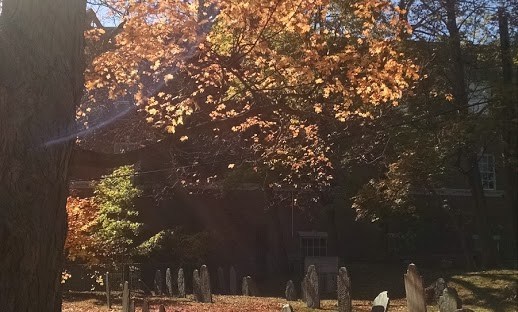
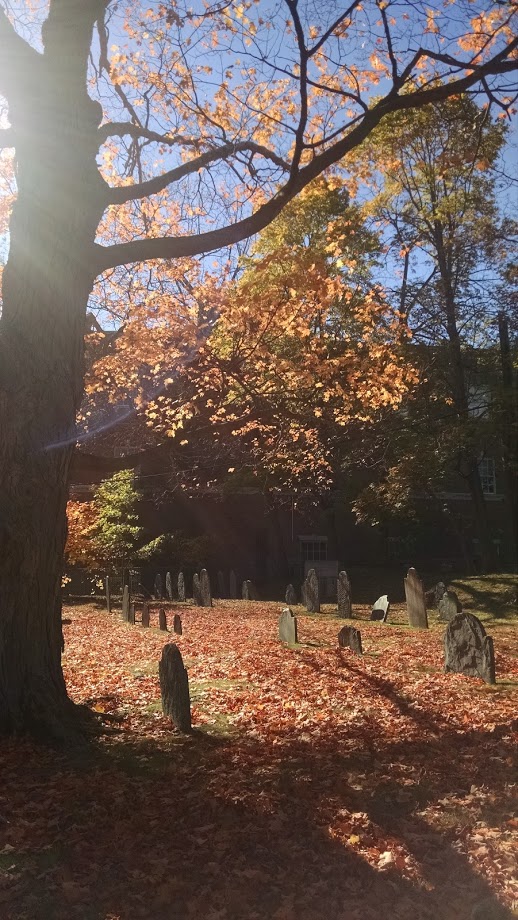
Graveyard, Arlington MA, October 2015. Photo by Meg Winikates

It’s autumn, and despite being an agreeably insane sort of busy right now, I had a chance to go out at lunch today and take in the seasonal delights. Peak foliage around town was actually probably the end of last week, but there’s still a lot of gorgeous to be had, and that brilliant invigorating bite in the breeze today is the sort that makes me glad to be alive.

And so in celebration of my favorite season, have a poem by fellow New Englander Emily Dickinson!

Besides the Autumn poets sing (131)
Emily Dickinson, 1830 – 1886

Besides the Autumn poets sing,
A few prosaic days
A little this side of the snow
And that side of the Haze –

A few incisive mornings –
A few Ascetic eves –
Gone – Mr Bryant’s “Golden Rod” –
And Mr Thomson’s “sheaves.”

Still, is the bustle in the brook –
Sealed are the spicy valves –
Mesmeric fingers softly touch
The eyes of many Elves –

Perhaps a squirrel may remain –
My sentiments to share –
Grant me, Oh Lord, a sunny mind –
Thy windy will to bear!

If you’re hungry for more autumnal poetry, you might want to check out this Wednesday’s Improbable Places Poetry Tour.  Imagined, organized, and hosted by poet and Montserrat professor Colleen Michaels, this month’s stop on the tour is at Green Meadows Farm in South Hamilton, MA, and a gathering of poets will be reading a selection of their works on the theme of “Harvest/Moon”– including me!

I’ll be there to listen, bask by the bonfire under the moon, and read one of my own night sky pieces.  Hope to see you there!

Uncategorized

Sunshiny Summer News: Poems in Print!

Happy summer, all! In the wake of last week’s downright delightful Supreme Court decisions on health care and marriage equality, I have less-momentous but much more immediately personal good news; I have four poems that are being published this summer on Window Cat Press.

Window Cat is an online literary journal run by a fabulous trio of poet/artist/editors, who are dedicated to bringing the work of young & emerging poets, writers, and artists to the wider world. Their mission is to “seek to celebrate, inspire, innovate, and play.” About the poems that will appear there, they said:

“We were charmed by the interplay of light and color in Michele’s photographs and thrilled by the rhythmic beauty of your words.”

You can imagine my key-smashing delight!

kermittypes

Publication date will be sometime mid-summer; as soon as the issue is live I will be posting the link here, as well as on Palettes of Light, as several of the poems to be published are part of that collection, with integral accompanying photography by the lovely and talented Michele Morris, as mentioned above.

In other happy news, I will also be reading this fall at Mass Poetry’s U35 reading series at the Marliave in Boston, on September 22nd. Hope to see you there!

Uncategorized

Sounds, scuba, and spine-tingles: MA Poetry Fest 2015 wrap-up

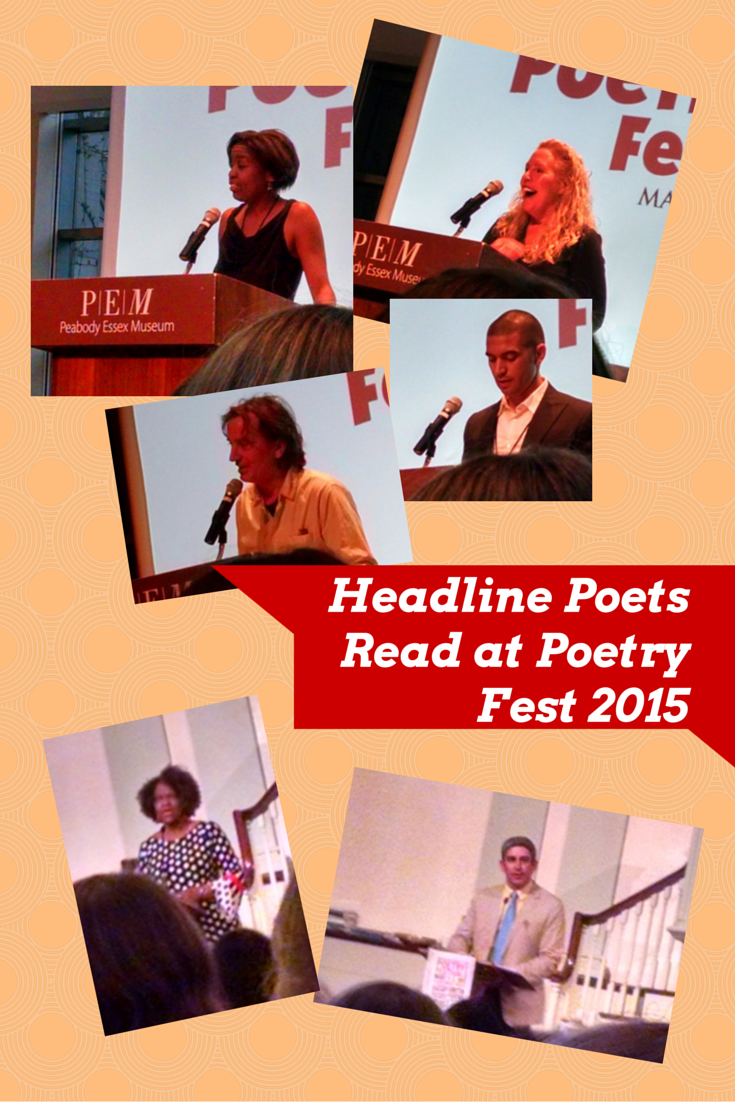
Headline Poets Read at MA Poetry Fest I have a fabulous time at the Mass Poetry Festival every year.  Every year I learn something new about writing, I am bowled over by a poet (or multiple poets) whose work I hadn’t before had a chance to appreciate, I get to spend time surrounded by people who love words as much as I do, and I come away exhilarausted, which is that peculiar state of wiped out and buzzed that comes from too much inspiration in too short a time period.

As always, the headline poets were fantastic. I didn’t make it to all the headline sessions, but both the Friday and Saturday night readings were interesting, featuring Nick Flynn, Adrian Matejka, Denise Duhamel, Rita Dove, and Richard Blanco. I was especially enamored of Rita Dove’s reading, and most particularly loved her poem “Maple Valley Branch Library, 1967,” linked below:

Full text of the poem can also be found here.

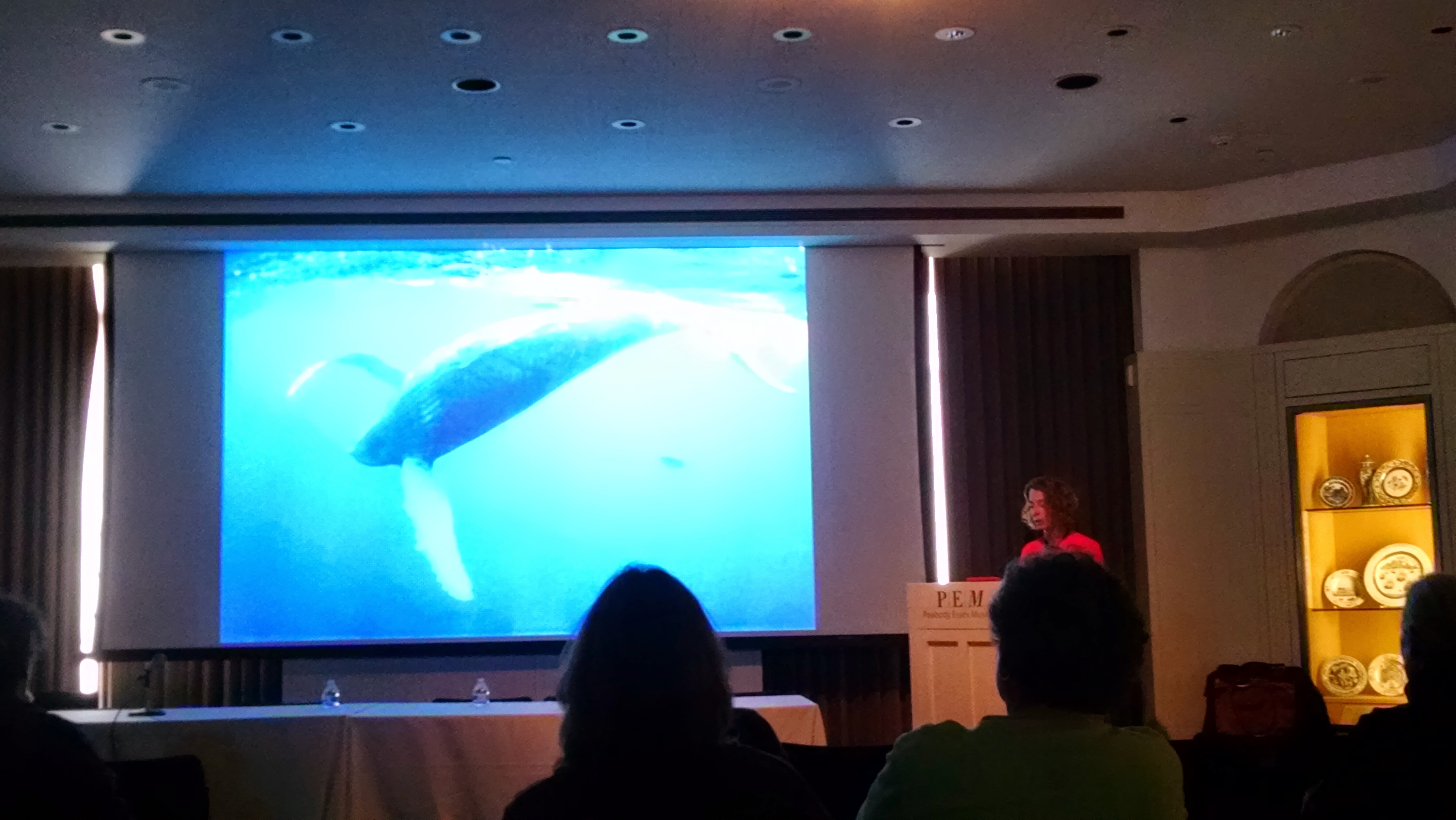
Scuba diving poet Marie Elizabeth Mali reads against a backdrop of her photography.

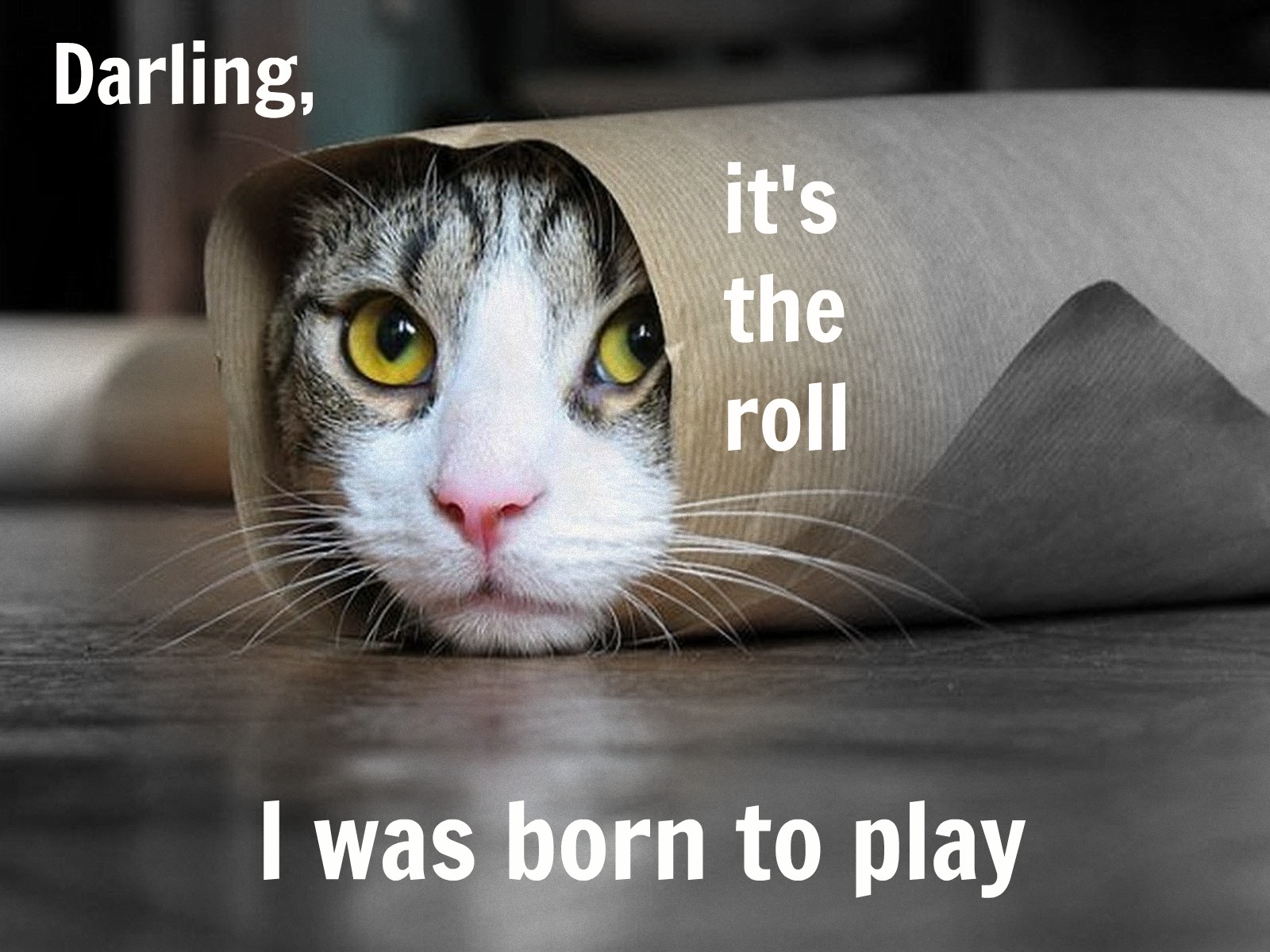
Other moments that caught my imagination included the reading of marine-inspired poetry to a running background of underwater photography, the highly entertaining “Digital Age Poetics” workshop from the lovely folks at Window Cat Press, and the absolutely fabulous “Writing Sound to Sound” workshop with Moira Linehan and Mary Pinard, which focused on exercises that build sound consciousness into your writing from the very start.  As someone who loves the music of language, syllable and rhythm, I found that session especially inspiring.  Overall, from humorous memes and ‘flarf’ searches to dictionary page and abecedarius poetry, I came away with a ton of new writing prompts and a few promising new poem kernels.

Dramatic Cat has found her role of a lifetime, courtesy of a penchant for puns.
Meme as digital poetics: Dramatic Cat has found her role of a lifetime, courtesy of a penchant for puns by yours truly.

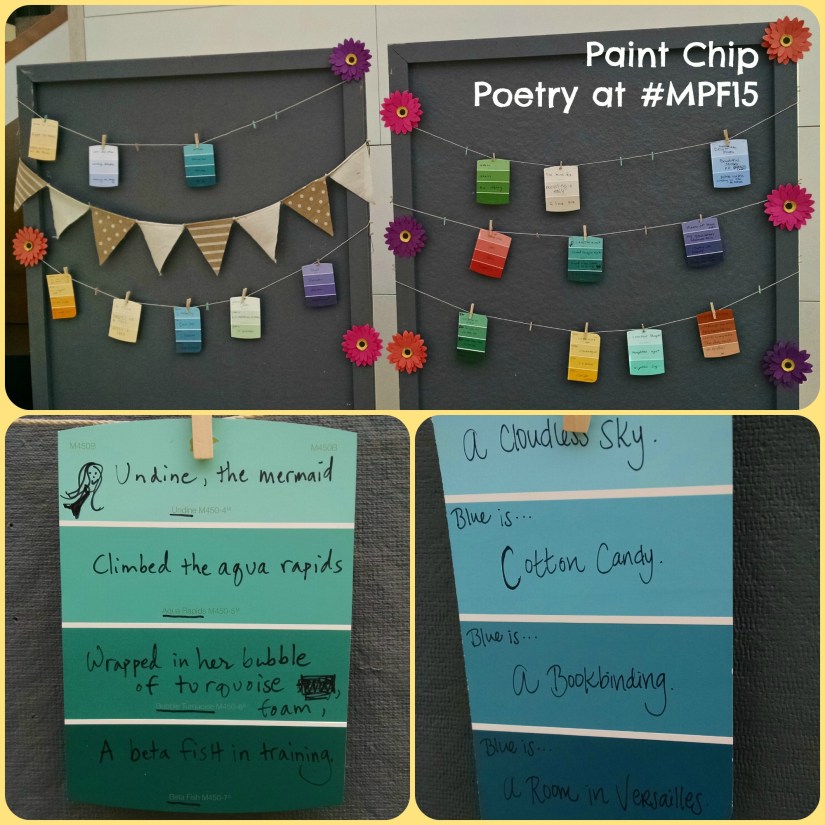
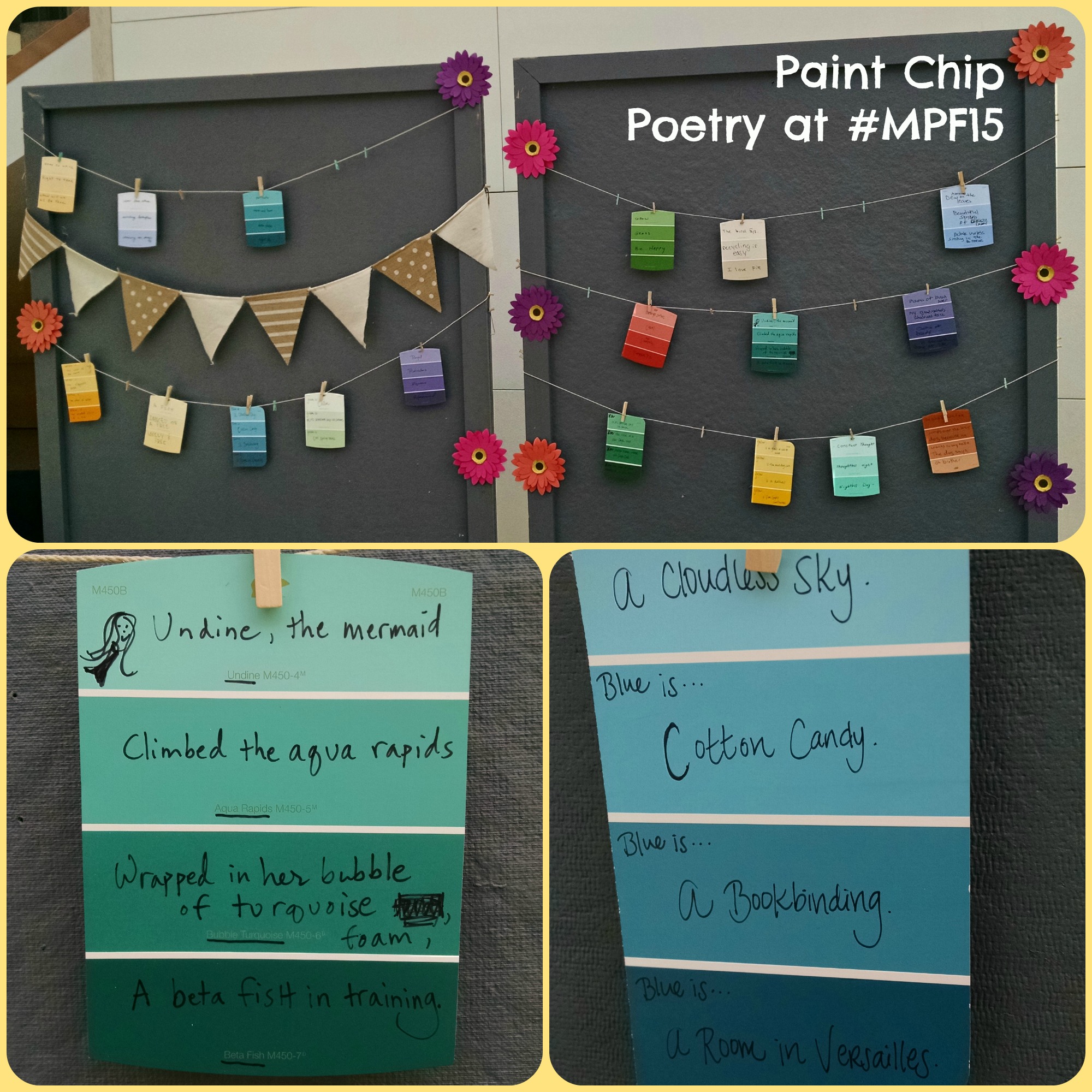
I learned about Edna St. Vincent Millay, read aloud and listened to a great collection of winter and spring poems from my fellow long-suffering New Englanders, and had many a meal with friends old and new.  Finally, I was pleased to see that PEM continued to play with words and art, featuring Mad Libs Muse prompts featuring ‘erasures’ from famous poems, paint chip poetry focused on color and brevity, and even a giant Scrabble game.

paintchippoetrympf15

Thanks and congratulations again to Michael, Jan, and Laurin for putting together another spectacular weekend!

Uncategorized

“Mill Brook” & Happy National Poetry Month

You didn’t think I’d let more than a few days of National Poetry Month pass without comment, did you? I celebrated the first week by diving headfirst into Mary Oliver’s latest volume, Blue Horses, which I adored, and also I’m gearing up for leading my session “Found Narratives” at the Mass Poetry Fest in May.  Finally, I’m doing my best to participate in the ‘poem a day’ challenge.  While I have been taking some of my themes from the challenge they’re hosting at Writers’ Digest, I’ve also been going where my whimsy takes me, so here’s a piece I’m fairly happy with from this month’s early efforts:

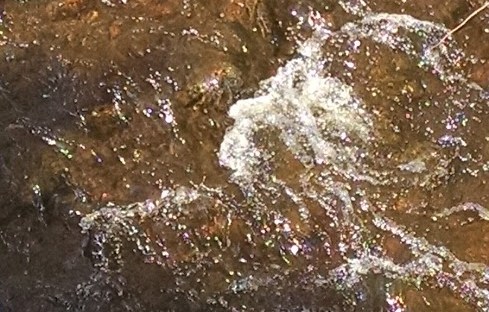
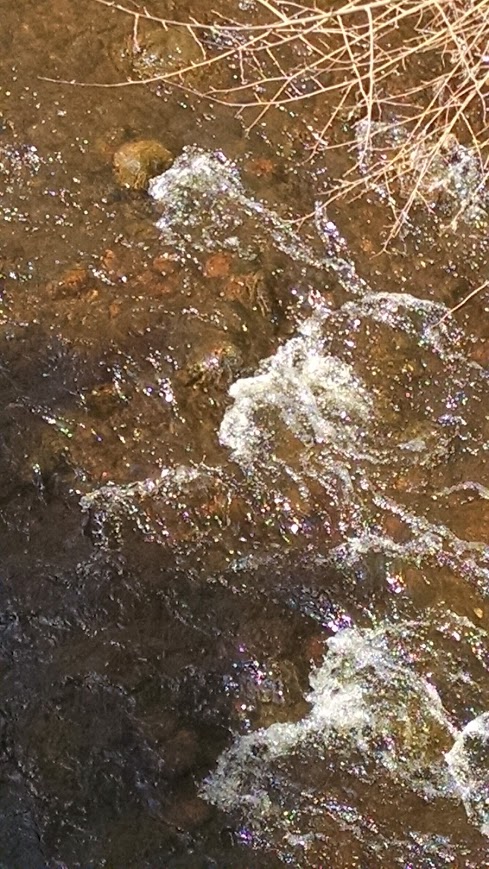
Mill Brook, from the Mill Street Bridge, Arlington, MA.  Photo by Meg Winikates
Mill Brook, from the Mill Street Bridge, Arlington, MA. Photo by Meg Winikates

Mill Brook
By Meg Winikates, April 2015

Missing the ocean, I have decided
to adopt the brook.
It is not especially approachable,
high-banked and fenced,
a little cantankerous at times
with the culverts and cobblestones
the city has gifted it.
But I am determined
to love its brown burbling,
its occasional patient mallard,
as we all await
the timid spring.

Uncategorized

What makes a literary district?

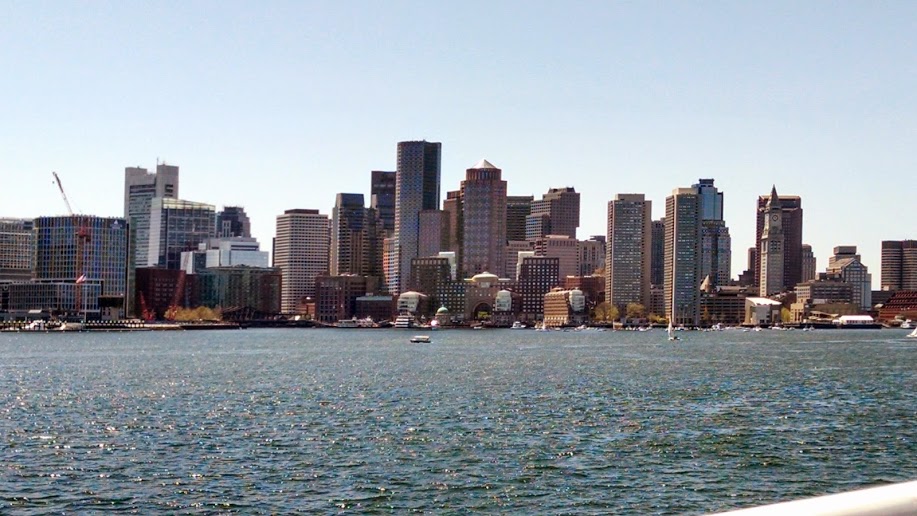
Boston from the harbor. Photo by Meg Winikates.

In August of this year, the Mass Cultural Council approved the creation of a ‘cultural district’ in Boston dedicated to the literary arts.  Cultural districts are a way of raising awareness about the various arts organizations and resources in an area, and are meant to have an economic impact as well, attracting businesses and creative professionals to a designated area.  There are currently 26 designated cultural districts in Massachusetts, and I find a lot to like in the definition the MCC provides:

It is a walkable, compact area that is easily identifiable to visitors and residents and serves as a center of cultural, artistic and economic activity. The Massachusetts Cultural Council recognizes that each community is unique and that no two cultural districts will be alike.

That seems like a set of very achievable guidelines, given that much of New England falls into the ‘walkable, compact’ category already, and the rest of the definition of ‘culture’ is left open to the strengths of the city/town that applies.

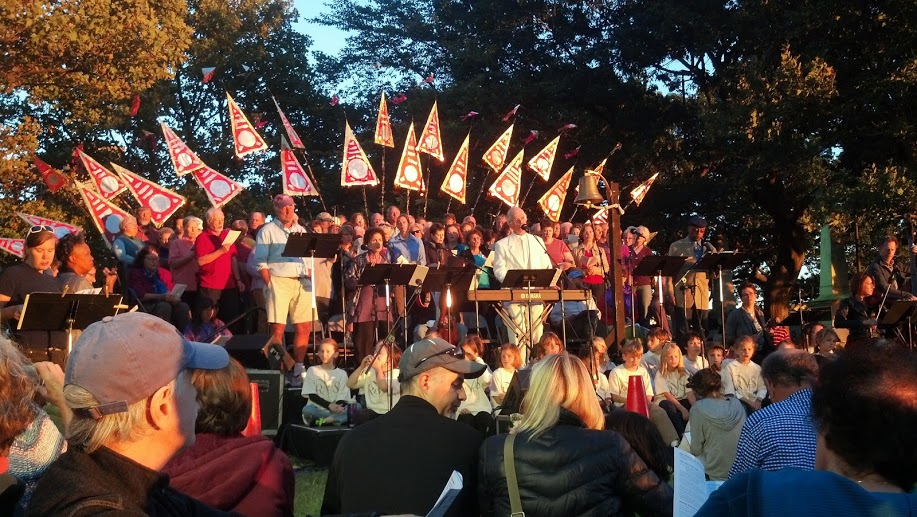
Revels' River Sing on the banks of the Charles.  Photo by Meg Winikates.
Revels’ River Sing on the banks of the Charles. Photo by Meg Winikates.  Many cultural districts seem to feature recurring music and dance festivals like this one, as well as the local waterfront, for understandable reasons. (Though the current Cambridge cultural district is in Central Square, up the road from where this celebration of the autumnal equinox occurs.)

So what makes the Boston Literary District (the only one of its kind in MA and the only district specifically geared to one arts discipline) fit the bill?

Mass Poetry recently interviewed Larry Lindner, the Literary District’s coordinator, who enthused about his hope that “the Lit District website becomes for Boston what Time Out is for people who go to London — a kind of what’s-going-on-in-the world-of-literature in Boston” and mentioned plans for an app to help explore the District in 2015.  And the physical district itself?  By making the sites and events more visible, accessible, and tangible, Lindner hopes to encourage timid readers as well as those already deep in the reading and writing world.  He also suggests that associate partnerships with organizations and businesses outside the District’s official borders can help their visibility as well, and bring some of the benefits of the district designation to other areas of the city that need it.  (Even events outside the city get a chance to be included on the District’s events calendar, such as a public art/poetry event in Newton earlier this month.)

The thing I love best about perusing the map of the district is the number of surprises it holds, even for someone who has lived all but 2 years of her life in and around this city, who has worked at a local literary/historical site (2 if you count the Paul Revere house and his own poetical connections), and who was an English major to boot.  For instance, did I know that E.B. White’s The Trumpet of the Swan was set in Boston’s Public Garden?  Maybe when I read it when I was nine, but I certainly didn’t remember the scene with Louis playing his trumpet on the actual existing bridge over the pond.  Nor could I have named even half the writers and poets listed as having ever been Boston residents.  (I love learning new things about my city!)

A few of the sites listed do seem like a stretch (there’s a small bookshop on the ground floor of the State House, really?) and some a bit vague (the Old City Hall listing says ‘Legend has it that that’s the setting for Edwin O’Connor’s novel The Last Hurrah‘) but on the other hand, one can choose to take that as a plus.  Some of these places had to really *try* to connect to the literary district.  It was worth the effort to find the thread, the history, the destroyed address that this modern building now stands over–and that’s kind of awesome, that people want to be a part of it.  I know next time I’m free to wander a bit downtown, I’ll be keeping my eye out for some of the literary landmarks listed.

Boston Public Garden (and Louis' bridge!).  Photo by Captain Tucker, used under creative commons license.  Click for source.
Boston Public Garden (and Louis’ bridge!)  Photo by Captain Tucker, used under creative commons license. Click for source.

And if you can’t make it to Boston to check out what’s going on on the bookish byways, take a stroll down Author Avenue  or Fantasy Street as you check out this virtual literary district at  My Independent Bookshop.  This site is a visually appealing compilation of people’s book recommendations which are then linked to independent bookstores.  I haven’t set up a ‘bookstore’ of my own yet, but it does look like a fun community and a fairly intuitive interface. (Don’t forget to scroll sideways as well as down, though!)

Uncategorized

Granite Calligraphy

I never get tired of being impressed and surprised by my friends.  My friend and former colleague Kyle Browne is an environmental artist, and has been remarkably busy this summer, with artist residencies, a piece from which is appearing in PEM’s Art & Nature Center show opening next week, Branching Out: Trees as Art, and apparently also walking the coastline on the North Shore, reading and writing the landscape there.

I’ve been thinking a lot about the New England coastline myself, between a project with my photographic collaborator on the West Coast, and my trip to Provincetown earlier this summer.  [There are poems brewing!]  I’ve always appreciated the kinds of patterns one gets on the sand in shallow tidal water, or rippled into the rocks of a bouldersome stream, but Kyle’s latest work gives me a new appreciation for the subtle curves and breaks of the rocky shores that are such a pain to carry scuba gear over.  They look like brush strokes, and make me want to spend more time on my favorite rock down at Collins Cove, watching the stones as well as the sea.

Check out the video of Kyle’s piece below or related photography on her site here.

Uncategorized

The Power of Improbable Places

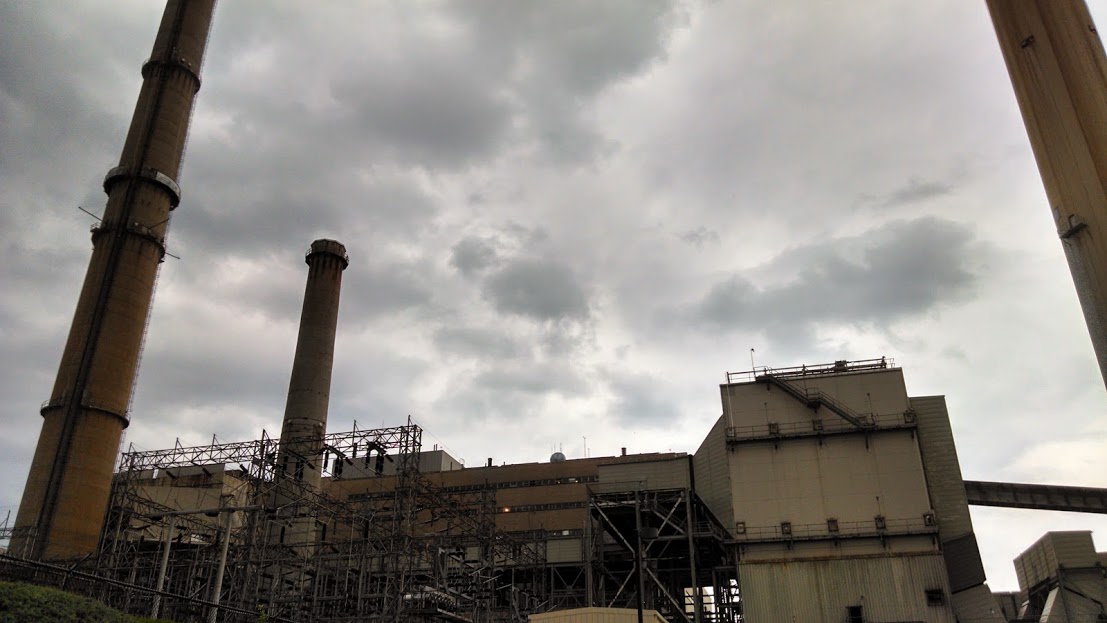
Poet Colleen Michaels is the brain behind the Montserrat College of Art’s Improbable Places Poetry Tour.  And this past Thursday, the improbable location for the latest set of poetry readings was Footprint Power’s recently decommissioned power plant on the edge of Salem Harbor.

Thunderclouds gloom over the quiet power plant.  Photo by me.
Thunderclouds gloom over the quiet power plant. Photo by me.

I was initially dubious and simultaneously drawn.  Having lived in Salem for over 4 years, just on the opposite side of Collins’ Cove from the familiar smokestacks, I’ve absorbed their shadows into the folds of my understanding of the local landscape, and grumbled occasionally about wind direction and sooty windows.  Like most people I know around here though, I’d never been inside.  Hydroelectric plants and windmills at Niagara and in the Netherlands and elsewhere?  Sure!  Coal and oil-fired behemoth in my backyard?  Nope.

So while I wasn’t sure what an evening of readings about ‘the work of power and the power of work’ would sound like, I was totally in for the chance to tour.

As it turned out, the readings were a fantastic variety.  Ranging from reflections on both the grit and the worth of daily grind to the concept of living on or off ‘the grid’ to poems inspired by this very power plant and the future of energy in the 21st century, the poems and poets offered a beautiful and thought-provoking set of mental images.

Check out more of the ‘cathedral of steel’ and its unusual evening occupants in the gallery below:

This slideshow requires JavaScript.

Local poet January O’Neil also has a nice write-up of the event, where she too highlights one of my favorite moments: the reading ended, not with a headliner or a speech, but a moment of silence that was filled by a recording of the actual crackle-rumble-hum of the turbines when the plant was operating.  It was a very cool kind of ghostly and really made me want to go home and write.

In the meantime, however, have a draft of a poem inspired by my own workplace, and what it’s like on a festival weekend as the visitors are heading out and you’re waiting for that last performer to finish packing up their gear, thinking about attendance numbers and what you’ll put in your program evaluation come Monday…

8 days a week

By Meg Winikates

I tell myself it’s a good ache,
the dull burn in my heels that says
the miles I’ve walked circularly
over this granite floor have made
a lasting impression on me.

My calves recall the frequent dash,
sore hands avert another crash
ff child and chair, of floor and phone,
and whisking fingers vamoose trash—
rub buzzing ears, block joyous drone.

Duty’s done, but wonder lingers—
Did I meet just eyes and fingers?
Save one bad day, help one smile grow?
Made one growler’s heart a singer’s?
Or worn my footprints on this stone?
Enough would be one ‘yes’ alone.

Have you ever encountered poetry or art in an unusual place that helped you to look at it differently?  What places inspire you?