The second workshop I led for MassPoetry Festival 2017 was “Solarpunk Serenades,” which was an introduction to the world of eco-conscious, optimistic, near-future science fiction that is now termed solarpunk. Arguably, there are moments in poetry, publishing, and popular culture which have fit this bill in the last hundred years at least, but now it has a name, and an opportunity to make its mark in sci-fi literature, aesthetics, design, and imagination the same way cyberpunk or steampunk have.
The slides below contain links to and names of most of the resources I mentioned in my presentation, for both the context and history of solarpunk, and places to find inspiration to write your own. There are also three themed writing prompts with visual cues. You can find most of those visuals and links to their originals on my Pinterest board. It was fabulous to see such a packed room of optimistic geeky poets, and I was really impressed with the breadth of imagination and vivid imagery that people who chose to share their poem drafts demonstrated. Thanks for inspiring me in return, poetpunks!
You can also download the handout from this workshop, with examples of poems both new and classic that use some solarpunk ideas and ideals here: SolarpunkSerenades workshop handout.
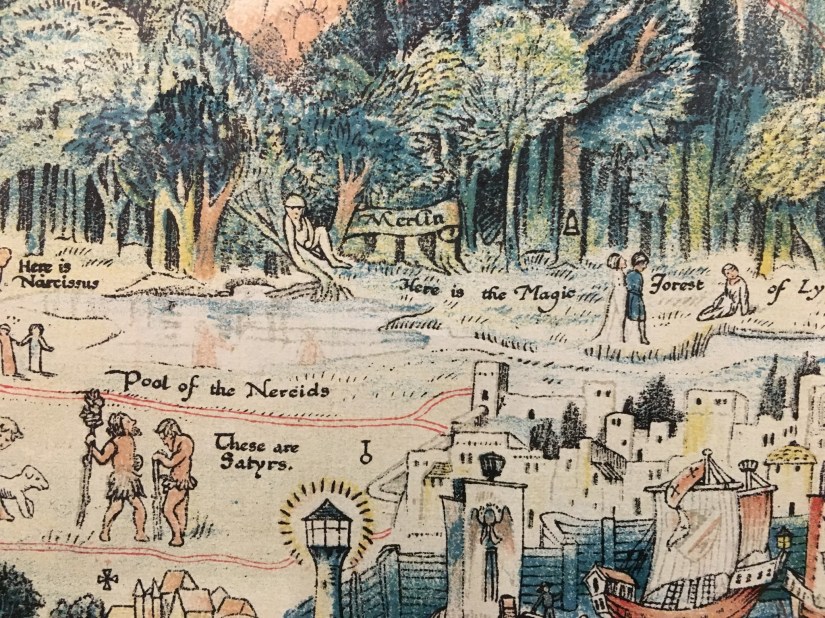
Detail from a map in the collection of the Boston Public Library’s Norman B. Leventhal Map Center.
A few weeks ago, all the sins published my reflections on and exhortations to the wonders of gathering artistic inspiration in museums. (If you missed it, you can find it here.)
This week, they’re back with my best suggestions on how to outfit yourself for a museum exploration. Matthew Henson didn’t head for the North Pole without a coat, after all!
So if you’re suffering writer’s block, or it’s been ages since you went on that school trip to your local historical society, here are my 5 tips on using museums for inspiration.
…Inspiration can come from a fossil in a natural history collection, a scrap of wallpaper in a historic house, the view from a national park peak. What would a taxidermied specimen have to say to its collector? What words still resonate in the walls of an old structure? Whose hands molded the pot whose shards sit in that case, and how do the pieces evoke the whole?
My features essay, “Art Heists for Art’s Sake,” is now up to kick off Issue 3 of the lovely UK literary journal, all the sins!
…the day I stood in front of that Breugel painting and talked poetry with my mother was a turning point for me. Since then, I’ve worked inspiration from other art forms into my creative writing, both poetry and prose, both consciously and unconsciously. Museums have also become my career, both as a museum educator and as a museum advocate. Fortunately, one creative practice informs the other in a rewarding cycle.
I rang in the New Year by spending some quality time in Middle Earth, and found myself still there today courtesy of this beautiful art project by Friedrich van Schoor and Tarek Mawad. Surely Imladris or Lothlorien looked like this?
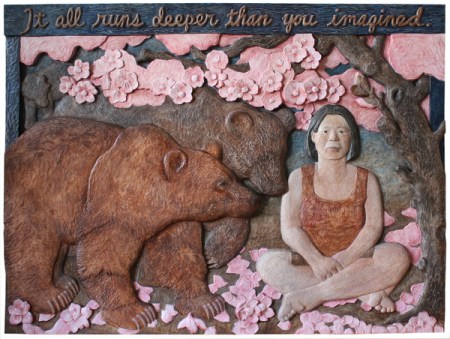
Deeper Than You Imagined, by Sachiko Akiyama (featured artist in Branching Out), click for source.
If any of you follow my museum education blog, Brain Popcorn, you’ll know I’ve been working on a show that opened just a few weeks ago called Branching Out: Trees as Art. In the course of researching for that show, I was introduced to the work of Suzanne Simard, a forester who works with tree root/fungal networks, which form an underground communication chain between trees of all ages and species in a forest. Her research inspired me to write a speculative flash fiction story which has now been published on PEM’s blog, Connected.
I never get tired of being impressed and surprised by my friends. My friend and former colleague Kyle Browne is an environmental artist, and has been remarkably busy this summer, with artist residencies, a piece from which is appearing in PEM’s Art & Nature Center show opening next week, Branching Out: Trees as Art, and apparently also walking the coastline on the North Shore, reading and writing the landscape there.
I’ve been thinking a lot about the New England coastline myself, between a project with my photographic collaborator on the West Coast, and my trip to Provincetown earlier this summer. [There are poems brewing!] I’ve always appreciated the kinds of patterns one gets on the sand in shallow tidal water, or rippled into the rocks of a bouldersome stream, but Kyle’s latest work gives me a new appreciation for the subtle curves and breaks of the rocky shores that are such a pain to carry scuba gear over. They look like brush strokes, and make me want to spend more time on my favorite rock down at Collins Cove, watching the stones as well as the sea.
Check out the video of Kyle’s piece below or related photography on her site here.
All of us, at one point or another, have answered that question about having dinner with any three people from any point in history. My answer is always Abigail Adams, Jane Austen, and some rotating third figure depending on my mood. Sally Ride, maybe, or Eleanor Roosevelt, or Princess Leia (what, you didn’t mean *Earth-bound* historical figures, did you? Well in that case, Michelle Obama).
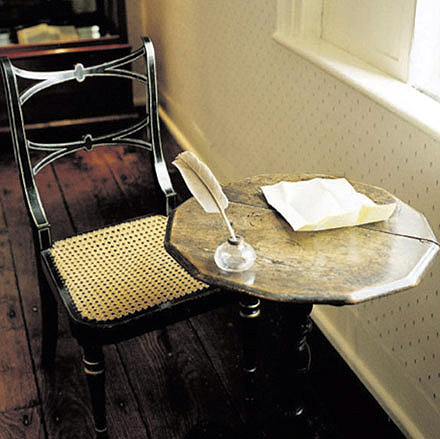
Of course, when you can’t meet them, you can go stand by the window where they sat and absorb the genius vibes, instead. Jane Austen’s writing table, Chawton.
The point is, most of us answer that question with the names of people we have no chance in this reality of ever meeting, death and the Secret Service generally being no-nonsense sorts of barriers. It doesn’t change the fact that meeting people you admire can be an amazing kick-start to your own sense of self.
A number of years ago now, I went to a panel on ‘why write fantasy?’ hosted by the Cambridge Public Library, featuring a discussion between two of my literary heroes, Susan Cooper and Gregory Maguire. I spent the entire two hours or so pretty much vibrating out of my seat with joy, most especially when Susan Cooper said she writes fantasy because ‘that’s just the way [her] brain works.’ She wants to write a Shakespearean historical fiction, or about Nelson and the Napoleonic wars, they turn into time travel stories. It was among the top five most validating things I’ve ever heard in my life, and she wasn’t even talking to me.
(Mind you, when I did get a chance to talk to her, I babbled something probably incoherent about how much I love her writing and how I reread The Dark is Rising every time I need a reminder about how pacing works. I was so not smooth.)
And then this past Sunday I had the opportunity to hear Naomi Novik read during Geek Central (Cambridge, again! Why do I not live there?). I’ve loved her Temeraire series since the beginning, with much wailing and gnashing of teeth at the same time (dragons and Napoleon, why didn’t I think of that!?). I’ve been to one other reading of hers, which was much more crowded, and though I felt bad she had a smaller audience this time (most of us who were there were blaming the RI Comic Con) I appreciated the fact that it meant we got to have actual conversation with her. She read us the opening to a new fairy-tale inspired piece, and talked about finishing up the Temeraire series, what’s next after that, and who inspires her and why. She even asked for input on potential titles for her new work, which made me grin. (Titling is hard!)
And when it was my turn to get my book signed, I managed not to sound like an idiot (progress!). We talked about her dragons-in-ancient-Rome short story, and discussed how cool her Anglewing dragons were, and even though I said absolutely nothing to her about being a writer myself, I came away inspired and heartened. Because she’s not so different from me, and she reads authors I read and writes things in the genres I write, and my first drafts don’t sound so much rougher than the piece she read us all. And since our brief conversation on Sunday I’ve managed to write over 6K words of my own current project.
So it matters, meeting the writers you admire, because while it’s easy enough to throw up your hands and say “I don’t know how they do it!” the next step is to bring those hands right back down to the keyboard.




 Sea Dreams and Time Machines