I spend a lot of time on the road these days, and though I never used to be much of a podcast listener, I’ve become a convert, largely thanks to these several podcasts that keep me company on my peregrinations:
For a short thoughtful dose of poetry
The Slowdown, with Tracie K. Smith – a 5-minute daily dose of personal reflection and a single poem, read by a US Poet Laureate. She usually talks more about what the poem makes her think of, rather than the technicalities of the poemcraft, but sometimes there’s a bit of that too.
For the joy of listening to stories, with great voice acting and diverse authors/cultures
Levar Burton Reads – Reading Rainbow for grown-ups. Mostly speculative fiction, but with a dash of anything and everything else, with introductions and conclusions where Burton talks about what draws him to these short stories. (Dangerous to listen to on late night drives because his voice is so warm and comfortable it’s like a bedtime story, but great for keeping calm in rush hour traffic!)
Circle Round – Hosted by WBUR with the tagline “Where storytime happens all the time,” this is kid-safe folktales and fairytales, from many cultures, with fabulous guest actors/readers and great sound and music effects. It’s more like a radio play than a single-reader storytime, and while it’s pitched to kid listeners, with suggestions for conversations and activities to do with one’s family/friends after each story, the stories themselves are ageless.
For story-craft, author interviews, etc
Cooking the Books – Hosted by two authors, Fran Wilde and Aliette de Bodard, ‘where genre fiction meets food,’ each episode features an interview with an author talking about a recently published or about to be published book, with questions mostly focused on food and worldbuilding, but with fun departures into other parts of storycraft, personal interests, etc. I add a lot of books to my TBR list from this podcast. They also have a recipe from each author on the website, which is fun.
Imaginary Worlds – Hosted by Eric Molinsky, a show about the worlds we create, how, and why. It’s both about creators and fans, the experience of fandom in many forms, and across many platforms, including books, movies, games, and more. Not every episode speaks ‘to me,’ but there’s humor and interesting things to think about in every episode, even the ones that are initially more of a stretch for me to appreciate.
For word-geekery
Lingthusiasm – “A podcast that’s enthusiastic about linguistics by Gretchen McCulloch and Lauren Gawne.” I’ve always been fascinated with words and languages, and in another reality there’s likely a version of me that decided linguistics was the way to go. This universe’s version of me enjoys listening to people who know what they’re talking about be excited about things like the sounds you stop hearing once you’re no longer a baby, or the way concepts of color are constructed in languages around the world, or that ‘every word is a real word.’ It gives me thoughts about world-building, of course, but it’s also just fun and gives you random cool facts to bring up at the dinner table.
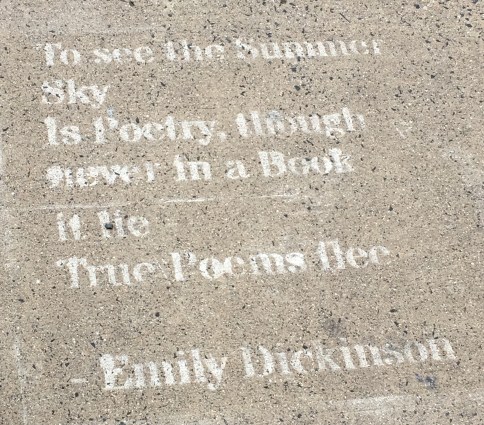
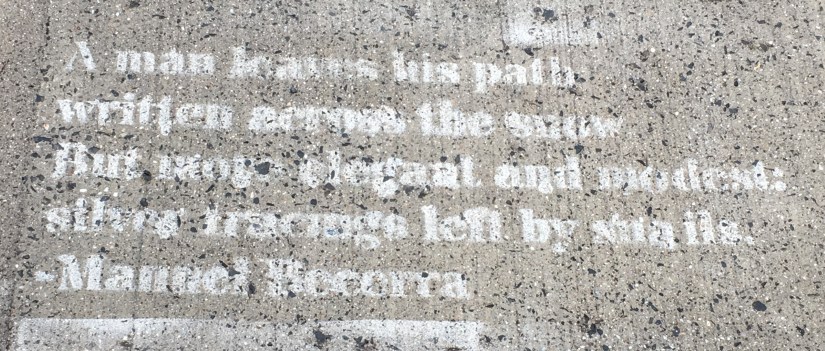
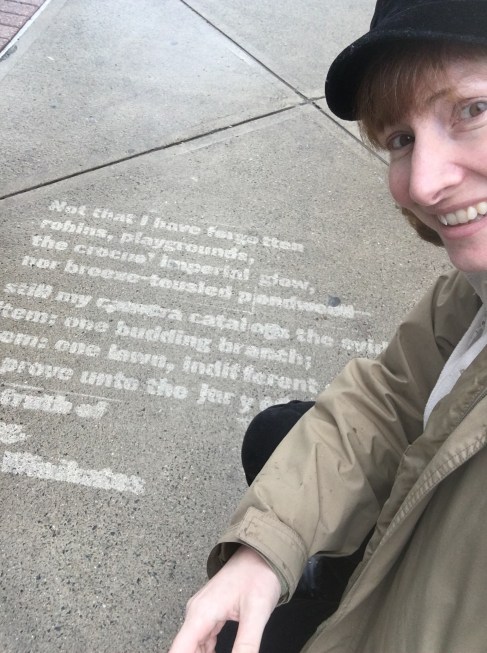
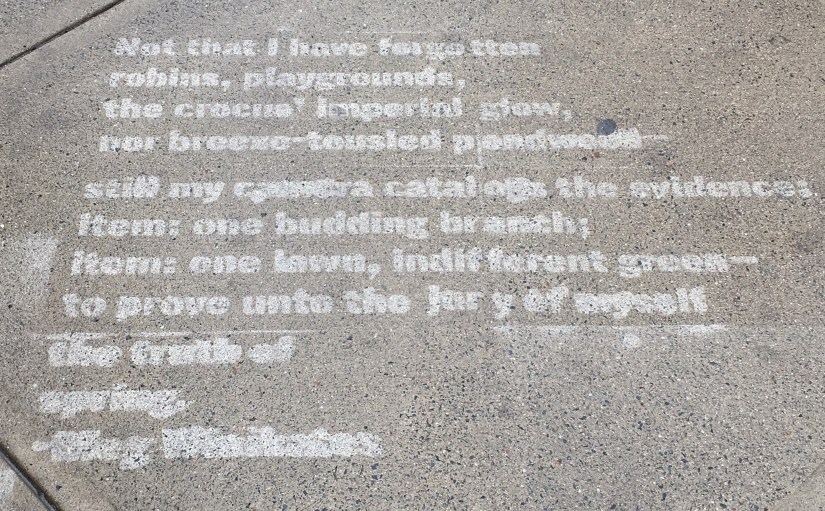
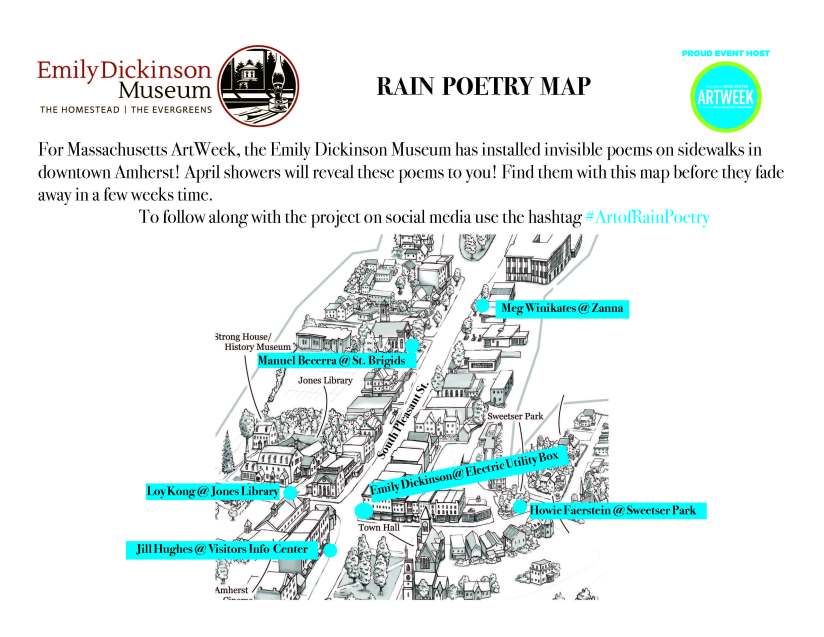
It was a gloriously damp weekend for much of the start of ArtWeek, which meant good visibility for the Emily Dickinson Museum’s installation of rain poetry in downtown Amherst. Below are some of the poems that I spotted walking around town (including mine!)
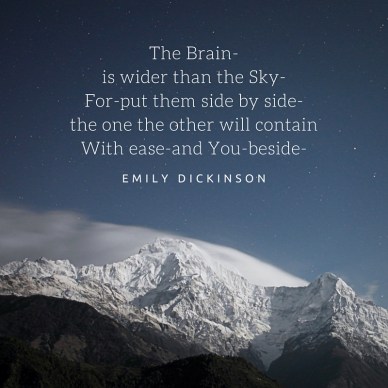
“To see the Summer Sky Is Poetry, though never in a Book it lie True Poems flee” by Emily Dickinson“A man leaves his path written across the snow But more elegant and modest: silver tracings left by snails.” by Manuel Becera
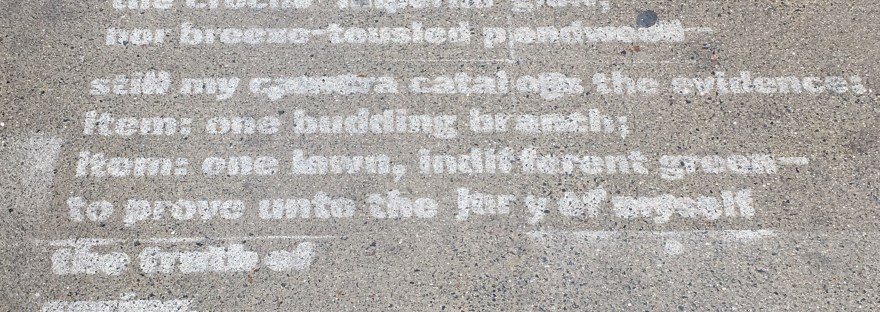
“Not that I have forgotten robins, playgrounds, the crocus’ imperial glow, nor breeze-tousled pondweed– still my camera catalogs the evidence: item: one budding branch; item: one lawn, indifferent green– to prove unto the jury of myself the truth of spring.” by Meg Winikates
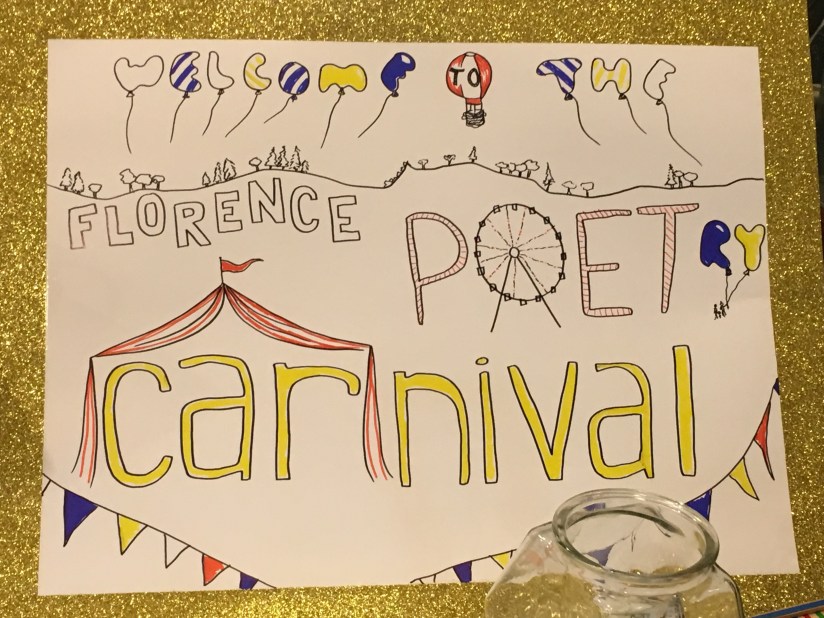
Florence Poetry Carnival
Up the road from where I live, the neighborhood of Florence hosted their first ever “Poetry Carnival” on Saturday afternoon, which was fairly well attended despite the chill and damp. A number of local institutions sent representatives, including the Emily Dickinson Museum, the Forbes Library, the Freckled Fox Cafe, Poems2Go, and Perugia Press. There were writing activities and poetry-inspired crafts, an open mic session, and a discussion/reading between the outgoing and incoming Florence Poets Laureate. Though it was small, in the absence this year of the statewide MassPoetry Festival, it was lovely to spend an afternoon among other poetry readers, writers, and enthusiasts.
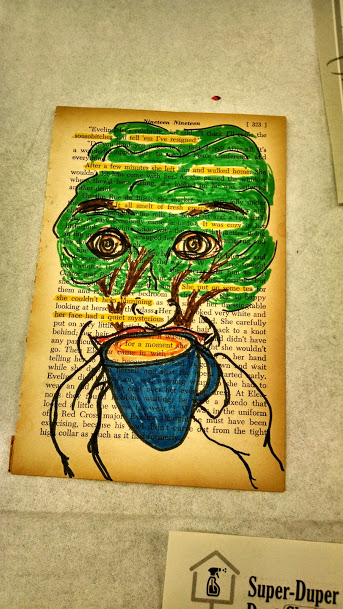
This was my favorite activity brought by the Emily Dickinson Museum, which plays with Dickinson’s habit of using variants in her poetry (lines where there are options for more than one word to fill out the thought), and invites attendees to add their own variants to her poem “Water is taught by thirst.” I added “the return of dawn” as a variant to “Birds, by the….”Blackout poem by Meg Winikates, from a recycled book page provided by Northampton’s Forbes Library. The librarians were collecting the poems created that day for the library’s zine club to turn into a zine commemorating the day, so I left mine behind to participate. I also found out the library has a massive poetry collection, which I’m looking forward to exploring.
A few weeks ago, when the Emily Dickinson Museum posted a call for short poems for potential inclusion in their #ArtofRainPoetry event for ArtWeek, I got very excited. I’ve enjoyed the many photos I’ve seen from MassPoetry’s previous rain poetry installations, and I’m always in favor of projects that get poetry out into public view. Last fall I had a haiku, “Robin and Rabbit,” selected to be part of the Minuteman Bikeway Public Art project, though sadly I never managed to get a good picture of it in situ, as the chalk paint was laid down one day and the next four days were heavy wind and rain, so many of the poems were obscured by wet leaves.
This spring, however, I can look forward to a rainy day, as my poem “If Spring (Recalcitrance)” was one of five selected from over 80 submissions to be part of the Dickinson Museum’s installation on the sidewalks of Amherst.
Starting this weekend, you can find my poem and 5 others, on the sidewalks of Amherst. We’re due for rain both Saturday and Sunday, so keep your eyes peeled! (Bonus: my poem is going to be located only a block from Bart’s, so you can grab some ice cream at the same time!)
The second workshop I led for MassPoetry Festival 2017 was “Solarpunk Serenades,” which was an introduction to the world of eco-conscious, optimistic, near-future science fiction that is now termed solarpunk. Arguably, there are moments in poetry, publishing, and popular culture which have fit this bill in the last hundred years at least, but now it has a name, and an opportunity to make its mark in sci-fi literature, aesthetics, design, and imagination the same way cyberpunk or steampunk have.
The slides below contain links to and names of most of the resources I mentioned in my presentation, for both the context and history of solarpunk, and places to find inspiration to write your own. There are also three themed writing prompts with visual cues. You can find most of those visuals and links to their originals on my Pinterest board. It was fabulous to see such a packed room of optimistic geeky poets, and I was really impressed with the breadth of imagination and vivid imagery that people who chose to share their poem drafts demonstrated. Thanks for inspiring me in return, poetpunks!
You can also download the handout from this workshop, with examples of poems both new and classic that use some solarpunk ideas and ideals here: SolarpunkSerenades workshop handout.
In my sixth year of attending the Massachusetts Poetry Festival, I once again listened to amazing poets that were new to me, reconnected with friends and colleagues, and came away with several pages of thoughts on poems I want to write (even a few scribbled draftlets!).
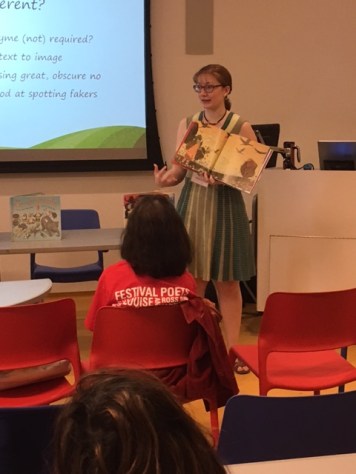
I also led two workshops on Sunday morning of the festival, the first of which was “On Beyond Giggles: Writing Children’s Poetry.”
Several of the folks in the room currently write poetry for children, others were interested in getting into writing for a younger audience, and all of us spent a little time thinking about who we were as children to get in the right mindset for the rest of the workshop.
Who were you when you were five years old? What did five year old you like to play? Who were your friends? Did you have a favorite toy or hideout or joke? Did you have siblings to play with, fight with, or play jokes on?
Who were you when you were seven? Did you have the same friends or new ones? The same fights? The same favorite color?
Who were you when you were ten? Were you out exploring your neighborhood? Getting into reading or sports or board games? Who were your friends? What were you afraid of? What made you laugh?
After calling our kid-selves back to the surface, we looked at some examples of great and effective children’s poetry, and talked about the poems we remembered from childhood ourselves, or from our kids’ favorites. Then we wrote, inspired by several prompts from one of my favorite kids’ poets, Jack Prelutsky. People came up with some fantastic verse, rhyming and free verse, inventive and imaginative, silly and sweet (and bittersweet too).
The slides from the workshop are here below. Thanks to all the hardy folks who attended on an early Sunday morning to talk and write playful poetry with me!
I had a fantastic time at Readercon, so much so, in fact, that I totally failed to take pictures or tweet more than about twice. I did take about a thousand pages worth of notes, not just of the thought-provoking things people were saying, but of ideas that I was generating for stories, and things to keep in mind when revising stories I’m already working on. And clearly, there was a lot to absorb, which is why it’s taken me nearly a week to write up my reactions.
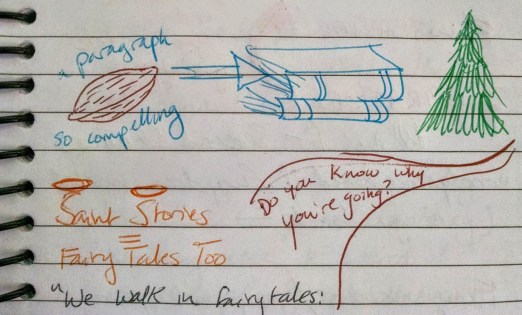
Not all my notes are this pretty. Many of them do contain doodles of rocketships, though.
Readercon is, of course, run by humans, well-intentioned yet possessed of blind spots, so there were a few moments in panels I attended where I winced. Others have covered those moments with more authority than I, however, and overall I was positively impressed with the level of dialogue and discussion in the panels I attended. (I wasn’t at some of the others that caused raised eyebrows.) Given Readercon’s reputation for listening to and responding to feedback, I hope next year will be better. Meanwhile, all my personal interactions with folks were fabulous, and I particularly enjoyed my two shifts at the Broad Universe table in the Bookstore room, getting to know my fellow New England broads.
The highest hilarity of the weekend for me was the “My Character Ate What?” game show on sci-fi fantasy and food. I went because I so enjoyed watching that video of Mary Robinette Kowalbreaking Pat Rothfuss’s brain, and I was sure she would not disappoint here either. She didn’t, and the rest of the panel of author ‘experts’ were equally hilarious, earnest, and full of beans in turn. (Both this and the engineering panel were led by Fran Wilde who also gets kudos for being a spiffing moderator.)
Guest of Honor Catherynne Valente was gracious, snarky, and inspiring by turns, and I thoroughly enjoyed all the panels I attended that she was on, as well as her solo reading. I even managed to get a couple of books signed and say ‘hi’ without making a complete fool of myself, so go me. (Author-encounter word-vomit is a thing, I’m sorry to say, but I did avoid it this weekend.)
I won’t attempt to transcribe my gazillion notes for you, but here are some highlights and particularly cool thoughts from some of the panels I attended.
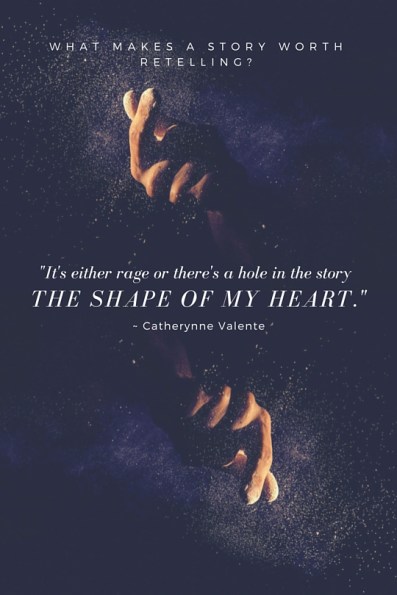
Speculative Retellings – Fabulous kickoff to the con for me. Retellings of myths and fairytales and folklore are *so* much fun, and the folks on the panel clearly agreed. The quote from Cat Valente above was from this panel, as is the picture of my notebook. The conversation ranged from superheroes to saints, origin stories galore, the retelling opportunities present in both senses of identification with a story and senses of confusion or other-ness (‘this story isn’t really meant for me, but what if it was?’). We re-tell stories either because we love them or we hate them and want to fix them (hello, fandom!). Frustration as inspiration, and questions about the currency of sacrifice–what are you willing to give up, to walk the path of the hero? What are the stories or characters that need second chances? Or choices? (Cat Valente pointed out that no one ever asked Eurydice if she *wanted* to leave the underworld with Orpheus, after all. Maybe she wanted to stay…)
Strong Female Characters and ‘Lady Bromances’ aka Female Friendships in Literature – I’m lumping my summary of these two panels together, because for me one fed into the other. There was a lot in here, and there’s room for more. I liked Mikki Kendall‘s point about Zoe Washburn in Firefly, and how she’s a perfect example of how the fact that women who possess the ability to compartmentalize in crisis are often not given the narrative room to have their grief or other emotional reactions once the crisis is passed. This is a trope that disproportionately affects black female characters; based on the evidence of Melinda May in the Marvel Universe and a few others I would think it affects other female characters of color as well. After all, Peggy Carter (whom I love, even recognizing the flaws in the show) gets a very rare but very real and necessary moment of grief for her roommate, who dies in the first episode after about 2.5 minutes of screen time. It’s a great moment, and more characters regardless of gender or race deserve the narrative space to be fully-rounded human beings. In counterpoint, the discussion of female friendships was great, because friends are part of what help make us fully rounded characters, and show different sides than might otherwise come across. Girlhood friends, adult friends, intergenerational friends; it was a good list of stories and characters that the panelists mentioned, and there were both books I now have to read and stories I now have to write.
Engineering in Fantasy – Definitely one of my favorite panels of the weekend. “Buildings have to get built, regardless,” said John Chu, and from there it was off to the role of engineering in worldbuilding (more than just how people get around; not only on what, but do they have roads? irrigation? cartographers?) and the way good engineering is invisible until it breaks. This means breaking your engineering is a good story point; when something fails, what takes its place? Was it working for its original purpose and only broke when it was repurposed? What happens to a society’s structure when new tech is introduced? How much engineering can your world have without the theoretical science to back it up? (Because you can make things work without knowing why…) What about social engineering, the structures that make feudal systems and militaries work, among other things? What about a kind of educational and cultural infrastructure, the role of political and religious elites in spreading and sharing knowledge? Plus there are the benefits of looking at the way different cultures find different ways to solve the same problems and what that tells you about them, which is engineering as a kind of cultural shorthand, ie. the bridges of the Elves vs. the bridges of the Dwarves in Tolkien. (Several people in that session now want to write the story about “OSHA goes to Moria…”) Many kudos to both the panelists and the people in the audience who asked brilliant follow up questions!
Magic in Space – Jedi are space wizards, and that’s a very fine thing. But who else is writing cool magic in traditionally sci-fi milieus? This was a really fun panel talking about working mythology and magic systems into sci-fi: techno-mages, for instance, or mythical monsters in charge of alien planets, the concept of interstellar travel as its own sort of epic fantasy. Mikki Kendall said something interesting about how the differences in sci-fi versus fantasy are essentially just a matter of tone: “You have power. Period. How you choose to use that power is up to you,” which led to a neat discussion about spellcasting equivalents to computer programming, fears as inspirations, about magic being about control or accepting the loss of same, and when is magic a science (part of the rules of how that universe works) or something else (which breaks or bends the established rules of that universe). Does magic or sci-fi better answer the questions of why we seem to be alone in the universe? Is it just because the scale of space and time is just so vast, or are we being avoided? Will we recognize life when we find it? What about that space-jellyfish in Star Trek? Hasn’t there been magic in sci-fi all along? And isn’t it an example of magical thinking just to imagine the ways that life could be better or different, the way sci-fi writers naturally do?
Keytars in SF – Music is such an integral part to culture; it’s as worth considering (or considering its deliberate lack) in worldbuilding as engineering is. Discussion in this panel included everything from Earth music of past times being re-interpreted in the future (Star Trek TNG‘s Riker plays jazz and Data plays classical violin, Doctor Who declared Britney Spears the fitting soundtrack to the final explosion of the Earth) to alien instruments (Spock’s lute/harp thing, Dixieland-style music in Star Wars ANH‘s cantina) to the challenges and benefits of describing music and mood and enviroment as opposed to being able to show/play it in live media. The major thought-provoking statement from this panel for me (which I’m pretty sure was one of Cat Valente’s points) was thinking about music starting point being in the body; dance, rhythm, the physical requirements of instruments that need breath or digits or tentacles. (Now I want to write about an alien rock band…)
Mary Robinette Kowal’s “Short Story Structure (for Novelists)” workshop/lecture was a real writers’ craft highlight. Unfortunately, as she said in the beginning, she had ‘2 hours worth of content and only an hour to deliver;’ had the program wizards given her a 2 hour block, we would surely all have stayed. [Much as I appreciate the rapid-fire blocks of 50 minute sessions, I’d actually argue for a few more longer sessions for this level of quality content.] Fortunately, she did get through all the content delivery, though our ‘workshop’ was limited to ‘write down a whizzbang idea.’ She did, however, mention that she has writing exercises available on her website, which I intend to use. The diagnostic tools she introduced (average wordcounts for introducing locations and characters, levels of complexity involved in number of plot elements) were really helpful; looking back at some of my stories that have ballooned past what could reasonably be considered ‘short’ I can now tell why! I will definitely be using the plot sequencing idea (open and close your plot threads like html tags) to revise some of my short stories as well.
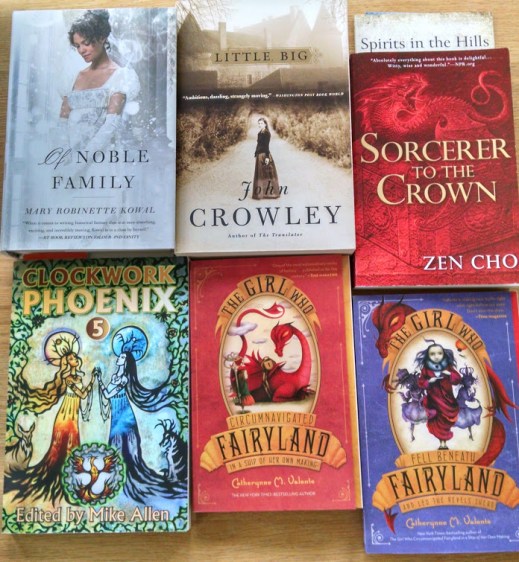
Books I either acquired this weekend or brought along to get autographs. My to-be-read pile just never gets any shorter…
It’s difficult as a thinking, feeling, breathing human being not to be incredibly distressed by the needless violence of the last week, from the horrific ISIS bombings in Medina and Baghdad to the senseless deaths of both civilians and cops here in the US. Life is messy, and people can be horrible, and standing in my place of privilege and safety much of what I can do is put my donations and my vote behind the people I believe have the best interests of the whole country, the wider world, and safety and peace for all at heart. So that’s what I’m doing. Also, please register to vote, if you’re eligible and you’re not registered yet. One person, one voice, one action can make a difference. (Just look at Brexit. Let’s not be Brexit, okay?)
In the meantime, this weekend there’s a chance to celebrate imagining better, more inclusive, more positive worlds, so I’m going to Readercon. If you too should happen to be in Quincy, MA this weekend, here are some of the places you may find me:
Friday
4 pm “Speculative Retellings” or “Harry Potter Goes to Grad School and Gets a Job”
5 pm “Clockwork Phoenix Group Reading” or autographs with Catherynne Valente
6 pm Guest of Honor reading by Catherynne Valente
7 pm “Single Wise Advisor Seeks Same”
Saturday
10 am “Instant Communication in Genre Fiction” or the Odyssey Writing Workshop intro session
11 am “Beyond Strong Female Characters” or “Colonization and Beyond: The fiction and science of exoplanets”
Noon “Engineering in Fantasy”
1 pm “I Pass the Test: the depictions, meanings, and consequences of magical tests and trials” or “If Thor can hang out with Iron Man, why can’t Harry Dresden use a computer?”
3 pm “Ladybromances”
4 pm “Interview with Catherynne Valente”
Sunday
10 am “Magic! In! Spaaaaaaaaace!”
Noon “Short Stories Explained for the Novelist” with Mary Robinette Kowal (yay!)
1 pm “Keytars in Science Fiction”
2 pm “Science Fiction and Fantasy Fashion” or “The No-Good, Very Bad Antagonist”
Any other time:
The Broad Universe table in the Bookstore – this is a great and welcoming group of folks who support women writers in sci-fi, fantasy, and horror. And truthfully, possibly you’ll find me anywhere else in the Bookstore as well. That does happen on a fairly regular basis, after all.
If I get sick of panels I will go to readings. There are lots of cool looking readings!
As always, the Mass Poetry Festival was awesome. The sun shone on the small press fair and the Poetry Circus, the readers were in good voice, and it was fabulous catching up with friends. I particularly enjoyed the “embodied creativity” yoga & writing workshop and the poets who read their works written in Emily Dickinson’s bedroom. My thanks and compliments to everyone involved in carrying out the festival: the hard-working staff at MassPoetry, PEM, and the scores of volunteers.
As part of the festival, I had the pleasure of leading another workshop at the Peabody Essex Museum on connecting poetry to visual art, this time focusing on the idea of incorporating scale. I had a group of about 30 people and loved getting to introduce them to the Art & Nature Center’s current show, Sizing it Up: Scale in Nature and Art.
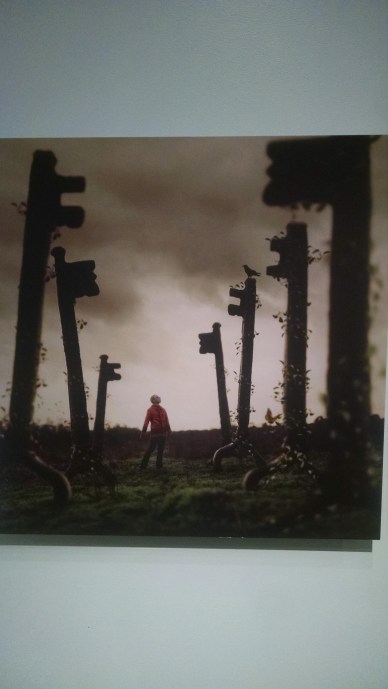
Led to Your True Path, Joel Robison, 2014. Part of the Sizing it Up exhibition at the Peabody Essex Museum
We started by defining ‘scale’ for the purposes of the workshop:
Visual (comparison to human scale)
Extra-visual (too extremely small or large for human perception)
Physical (in relation to your body)
Constructed (in relationship to your page or canvas)
To get our brains in gear, we did a ‘constructed scale’ poetry writing exercise, where people picked a piece of paper that was not their usual notebook size (register tape, index cards, post-it notes) and drafted a poem where the lines fit the size of the paper exactly, no line breaks too short or too long for the physical space.
Then we went into the gallery to read a few poems that use scale, next to visual art works that evoked the same feeling.
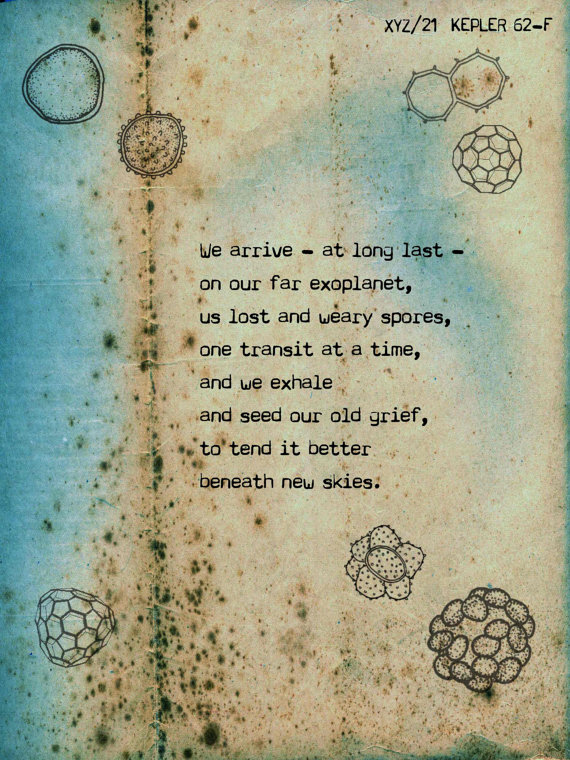
Searching for Goldilocks, by Angela Palmer, is an artwork that depicts all the exoplanets (planets found outside our solar system) including ones in the ‘Goldilocks zone’ that might contain recognizable life like our own Earth. (You can read more about planets in the Goldilocks zone here) Next to Searching for Goldilocks, we read “Kepler 62-F” by xYz, which is the pen name of Joanna Tilsley.
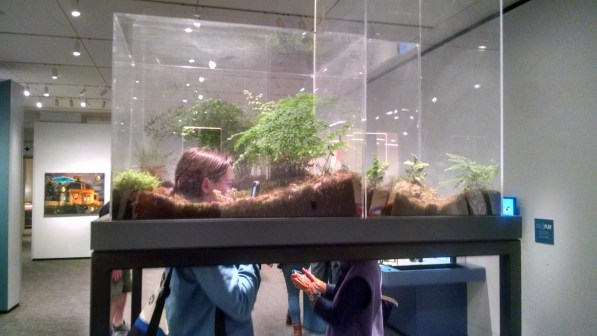
Metropolis, by Vaughn Bell, is an artwork that allows up to four people to get their faces at forest floor level by stepping under and up into a series of connected terrariums featuring local plantlife.
Workshop participants experiencing Metropolis.
Next to Metropolis, we read “The Scale of Things,” by Margaret Tait (originally published in The Hen and the Bees, 1960)
The Scale of Things
by Margaret Tait
There’s a whole country at the foot of the stone
If you care to look
These are the stones we have instead of trees
In the north.
Our trees all got lost,
Blown over or cut down
Long long ago, and some of them lie there still in the
peat moss
Or fossilized in limestone.
At the shady foot of trees
Certain things grow,
But at the foot of stone grow the sun-loving
wind–resisting short plants
With very small bright flowers
And compact, precise leaves.
The wind whips the tight stems into a vibration,
But they don’t break.
The full light of the sun reaches right down to the
ground,
And reflects obliquely and sideways in among and
under the snug leaves,
And settles on the stone too,
Makes a glow there,
A sufficient warmth and clarified light.
The stunning frequencies seem to get absorbed
And if you stare closely at the stone
It’s a calm light, not too blue,
Precisely indicating its variegated surface.
The great stone stands,
On a different scale, in a way, from the minute plants
at its base.
A proliferating green lichen
Grows on it
As well as round golden coin-patches of another
common lichen,
And only in the earth right up to the very stone but
not on it
Grow the crisp grass
And all the tiny plants and flowers
Which, together interlaced and inter-related,
Make the fine springing turf which people and animals
walk on.
Then I set the workshop participants free to spend about 20 minutes in the gallery brainstorming in front of one or more pieces of scale-related art, after which we shared our reactions and results. It was especially neat to hear which artworks drew people in, and how many participants felt the same dislocation as Alice or Gulliver, feeling themselves suddenly much larger or smaller than ever before. Several people also headed back into the gallery to spend more time with the art after the workshop, which felt like success to me.
You can download the handouts (writing exercise directions, poems, and more) here: The World in a Grain of Sand handout. I highly recommend a visit to the museum while you’re at it!
Finally, here are a few cool scale-related links I used in my research for the program, if you’d like to explore more:
It’s National Poetry Month! Lots of fun poetry news and discussion to share with you this month.
I recently re-encountered an article from 2014: “Everybody Should Write Poetry” by Peggy Rosenthal. I had bookmarked it because I was drawn to the idea that “everyone needs to nestle down inside language to get to know its ways, to get comfy with how playful it can be, how expansive, how unexpected in its openings to new experience.” It reminded me of the kinds of conversations I’ve had in the other part of my professional life, among those of us who work in museums and in education and in the arts. Participating in something; taking a class in glass fusing, for instance, gives you an appreciation for the process and the artistic choices and the intricacies of both which you keep forever, however lopsided or surprising your own* efforts turned out to be. (*Meaning, of course, my own!)
On the same day I apparently bookmarked an article with suggestions on “How to Read Poetry” – not requirements, but suggestions on ways to approach it without the apprehension of ‘getting it wrong.’ Again, a discussion that we keep having in museums and symphonies and similar venues; how do we best let people know that, barring actual destruction, there aren’t really ways to be ‘wrong’ in such spaces? (Perhaps we should take some marginalia notes ourselves.)
So what do you think? “Should” everyone write poetry? (or make art? or play music? or fix a car?) What’s your favorite way to approach a new poem or experience?
Finally, a shameless plug, because I firmly believe that while ‘shoulds’ are odious, ‘go for its!’ are necessary and beautiful. Therefore, if you feel like writing poetry, go for it! and you can even do some writing with me:
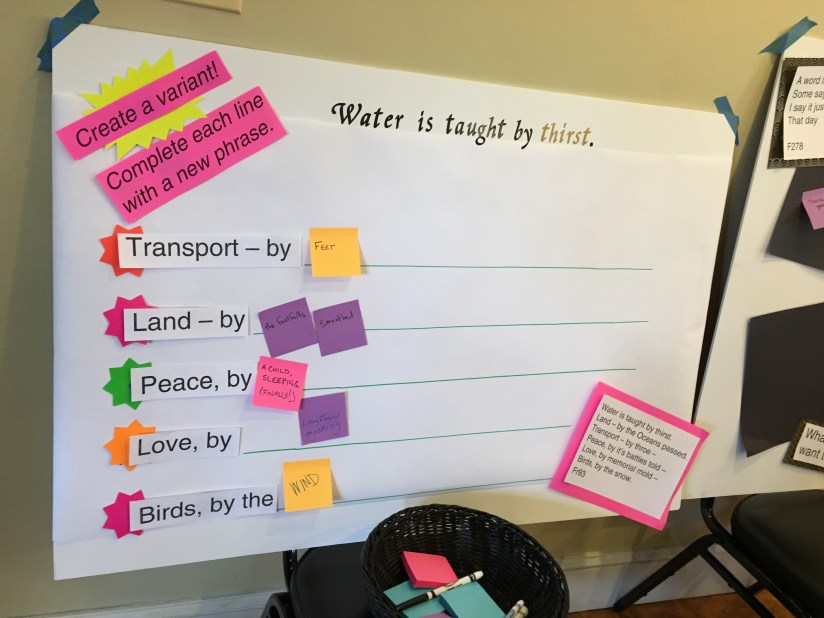 This was my favorite activity brought by the Emily Dickinson Museum, which plays with Dickinson’s habit of using variants in her poetry (lines where there are options for more than one word to fill out the thought), and invites attendees to add their own variants to her poem “Water is taught by thirst.” I added “the return of dawn” as a variant to “Birds, by the….”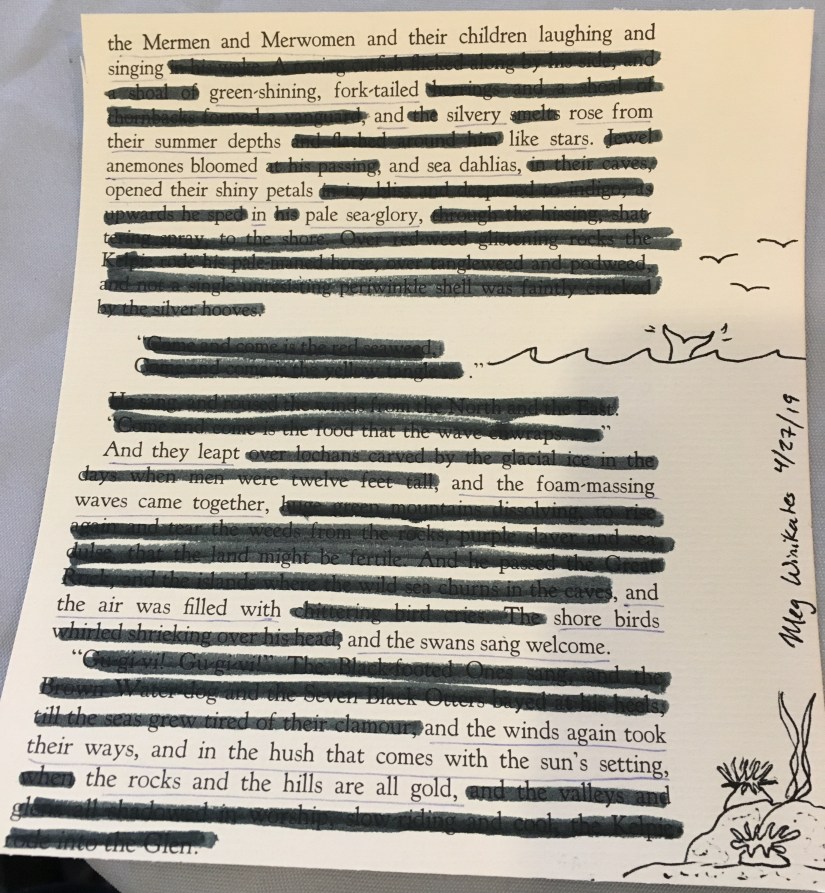






 Sea Dreams and Time Machines
.jpg)