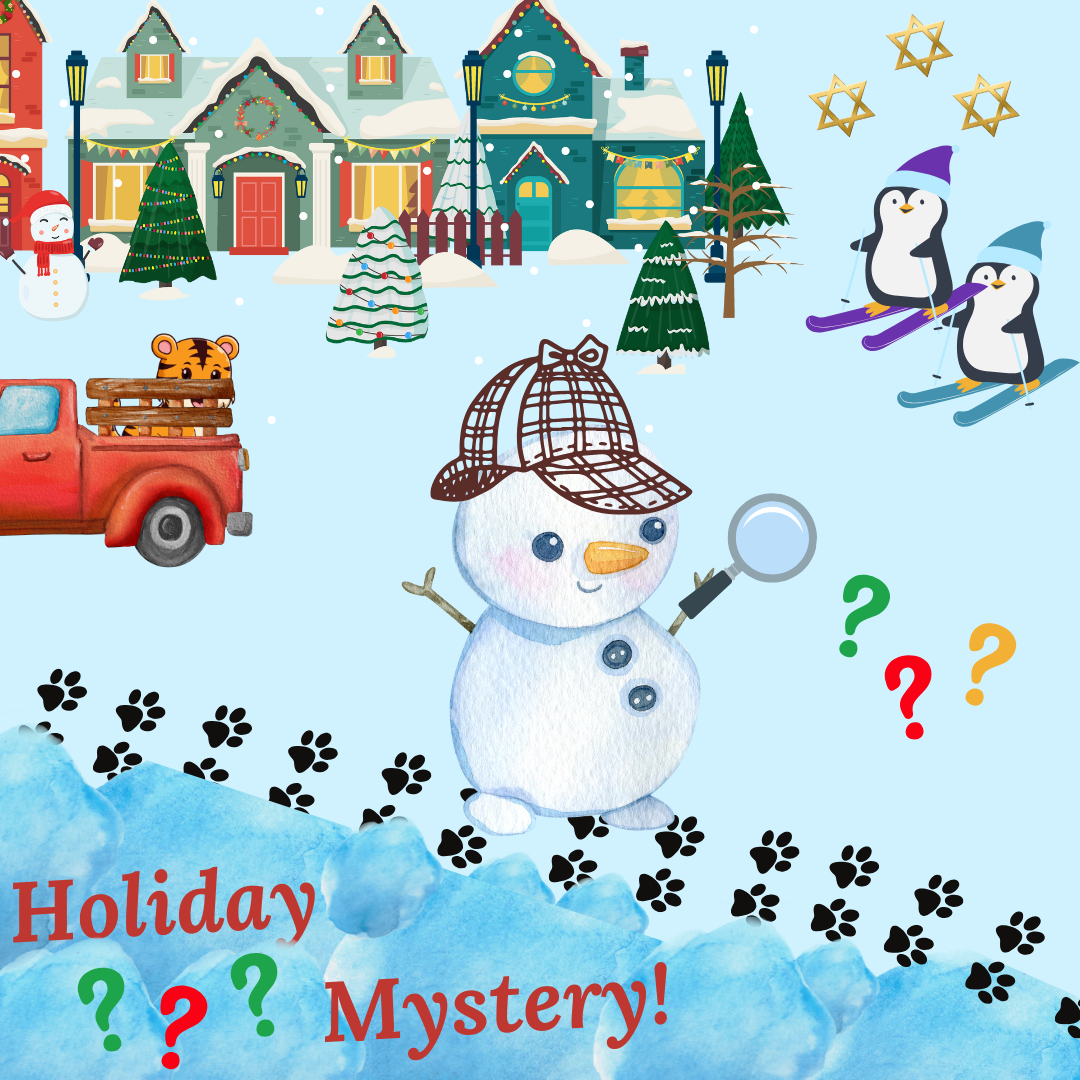
In amidst the addressing of Christmas cards, the list making, and tree decorating, it’s also the time for Susanna Leonard Hill’s Holiday Writing Contest!
Image from Susanna Hill’s contest page, see link above
The guidelines are that it must relate to any winter holiday, be a mystery, and no longer than 250 words (not including title). I was extremely honored to get an all-around honorable mention in the Halloweensie contest for Baby Goblin at the Halloween Ball, and am happy to present to you my tiny Christmas mystery, Who Stole Santa’s Boot?
An arctic fox in winter, all white, standing in the snow in front of a thicket of winter twigs. Emma, CC BY 2.0 https://creativecommons.org/licenses/by/2.0, via Wikimedia Commons
Who Stole Santa’s Boot? By Meg Winikates (250 words)
This is the kitchen, smelling great, where cookies slide right off the plate. A chocolate boot-print on the floor— and Mrs. Claus points to the door.
This is the spot beside the sleigh where Santa tucks his boots away. He turns to put his slippers on— but suddenly, one boot is gone!
This is the fox who nabs the shoe for playful kits to gnaw and chew.
This is the stoat who shocks the fox (while Santa wanders in his socks) and drags the boot along the ground, delighted by this thing he’s found.
This is the owl that spooks the stoat, who hides below as white wings float. The owl swoops, the boot falls down, and crashes into tunnel town!
These are the lemmings that scoot and swarm into the boot, so safe and warm.
(This is St. Nick with chilly toes, his glasses balanced on his nose, requesting acrobatic elves to search the closets, climb the shelves!)
This is the hare with legs so strong, a boot hat on his ears so long, leaping across a frozen brook— (Where else can Santa think to look?)
This is the wise old caribou who gently bends to sniff the shoe; with boot between her teeth, she clops, and near the stable-door it drops, ready for Santa to retrieve— barely in time for Christmas Eve!
“So where do you suppose it’s been?” asks Mrs. Claus, and Santa grins. “My dear, we must admit defeat, and just rejoice they’re on my feet!”
I love the opportunities which present themselves for my creative life and my work life to collide. Today I had the chance to present a webinar for my day job at the New England Museum Association, on bringing a poetry mindset to the world of writing exhibit labels (or using poetry to interact with your visitors through your exhibit labels).
“Hack This Label: National Poetry Month Edition” was a free webinar, the video and slides of which you can now access through NEMA here.
Or, you can watch or download them straight from this blog here:
And if you’re looking for other ways to think about creative writing in museum spaces, you can check out last year’s webinar, “Recharge, Reimagine, and Write.”
In my sixth year of attending the Massachusetts Poetry Festival, I once again listened to amazing poets that were new to me, reconnected with friends and colleagues, and came away with several pages of thoughts on poems I want to write (even a few scribbled draftlets!).
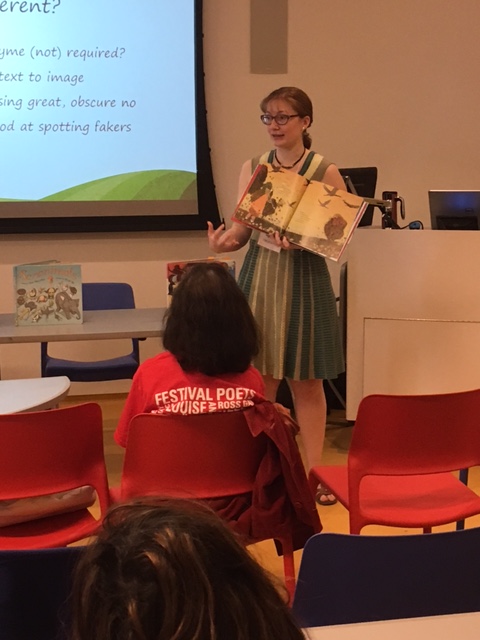
I also led two workshops on Sunday morning of the festival, the first of which was “On Beyond Giggles: Writing Children’s Poetry.”
Several of the folks in the room currently write poetry for children, others were interested in getting into writing for a younger audience, and all of us spent a little time thinking about who we were as children to get in the right mindset for the rest of the workshop.
Who were you when you were five years old? What did five year old you like to play? Who were your friends? Did you have a favorite toy or hideout or joke? Did you have siblings to play with, fight with, or play jokes on?
Who were you when you were seven? Did you have the same friends or new ones? The same fights? The same favorite color?
Who were you when you were ten? Were you out exploring your neighborhood? Getting into reading or sports or board games? Who were your friends? What were you afraid of? What made you laugh?
After calling our kid-selves back to the surface, we looked at some examples of great and effective children’s poetry, and talked about the poems we remembered from childhood ourselves, or from our kids’ favorites. Then we wrote, inspired by several prompts from one of my favorite kids’ poets, Jack Prelutsky. People came up with some fantastic verse, rhyming and free verse, inventive and imaginative, silly and sweet (and bittersweet too).
The slides from the workshop are here below. Thanks to all the hardy folks who attended on an early Sunday morning to talk and write playful poetry with me!
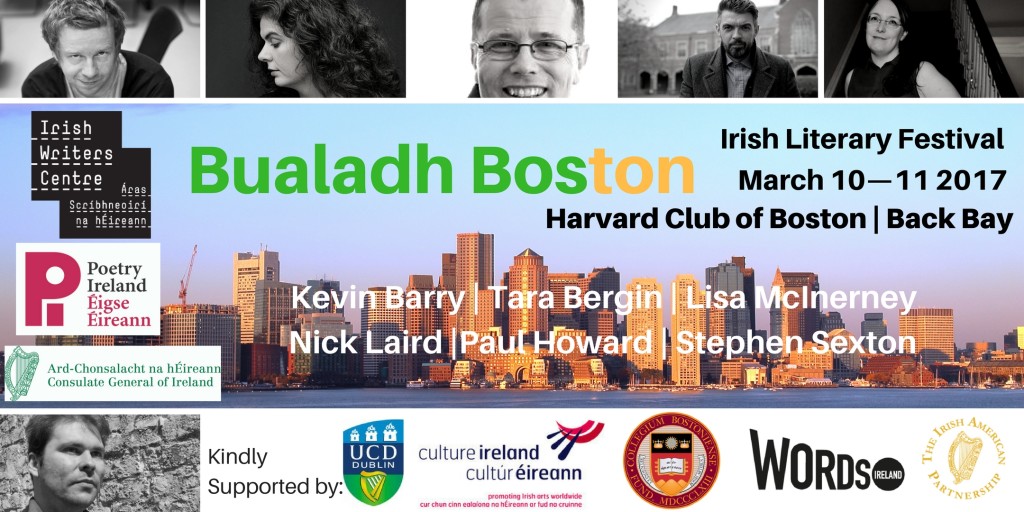
Apparently, “Bualadh Bos” is a phrase in Irish that means applause, and there was plenty of cause for cheers at the recent Irish Literary Festival, held for the first time at the Harvard Club in downtown Boston and arranged by a whole bunch of clever cultural ambassadors from the Irish Writers’ Centre, Poetry Ireland, and the Consul General of Ireland to Boston, Fionnuala Quinlan (@IrelandBoston). (My companion and I had a lovely conversation with Ms. Quinlan during the reception on Friday, and she’s delightful. I hope she has reason to remain posted in Boston and help arrange many such events in the future.)
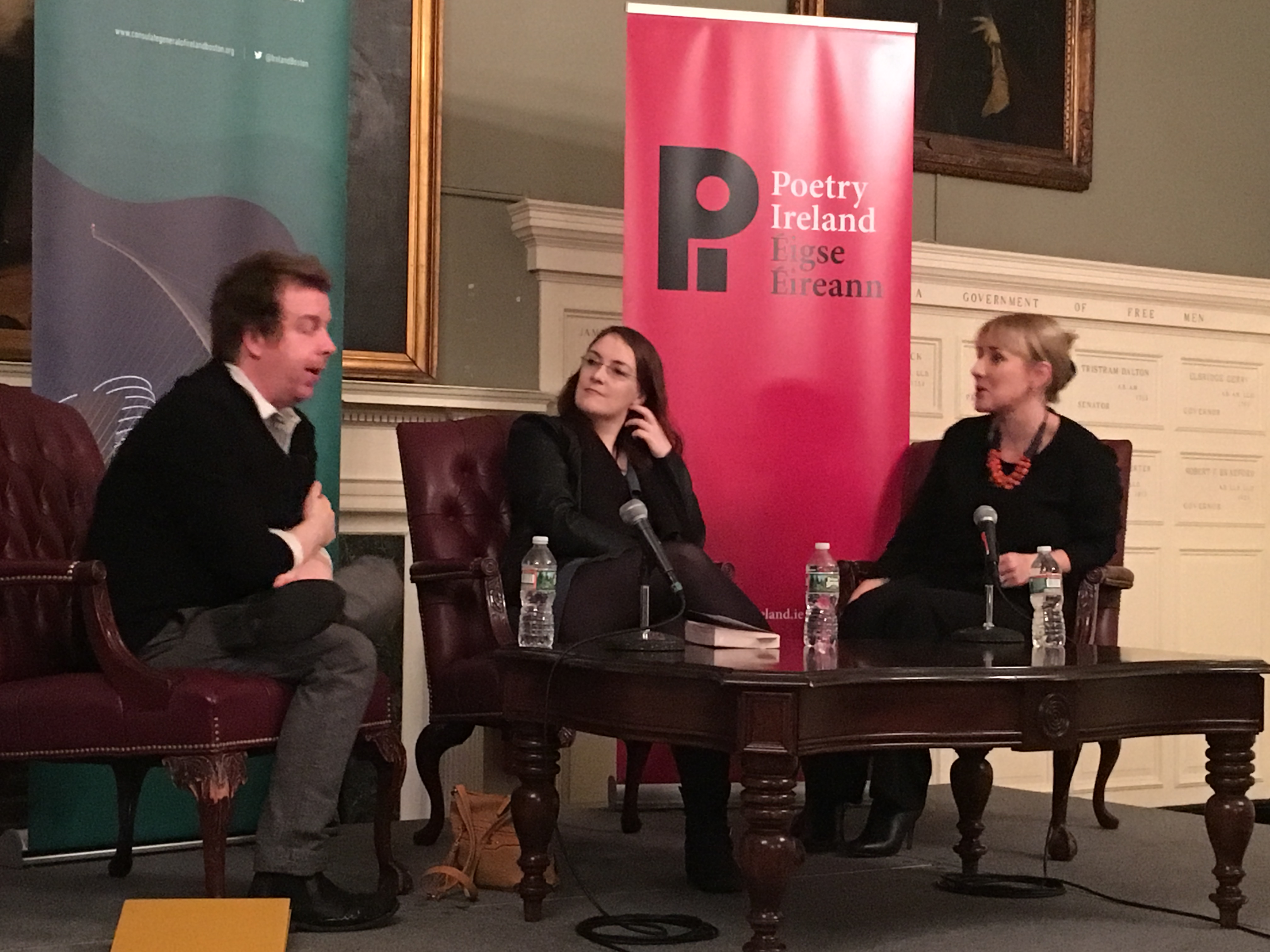
Kevin Barry, Lisa McInerney, and Fionnuala Quinlan in conversation during Friday’s opening event.
Barry read a section of one of his short stories, and McInerney from her recent award-winning novel, The Glorious Heresies. Both authors were excellent readers of their own work; funny, dramatic, and engaged with both the text and the audience, which meant that my companion and I both left the evening more interested in reading more of their work, rather than less, which can be the case with less skillful presenters.
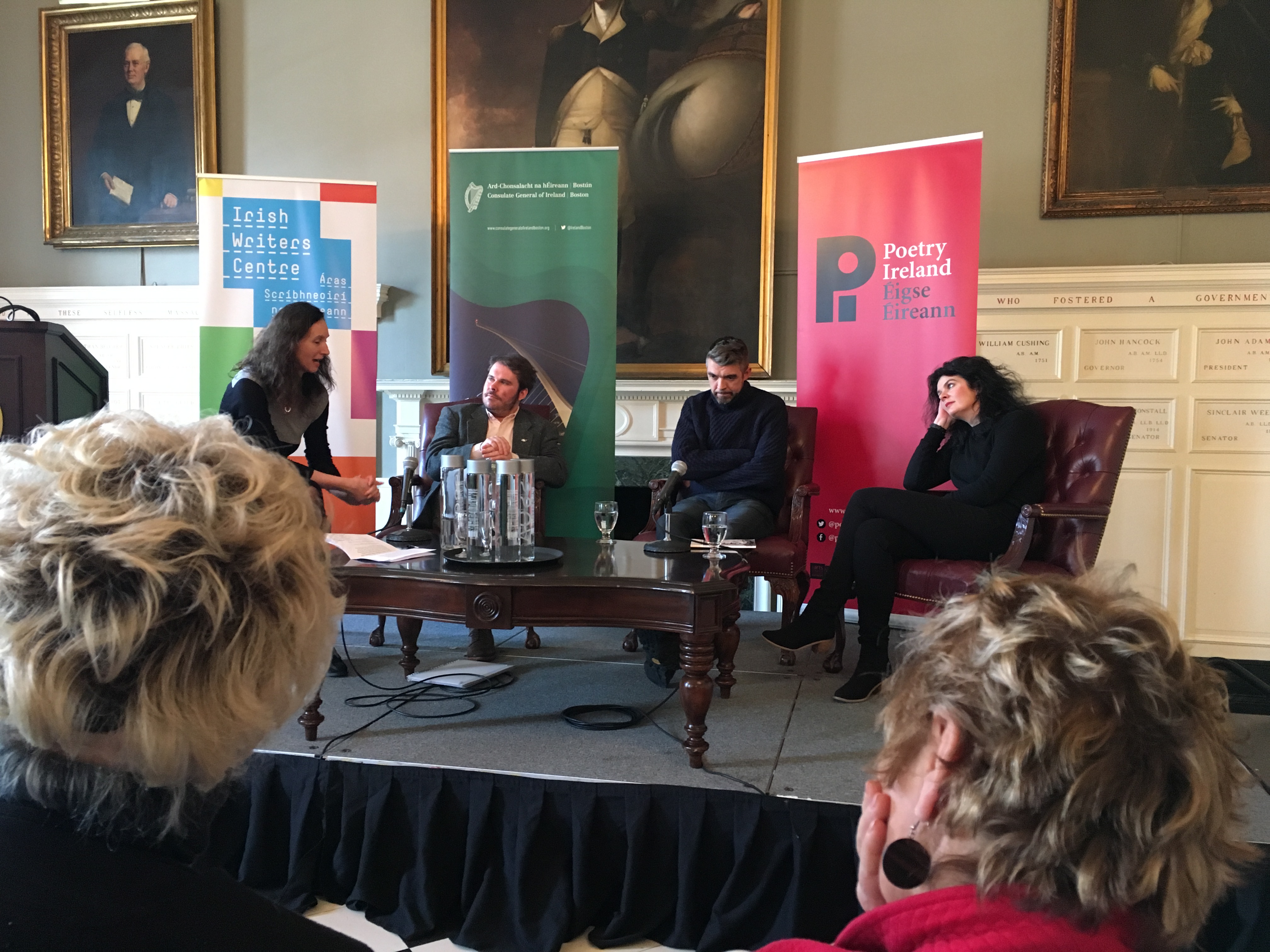
From right, Tara Bergin, Nick Laird, and Stephen Sexton in conversation with Maureen Kennelly of Poetry Ireland.
The next day we got to hear readings of some fantastic poetry from Tara Bergin, Nick Laird, and Stephen Sexton. Bergin’s poetry is lyrical, with an element of folklore-sound to it without ever directly referencing specific legends. You can read a review of her debut book, This is Yarrow, here. Laird’s poetry was sharp and wound round itself like an ammonite, and frequently referenced current events and recent scientific thought. You can read his article “Why Poetry is the perfect weapon to fight Donald Trump” here. Sexton’s poetry was often, though not solely, humorous; he noted as he began that when picking his poems for the event he discovered “[he had] a lot of hobbies for about three weeks,” which was long enough to work them into a poem or two before going on to something new. You can read one of the poems he read that day here: “The Curfew.”
Though my companion and I bought several books at the event, which I am reading with great pleasure, I also went and found more of their poetry after the event. My current favorite is Bergin’s “Appointment with Jane Austen,” especially appropriate as I shall shortly be undertaking a literary pilgrimage to Austen’s country myself.
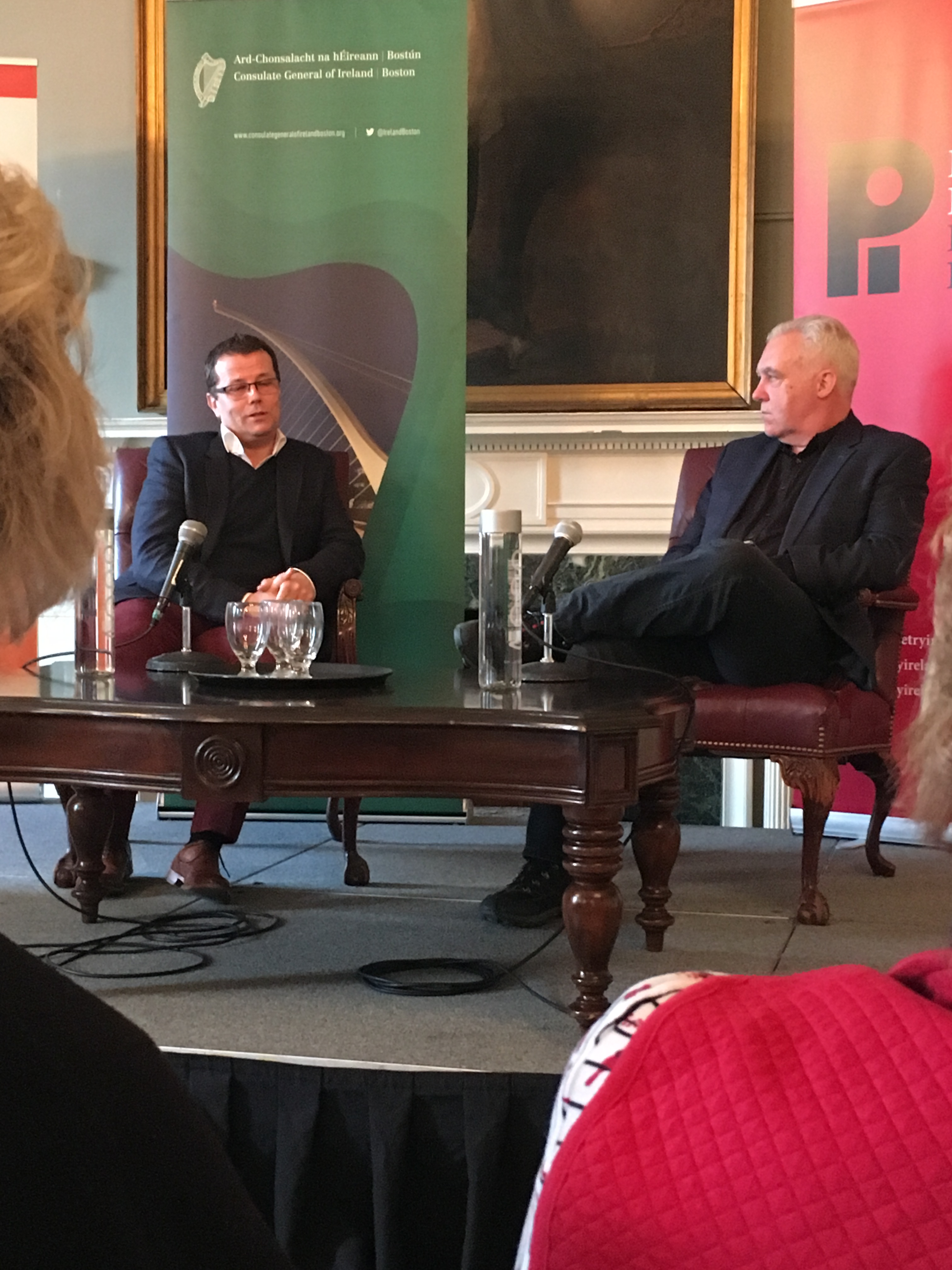
Paul Howard and Kevin Cullen
The last event of the weekend was Boston Globe columnist and journalist Kevin Cullen interviewing journalist and novelist Paul Howard. They spoke of everything from sports journalism and doping scandals to the success of Howard’s satirical main character, Ross O’Carroll-Kelly, in whose Homer-Simpson-esque adventures and foibles Howard keeps a running commentary on current events in Dublin and to a lesser extent, the wider world.
Overall it was a fascinating weekend, and I was only sorry that it seemed the event had not been widely enough publicized, as the room was moderately full but deserved to be more so on each of the two days. As it seemed many in the audience, like myself, were being introduced to most of these writers for the first time, the event definitely succeeded in its stated purpose to use Ireland’s literary offerings as a bridge to new audiences and new opportunities, and Boston was a perfect place to hold such a gathering. I will be keeping my eyes out for announcements of next year’s Irish Literary Festival, for sure.
I had a fantastic time at Readercon, so much so, in fact, that I totally failed to take pictures or tweet more than about twice. I did take about a thousand pages worth of notes, not just of the thought-provoking things people were saying, but of ideas that I was generating for stories, and things to keep in mind when revising stories I’m already working on. And clearly, there was a lot to absorb, which is why it’s taken me nearly a week to write up my reactions.
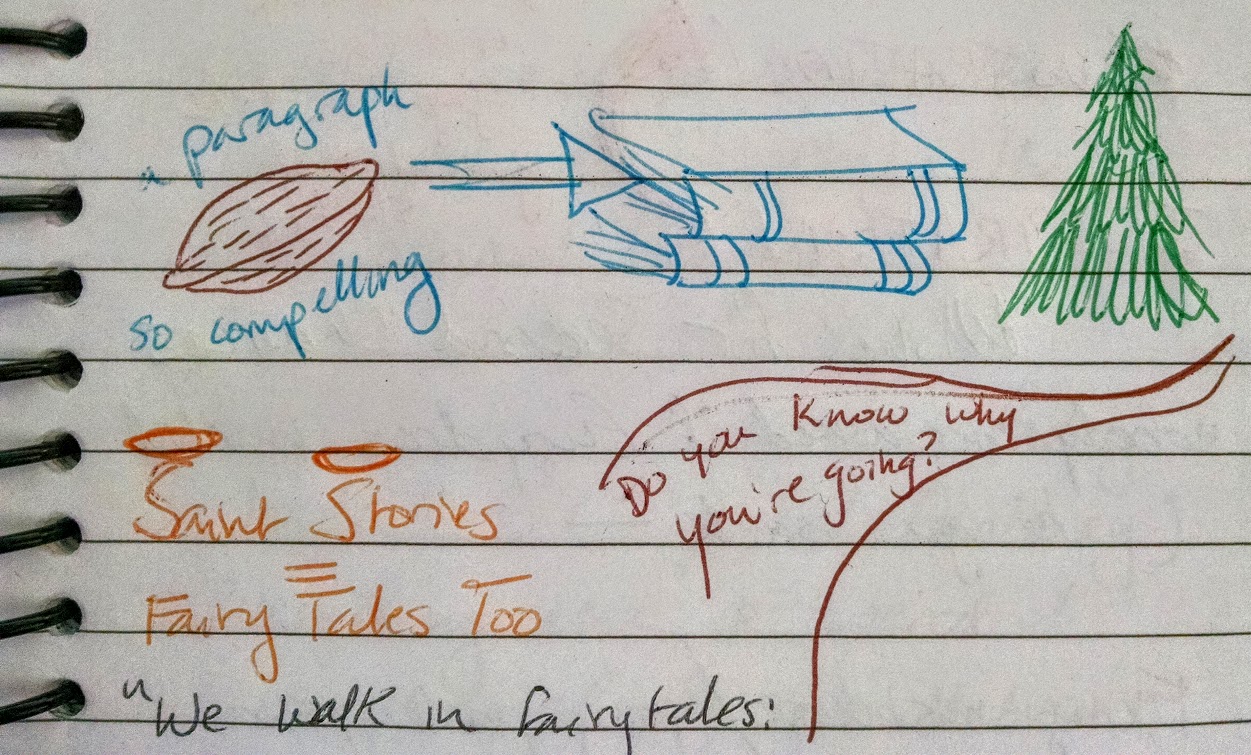
Not all my notes are this pretty. Many of them do contain doodles of rocketships, though.
Readercon is, of course, run by humans, well-intentioned yet possessed of blind spots, so there were a few moments in panels I attended where I winced. Others have covered those moments with more authority than I, however, and overall I was positively impressed with the level of dialogue and discussion in the panels I attended. (I wasn’t at some of the others that caused raised eyebrows.) Given Readercon’s reputation for listening to and responding to feedback, I hope next year will be better. Meanwhile, all my personal interactions with folks were fabulous, and I particularly enjoyed my two shifts at the Broad Universe table in the Bookstore room, getting to know my fellow New England broads.
The highest hilarity of the weekend for me was the “My Character Ate What?” game show on sci-fi fantasy and food. I went because I so enjoyed watching that video of Mary Robinette Kowalbreaking Pat Rothfuss’s brain, and I was sure she would not disappoint here either. She didn’t, and the rest of the panel of author ‘experts’ were equally hilarious, earnest, and full of beans in turn. (Both this and the engineering panel were led by Fran Wilde who also gets kudos for being a spiffing moderator.)
Guest of Honor Catherynne Valente was gracious, snarky, and inspiring by turns, and I thoroughly enjoyed all the panels I attended that she was on, as well as her solo reading. I even managed to get a couple of books signed and say ‘hi’ without making a complete fool of myself, so go me. (Author-encounter word-vomit is a thing, I’m sorry to say, but I did avoid it this weekend.)
I won’t attempt to transcribe my gazillion notes for you, but here are some highlights and particularly cool thoughts from some of the panels I attended.
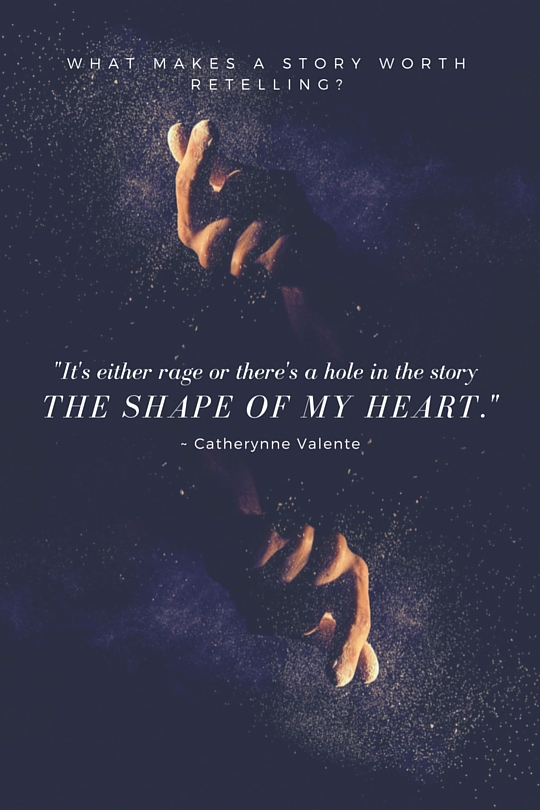
Speculative Retellings – Fabulous kickoff to the con for me. Retellings of myths and fairytales and folklore are *so* much fun, and the folks on the panel clearly agreed. The quote from Cat Valente above was from this panel, as is the picture of my notebook. The conversation ranged from superheroes to saints, origin stories galore, the retelling opportunities present in both senses of identification with a story and senses of confusion or other-ness (‘this story isn’t really meant for me, but what if it was?’). We re-tell stories either because we love them or we hate them and want to fix them (hello, fandom!). Frustration as inspiration, and questions about the currency of sacrifice–what are you willing to give up, to walk the path of the hero? What are the stories or characters that need second chances? Or choices? (Cat Valente pointed out that no one ever asked Eurydice if she *wanted* to leave the underworld with Orpheus, after all. Maybe she wanted to stay…)
Strong Female Characters and ‘Lady Bromances’ aka Female Friendships in Literature – I’m lumping my summary of these two panels together, because for me one fed into the other. There was a lot in here, and there’s room for more. I liked Mikki Kendall‘s point about Zoe Washburn in Firefly, and how she’s a perfect example of how the fact that women who possess the ability to compartmentalize in crisis are often not given the narrative room to have their grief or other emotional reactions once the crisis is passed. This is a trope that disproportionately affects black female characters; based on the evidence of Melinda May in the Marvel Universe and a few others I would think it affects other female characters of color as well. After all, Peggy Carter (whom I love, even recognizing the flaws in the show) gets a very rare but very real and necessary moment of grief for her roommate, who dies in the first episode after about 2.5 minutes of screen time. It’s a great moment, and more characters regardless of gender or race deserve the narrative space to be fully-rounded human beings. In counterpoint, the discussion of female friendships was great, because friends are part of what help make us fully rounded characters, and show different sides than might otherwise come across. Girlhood friends, adult friends, intergenerational friends; it was a good list of stories and characters that the panelists mentioned, and there were both books I now have to read and stories I now have to write.
Engineering in Fantasy – Definitely one of my favorite panels of the weekend. “Buildings have to get built, regardless,” said John Chu, and from there it was off to the role of engineering in worldbuilding (more than just how people get around; not only on what, but do they have roads? irrigation? cartographers?) and the way good engineering is invisible until it breaks. This means breaking your engineering is a good story point; when something fails, what takes its place? Was it working for its original purpose and only broke when it was repurposed? What happens to a society’s structure when new tech is introduced? How much engineering can your world have without the theoretical science to back it up? (Because you can make things work without knowing why…) What about social engineering, the structures that make feudal systems and militaries work, among other things? What about a kind of educational and cultural infrastructure, the role of political and religious elites in spreading and sharing knowledge? Plus there are the benefits of looking at the way different cultures find different ways to solve the same problems and what that tells you about them, which is engineering as a kind of cultural shorthand, ie. the bridges of the Elves vs. the bridges of the Dwarves in Tolkien. (Several people in that session now want to write the story about “OSHA goes to Moria…”) Many kudos to both the panelists and the people in the audience who asked brilliant follow up questions!
Magic in Space – Jedi are space wizards, and that’s a very fine thing. But who else is writing cool magic in traditionally sci-fi milieus? This was a really fun panel talking about working mythology and magic systems into sci-fi: techno-mages, for instance, or mythical monsters in charge of alien planets, the concept of interstellar travel as its own sort of epic fantasy. Mikki Kendall said something interesting about how the differences in sci-fi versus fantasy are essentially just a matter of tone: “You have power. Period. How you choose to use that power is up to you,” which led to a neat discussion about spellcasting equivalents to computer programming, fears as inspirations, about magic being about control or accepting the loss of same, and when is magic a science (part of the rules of how that universe works) or something else (which breaks or bends the established rules of that universe). Does magic or sci-fi better answer the questions of why we seem to be alone in the universe? Is it just because the scale of space and time is just so vast, or are we being avoided? Will we recognize life when we find it? What about that space-jellyfish in Star Trek? Hasn’t there been magic in sci-fi all along? And isn’t it an example of magical thinking just to imagine the ways that life could be better or different, the way sci-fi writers naturally do?
Keytars in SF – Music is such an integral part to culture; it’s as worth considering (or considering its deliberate lack) in worldbuilding as engineering is. Discussion in this panel included everything from Earth music of past times being re-interpreted in the future (Star Trek TNG‘s Riker plays jazz and Data plays classical violin, Doctor Who declared Britney Spears the fitting soundtrack to the final explosion of the Earth) to alien instruments (Spock’s lute/harp thing, Dixieland-style music in Star Wars ANH‘s cantina) to the challenges and benefits of describing music and mood and enviroment as opposed to being able to show/play it in live media. The major thought-provoking statement from this panel for me (which I’m pretty sure was one of Cat Valente’s points) was thinking about music starting point being in the body; dance, rhythm, the physical requirements of instruments that need breath or digits or tentacles. (Now I want to write about an alien rock band…)
Mary Robinette Kowal’s “Short Story Structure (for Novelists)” workshop/lecture was a real writers’ craft highlight. Unfortunately, as she said in the beginning, she had ‘2 hours worth of content and only an hour to deliver;’ had the program wizards given her a 2 hour block, we would surely all have stayed. [Much as I appreciate the rapid-fire blocks of 50 minute sessions, I’d actually argue for a few more longer sessions for this level of quality content.] Fortunately, she did get through all the content delivery, though our ‘workshop’ was limited to ‘write down a whizzbang idea.’ She did, however, mention that she has writing exercises available on her website, which I intend to use. The diagnostic tools she introduced (average wordcounts for introducing locations and characters, levels of complexity involved in number of plot elements) were really helpful; looking back at some of my stories that have ballooned past what could reasonably be considered ‘short’ I can now tell why! I will definitely be using the plot sequencing idea (open and close your plot threads like html tags) to revise some of my short stories as well.
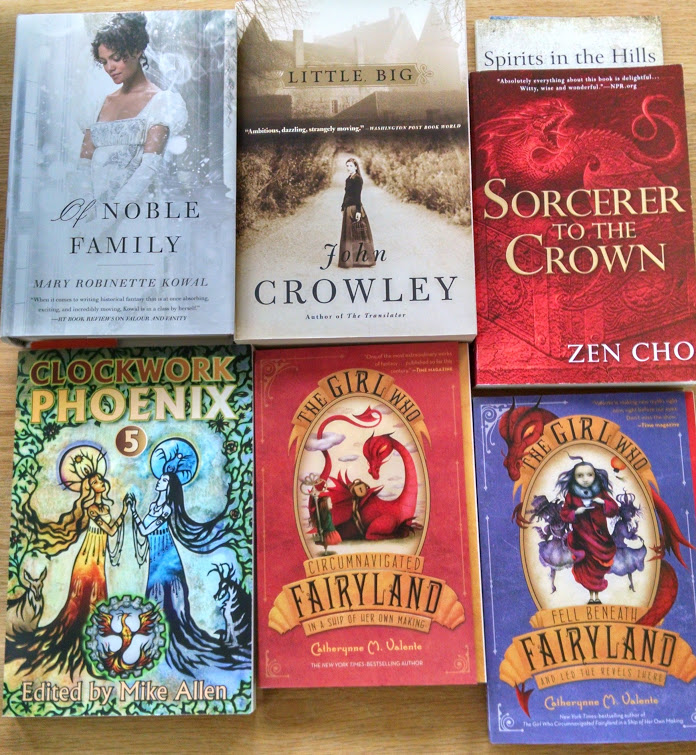
Books I either acquired this weekend or brought along to get autographs. My to-be-read pile just never gets any shorter…
There was, as those of us in eastern Massachusetts know, quite a band of rain and hail that crossed through yesterday afternoon, which might be why the leader of our writers’ group last night had puddles on the brain. For one writing prompt, we were challenged to use the words ‘middle, addle, and puddle’ in a scene. My brain went from Beatrix Potter’s oft-confused Jemima Puddleduck to ee cummings’ “puddle-wonderful,” and this is what happened next.
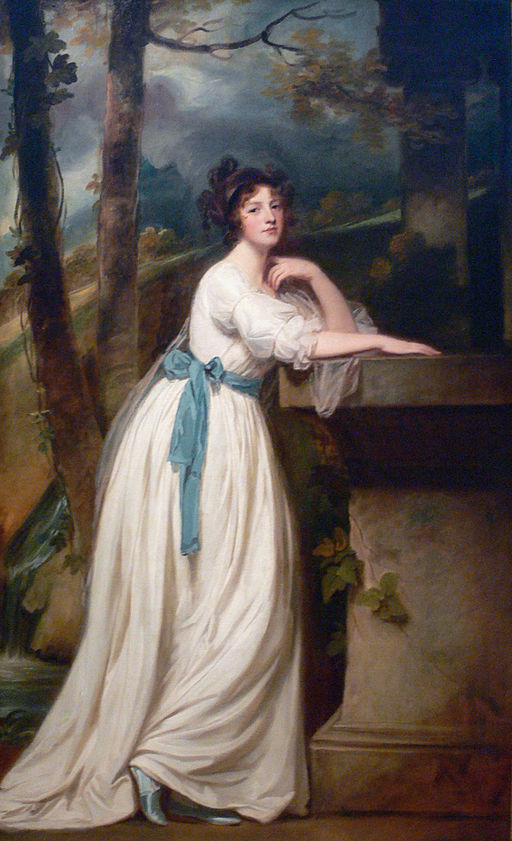
Portrait of Mrs. Andrew Reid; c. l780–1788 Kimbell Art Museum, Fort Worth, Texas; Public domain, via Wikimedia Commons, (Looks like a puddle-splashing fan, doesn’t she?)
Promenade by Meg Winikates
Misty morning meander to
the green in middle distance,
addle-pated chatter of a
governess’ persistence.
Mischief of a moment,
a jollity, a happenstance:
Puddles soak through petticoats!
The scold, the cold are
worth the dance,
to turn, to trip, from twenty
back to twelve,
to find beneath the formal figure
one’s former sense of elf.
Deeper Than You Imagined, by Sachiko Akiyama (featured artist in Branching Out), click for source.
If any of you follow my museum education blog, Brain Popcorn, you’ll know I’ve been working on a show that opened just a few weeks ago called Branching Out: Trees as Art. In the course of researching for that show, I was introduced to the work of Suzanne Simard, a forester who works with tree root/fungal networks, which form an underground communication chain between trees of all ages and species in a forest. Her research inspired me to write a speculative flash fiction story which has now been published on PEM’s blog, Connected.
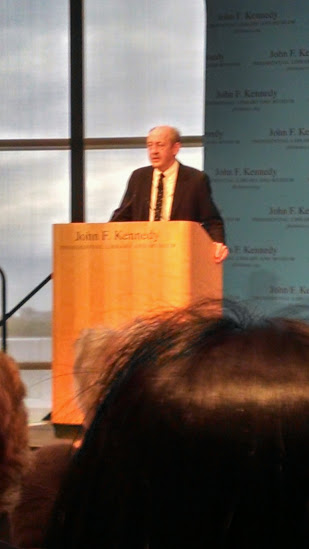
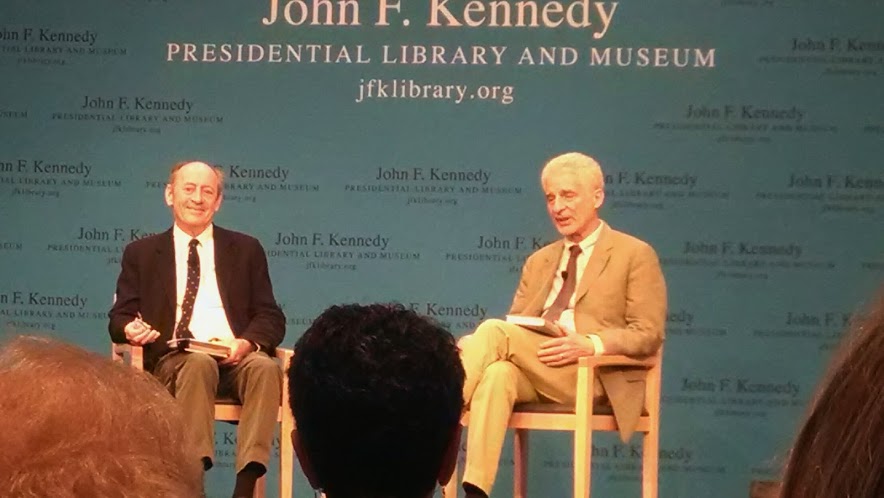
The JFK Library and Museum runs fabulous and fascinating evening events, and last month I was thrilled to go hear Billy Collins (former US Poet Laureate, a title he enjoys saying, apparently, and who can blame him?) read some of his work and have a conversation about poetry and writing and reading of same.
And, of course, the view of the city and harbor out the windows behind the speaker was as stunning as always.
Billy Collins reads at the JFK Library, May 2014
Collins was entertaining from the very start, declaring that it was an honor to be mentioned in the same breath as Robert Frost, as “compared to Frost, my poems are like an unmade bed in a dorm room.”
Other highlights from the discussion–
On the surreal tone of some of his poems and how not to lose readers: “start in Kansas, but end up in Oz.” Start with an idea, set the tone, start out ordinary and develop into something interesting and strange
Domesticity is interesting, to start with a common experience and then dive ‘down and in’ to the more subjective point of view
To be alone with the reader is not the same as being lonely
When ‘finding the way through’ the poem, Collins looks at it like a map: ‘how does it move’ as opposed to ‘what does it mean.’
Collins’ writing ‘persona’ is very present in his poems – open, ready to be pleased (though not always succeeding), and with ‘little capacity for misery.’ According to Collins, all poetry needs/involves persona, which is not the same as personal – he denies any explicit autobiography in his writing. (And, indeed, is not fond of overtly familial poems as reading matter, either)
One doesn’t exactly choose to become a professional poet, it is more like ‘a hobby that swallows you up.’
At the end of the evening, there was a little time for Q&A. I’m not a big fan of getting up to ask questions in front of a microphone (I don’t mind public speaking, but public interrogation is somehow harder!) Since Collins was signing books after, however, I did get to ask him about one of his comments from earlier in the evening. He had stated that the majority of poems (not to mention poetry collections), he doesn’t even read all the way through, so I asked which poets, if any, had writing which he did read all the way to the end.
That’s a name I recognized, though I couldn’t put words to the name, so I did a little research and reading, and now know enough to put him on the list of poets’ names to scan for when I’m in a bookstore.
As much reading and writing as I do in front of a screen these days, it’s still nice to curl up in a sunny corner that has *just enough* shade and enjoy the feel of a book in hand. (I get so much reading done in the spring!) Here are a few of the books I’ve read and enjoyed in the last week or two:
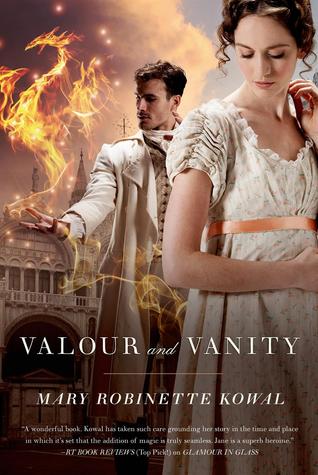
Valour and Vanityby Mary Robinette Kowal – I’ve loved this series from the beginning (Shades of Milk and Honey), and this latest installment was just as entertaining, full of the joy of someone who really loves both the period and the universe she’s created within it. Unlike some authors who lose interest in their characters once they’re married, Kowal gives us a plot with well developed characters undergoing understandable relationship growing pains even well into a married partnership. Jane and Vincent have always reminded me of the best of Elizabeth Peters’ Amelia Peabody and ‘the irascible Emerson,’ so it was fun to return to their dynamic. Plus, heists! Cons! A Doctor Who cameo! As a bit of light reading after a steady diet of poetry for the last several weeks, it was perfect. I highly recommend it if you’re fond of historical fantasy, Regency England, bonus Venice and glassblowing, and/or magic. Plus, Kowal is the mind behind the awesome Month of Letters I’ve mentioned before, and she wrote me a really awesome response to the letter I sent her main character, Jane, Lady Vincent.
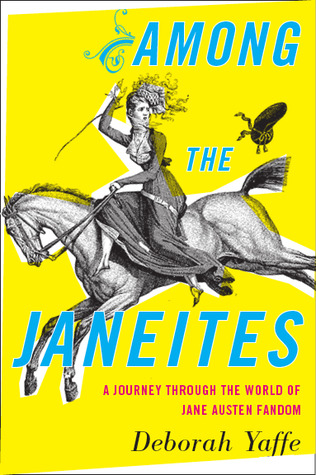
Among the Janeitesby Deborah Yaffe – I do a fair amount of research at work, so when I’m off duty I tend not to read a ton of nonfiction, but a friend lent me this book and I was excessively diverted. While not purporting to explore the entirety of Austen’s popularity, her fans, or global fandom, this book did a pretty admirable job of exploring the many ways people relate to Austen and her work, the possible reasons they are drawn to her, and the history of the founding, growth, and eventual membership explosion of the Jane Austen Society North American branch. Fandom history is always entertaining to me, and while I did not recognize a ‘me’ style fan in Yaffe’s accounts, I certainly have encountered some similar personalities among other Austen fans or fans in general. (I did, after all, declare in high school that ‘Everything in life relates to Jane Austen. Or Star Wars. And possibly both.’) If you have any affection for Austen’s work or any curiosity about the phenomenon that is her pop culture presence, this is a quick and enjoyable read.
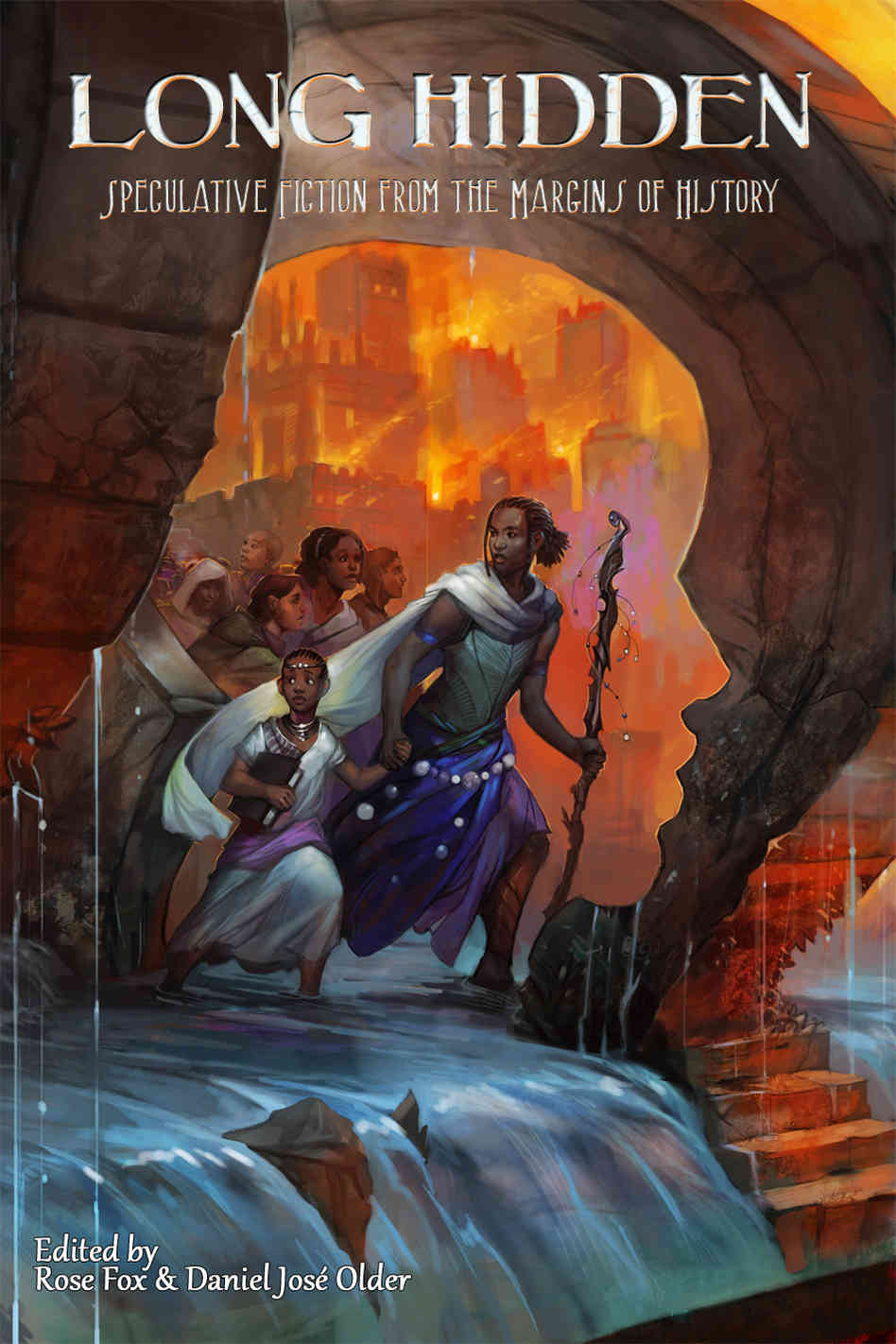
Long Hidden short story anthology from Crossed Genres – I’m actually only partway through this anthology so far, but I’m having a fascinating time while reading. The voices are as diverse as the editors proclaimed, the vocabulary rich, and the assorted magic systems and other fantastical elements so far have a lot of emphasis placed on dreaming. I can’t tell yet whether that last element’s due to editorial bias, something that non-Western stories have in common, the product of small sample size, or simply what happens when the author/main character exists in a tradition where their voices and actions are belittled in a prejudiced or oppressive society. It’s certainly giving me a lot to think about! My one quibble with the anthology so far is physical–the margins on each page are nearly nonexistent, meaning one opens the book to a wall of text with little white space for either ocular rest or helpful marginalia. I don’t write in my books much, but I can see where one might be prompted to with a collection like this, and would be forced to resort to post-its instead.
Did you get through all that? Then I present to you, a moment of cute:
The following bit of fluff was written for my good friend and co-conspirator, Devlin, and rather giddily spun off our archaeological epistolary adventure. The formal excuse for writing it was a writers’ group exercise in telling a story through letters or emails, but this particular pair of highly unusual library assistants prefers to leave each other notes on the backs of discarded card catalog cards, tucked into the split between the desk and the paneling of study carrel A23.
Hazard Pay,or, Assorted notes left in Carrel A23
Dear Clara,
Have misplaced the secret entrance to the royal academy library. Please advise.
Ren
– – – – –
Dear Ren,
On alternate Thursdays it has a sudden maritime mood. Did you try looking behind the Nelson biographies?
Clara
— – – –
Dear Clara,
Tried the Nelson biographies and got doused in a wave of grog. Think it may have spread into the poetry aisle. Suggestions?
Ren
– – – – – –
Dear Ren,
Wear a raincoat next time. Also, grog’s not so bad, but don’t let Keats at the port, he gets morose and starts a several hour monologue about the nature of beauty. Whitman can usually snap him out of it, but watch out. He has wandering hands.
Clara
– – – – – –
Dear Clara,
I do not get paid enough for this. The library entrance is hiding in classical mythology again and won’t open until all the scholars that want to access it answer three riddles. I have already rescued two of them from being eaten by the sphinx carved into the end of the stacks. Also, my favorite leather jacket is now missing a sleeve. What’s next, velociraptors?
Ren
– – – – – –
Dear Ren,
I suggest swinging by the 12th century and stocking up on chain mail. Sorry to hear about your jacket, but you’re too skinny for the Indiana Jones look anyway. At least it didn’t eat your hat.
Stay away from the paleontology section until the new moon at least.
…I’m serious.
Clara
– – – – – – – –
Dear Clara,
Found your satchel halfway up the travel section. Decide to go backpacking on the Giant’s Causeway again? Hope you remembered your sweater this time. Left your satchel safely under sewing and notions. Meet me in Astronomy behind the Kuiper belt later?
Ren
– – – – –
Dear Ren,
Wondered where I’d left the satchel. It didn’t have a pocket full of rose petals when I left it, though, I don’t think. Been sipping that grog with Robbie Burns again? You don’t really need his kind of help.
And yes, but not the Kuiper belt, it’s freezing there. Last one to Verne’s complete works has to wrestle the kraken.
Clara
– – – – – – –
Dear Clara,
Joke’s on you. I brought Keats’ port to the kraken last week and now that thing thinks I walk on water. See you at 20,000 leagues.








 Sea Dreams and Time Machines