
Uncategorized

A grand weekend of Bualadh Bos(ton)

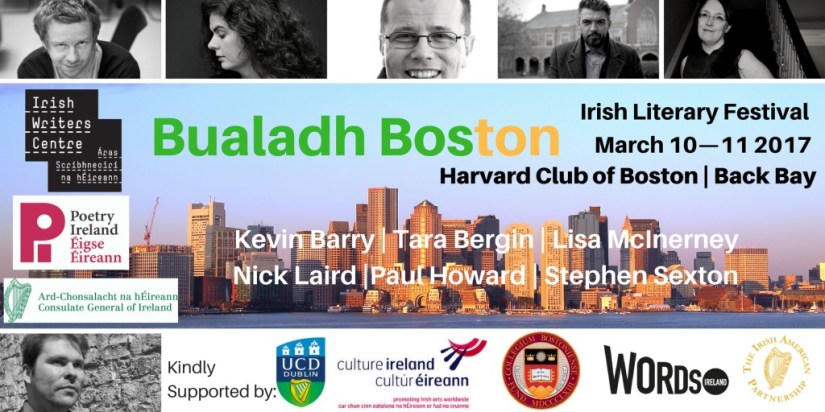
Bualadh-Boston-e-flyer-2-1024x512

Apparently, “Bualadh Bos” is a phrase in Irish that means applause, and there was plenty of cause for cheers at the recent Irish Literary Festival, held for the first time at the Harvard Club in downtown Boston and arranged by a whole bunch of clever cultural ambassadors from the Irish Writers’ Centre, Poetry Ireland, and the Consul General of Ireland to Boston, Fionnuala Quinlan (@IrelandBoston). (My companion and I had a lovely conversation with Ms. Quinlan during the reception on Friday, and she’s  delightful. I hope she has reason to remain posted in Boston and help arrange many such events in the future.)

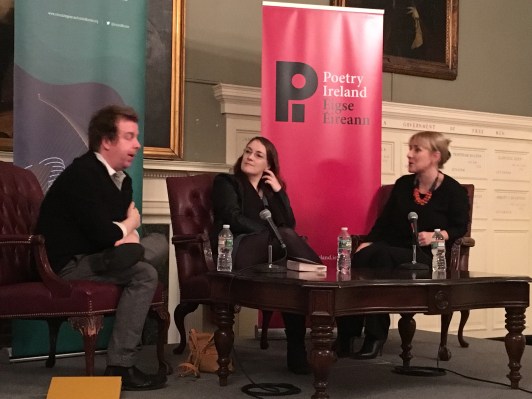
Friday night began with readings by novelists Kevin Barry and Lisa McInerney (@SwearyLady), followed by a discussion led by Fionnuala Quinlan.
IMG_0803
Kevin Barry, Lisa McInerney, and Fionnuala Quinlan in conversation during Friday’s opening event.

Barry read a section of one of his short stories, and McInerney from her recent award-winning novel, The Glorious Heresies. Both authors were excellent readers of their own work; funny, dramatic, and engaged with both the text and the audience, which meant that my companion and I both left the evening more interested in reading more of their work, rather than less, which can be the case with less skillful presenters.
IMG_0811
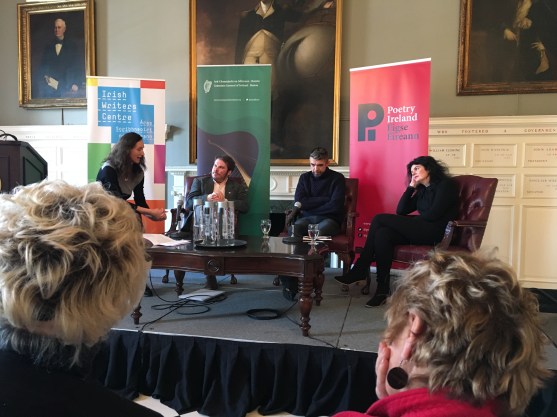
From right, Tara Bergin, Nick Laird, and Stephen Sexton in conversation with Maureen Kennelly of Poetry Ireland.

The next day we got to hear readings of some fantastic poetry from Tara Bergin, Nick Laird, and Stephen Sexton. Bergin’s poetry is lyrical, with an element of folklore-sound to it without ever directly referencing specific legends. You can read a review of her debut book, This is Yarrow, here.  Laird’s poetry was sharp and wound round itself like an ammonite, and frequently referenced current events and recent scientific thought. You can read his article “Why Poetry is the perfect weapon to fight Donald Trump” here. Sexton’s poetry was often, though not solely, humorous; he noted as he began that when picking his poems for the event he discovered “[he had] a lot of hobbies for about three weeks,” which was long enough to work them into a poem or two before going on to something new. You can read one of the poems he read that day here: “The Curfew.”

Though my companion and I bought several books at the event, which I am reading with great pleasure, I also went and found more of their poetry after the event. My current favorite is Bergin’s “Appointment with Jane Austen,” especially appropriate as I shall shortly be undertaking a literary pilgrimage to Austen’s country myself.
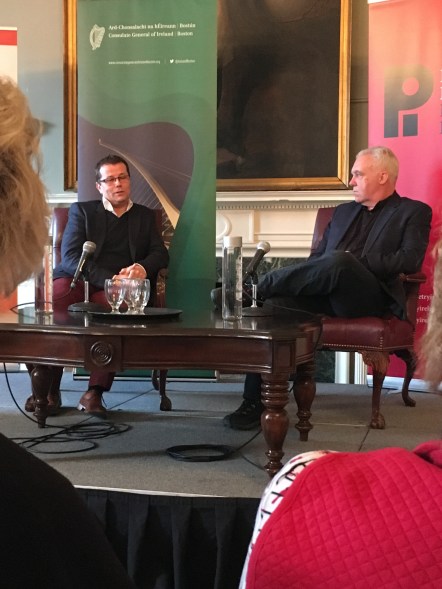
IMG_0814.JPG
Paul Howard and Kevin Cullen

The last event of the weekend was Boston Globe columnist and journalist Kevin Cullen interviewing journalist and novelist Paul Howard. They spoke of everything from sports journalism and doping scandals to the success of Howard’s satirical main character, Ross O’Carroll-Kelly, in whose Homer-Simpson-esque adventures and foibles Howard keeps a running commentary on current events in Dublin and to a lesser extent, the wider world.

Overall it was a fascinating weekend, and I was only sorry that it seemed the event had not been widely enough publicized, as the room was moderately full but deserved to be more so on each of the two days. As it seemed many in the audience, like myself, were being introduced to most of these writers for the first time, the event definitely succeeded in its stated purpose to use Ireland’s literary offerings as a bridge to new audiences and new opportunities, and Boston was a perfect place to hold such a gathering. I will be keeping my eyes out for announcements of next year’s Irish Literary Festival, for sure.
Save

Uncategorized

What makes a literary district?

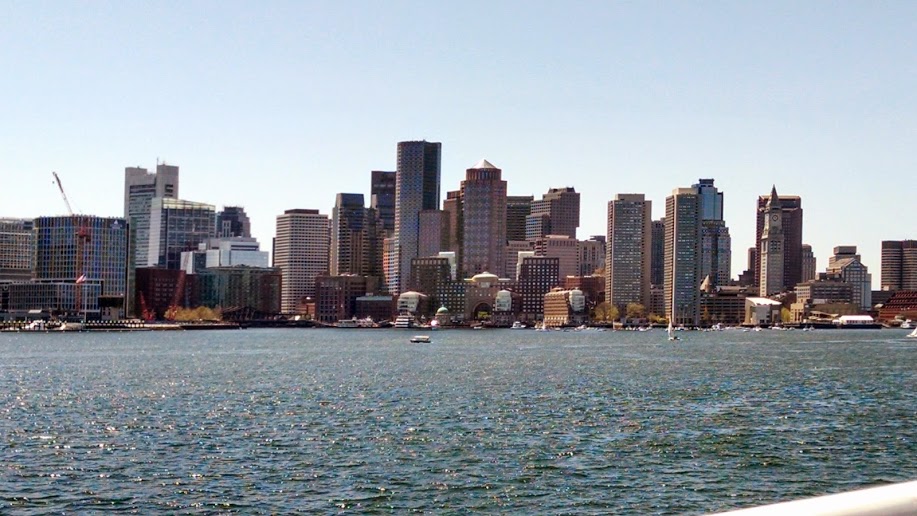
Boston from the harbor. Photo by Meg Winikates.

In August of this year, the Mass Cultural Council approved the creation of a ‘cultural district’ in Boston dedicated to the literary arts.  Cultural districts are a way of raising awareness about the various arts organizations and resources in an area, and are meant to have an economic impact as well, attracting businesses and creative professionals to a designated area.  There are currently 26 designated cultural districts in Massachusetts, and I find a lot to like in the definition the MCC provides:

It is a walkable, compact area that is easily identifiable to visitors and residents and serves as a center of cultural, artistic and economic activity. The Massachusetts Cultural Council recognizes that each community is unique and that no two cultural districts will be alike.

That seems like a set of very achievable guidelines, given that much of New England falls into the ‘walkable, compact’ category already, and the rest of the definition of ‘culture’ is left open to the strengths of the city/town that applies.

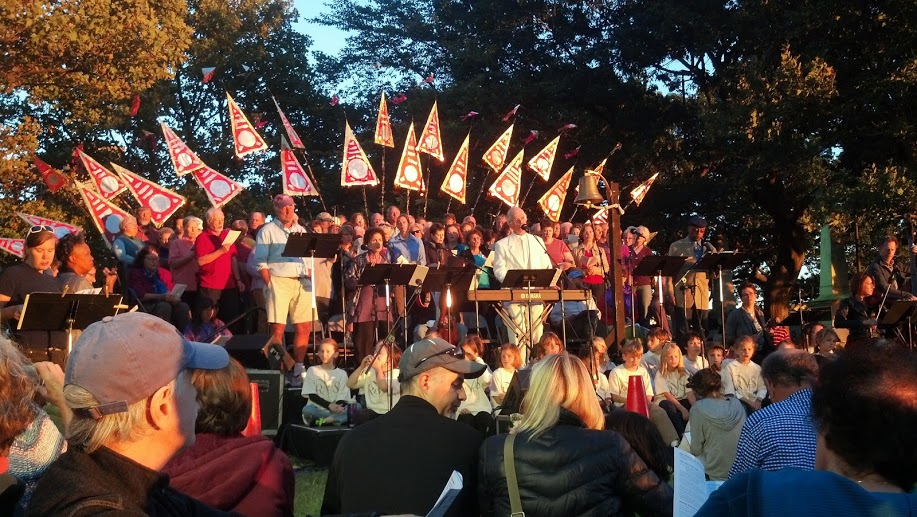
Revels' River Sing on the banks of the Charles.  Photo by Meg Winikates.
Revels’ River Sing on the banks of the Charles. Photo by Meg Winikates.  Many cultural districts seem to feature recurring music and dance festivals like this one, as well as the local waterfront, for understandable reasons. (Though the current Cambridge cultural district is in Central Square, up the road from where this celebration of the autumnal equinox occurs.)

So what makes the Boston Literary District (the only one of its kind in MA and the only district specifically geared to one arts discipline) fit the bill?

Mass Poetry recently interviewed Larry Lindner, the Literary District’s coordinator, who enthused about his hope that “the Lit District website becomes for Boston what Time Out is for people who go to London — a kind of what’s-going-on-in-the world-of-literature in Boston” and mentioned plans for an app to help explore the District in 2015.  And the physical district itself?  By making the sites and events more visible, accessible, and tangible, Lindner hopes to encourage timid readers as well as those already deep in the reading and writing world.  He also suggests that associate partnerships with organizations and businesses outside the District’s official borders can help their visibility as well, and bring some of the benefits of the district designation to other areas of the city that need it.  (Even events outside the city get a chance to be included on the District’s events calendar, such as a public art/poetry event in Newton earlier this month.)

The thing I love best about perusing the map of the district is the number of surprises it holds, even for someone who has lived all but 2 years of her life in and around this city, who has worked at a local literary/historical site (2 if you count the Paul Revere house and his own poetical connections), and who was an English major to boot.  For instance, did I know that E.B. White’s The Trumpet of the Swan was set in Boston’s Public Garden?  Maybe when I read it when I was nine, but I certainly didn’t remember the scene with Louis playing his trumpet on the actual existing bridge over the pond.  Nor could I have named even half the writers and poets listed as having ever been Boston residents.  (I love learning new things about my city!)

A few of the sites listed do seem like a stretch (there’s a small bookshop on the ground floor of the State House, really?) and some a bit vague (the Old City Hall listing says ‘Legend has it that that’s the setting for Edwin O’Connor’s novel The Last Hurrah‘) but on the other hand, one can choose to take that as a plus.  Some of these places had to really *try* to connect to the literary district.  It was worth the effort to find the thread, the history, the destroyed address that this modern building now stands over–and that’s kind of awesome, that people want to be a part of it.  I know next time I’m free to wander a bit downtown, I’ll be keeping my eye out for some of the literary landmarks listed.

Boston Public Garden (and Louis' bridge!).  Photo by Captain Tucker, used under creative commons license.  Click for source.
Boston Public Garden (and Louis’ bridge!)  Photo by Captain Tucker, used under creative commons license. Click for source.

And if you can’t make it to Boston to check out what’s going on on the bookish byways, take a stroll down Author Avenue  or Fantasy Street as you check out this virtual literary district at  My Independent Bookshop.  This site is a visually appealing compilation of people’s book recommendations which are then linked to independent bookstores.  I haven’t set up a ‘bookstore’ of my own yet, but it does look like a fun community and a fairly intuitive interface. (Don’t forget to scroll sideways as well as down, though!)