I always appreciate it when my writers’ group offers up a prompt that makes you consider a new perspective. This week’s best prompt was to write from the point of view of “someone who works at an airport.”
“Logan Airport, Terminal A at night” by Alan Myles. Creative Commons, click for source
At the Info Desk (Logan Airport, 10 pm)
by Meg Winikates
Departures, arrivals, wheels up, wheels down,
conveyor belts creak round and round,
handles up, wheels down.
“Cup of coffee? That’s three fifty,”
and her sigh’s a lonely sound–
Ten pm at Logan: parking up, buses down.
“Did I miss the Silver Line?”
“Five more minutes, head on down–
last exit on the left,” and
the wheels go round and round.
“Left my passport at the hotel!”
Customs up, taxis down.
Peculiar sort of silence as
the last flight touches down
and the echoes of the travelers
pulse like heartbeats round and round.
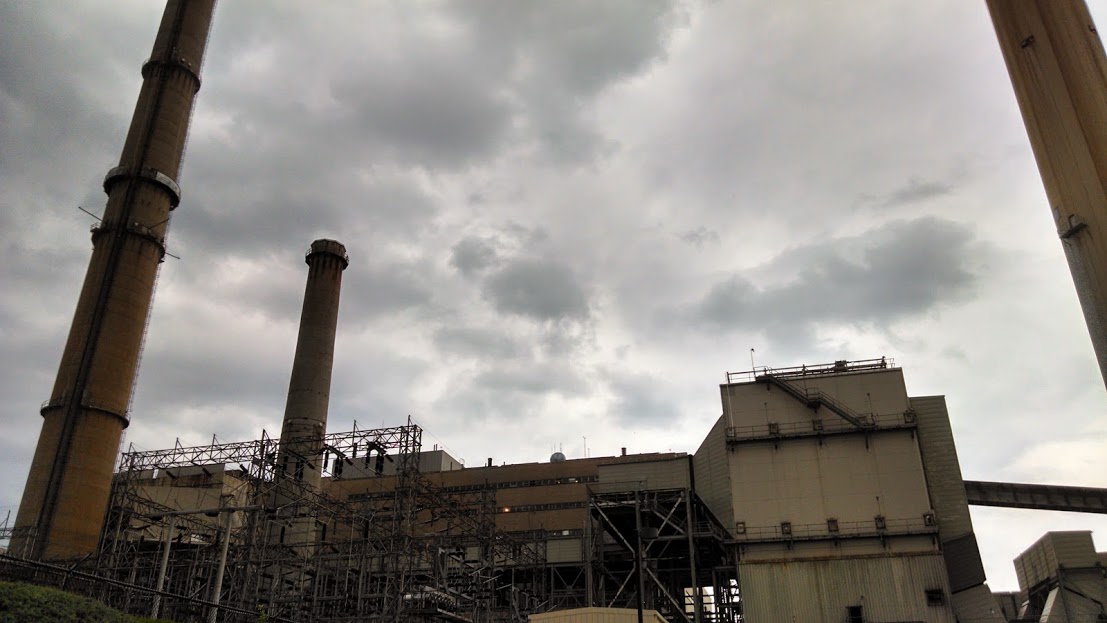
Poet Colleen Michaels is the brain behind the Montserrat College of Art’s Improbable Places Poetry Tour. And this past Thursday, the improbable location for the latest set of poetry readings was Footprint Power’s recently decommissioned power plant on the edge of Salem Harbor.
Thunderclouds gloom over the quiet power plant. Photo by me.
I was initially dubious and simultaneously drawn. Having lived in Salem for over 4 years, just on the opposite side of Collins’ Cove from the familiar smokestacks, I’ve absorbed their shadows into the folds of my understanding of the local landscape, and grumbled occasionally about wind direction and sooty windows. Like most people I know around here though, I’d never been inside. Hydroelectric plants and windmills at Niagara and in the Netherlands and elsewhere? Sure! Coal and oil-fired behemoth in my backyard? Nope.
So while I wasn’t sure what an evening of readings about ‘the work of power and the power of work’ would sound like, I was totally in for the chance to tour.
As it turned out, the readings were a fantastic variety. Ranging from reflections on both the grit and the worth of daily grind to the concept of living on or off ‘the grid’ to poems inspired by this very power plant and the future of energy in the 21st century, the poems and poets offered a beautiful and thought-provoking set of mental images.
Check out more of the ‘cathedral of steel’ and its unusual evening occupants in the gallery below:
This slideshow requires JavaScript.
Local poet January O’Neil also has a nice write-up of the event, where she too highlights one of my favorite moments: the reading ended, not with a headliner or a speech, but a moment of silence that was filled by a recording of the actual crackle-rumble-hum of the turbines when the plant was operating. It was a very cool kind of ghostly and really made me want to go home and write.
In the meantime, however, have a draft of a poem inspired by my own workplace, and what it’s like on a festival weekend as the visitors are heading out and you’re waiting for that last performer to finish packing up their gear, thinking about attendance numbers and what you’ll put in your program evaluation come Monday…
8 days a week
By Meg Winikates
I tell myself it’s a good ache,
the dull burn in my heels that says
the miles I’ve walked circularly
over this granite floor have made
a lasting impression on me.
My calves recall the frequent dash,
sore hands avert another crash
ff child and chair, of floor and phone,
and whisking fingers vamoose trash—
rub buzzing ears, block joyous drone.
Duty’s done, but wonder lingers—
Did I meet just eyes and fingers?
Save one bad day, help one smile grow?
Made one growler’s heart a singer’s?
Or worn my footprints on this stone?
Enough would be one ‘yes’ alone.
Have you ever encountered poetry or art in an unusual place that helped you to look at it differently? What places inspire you?
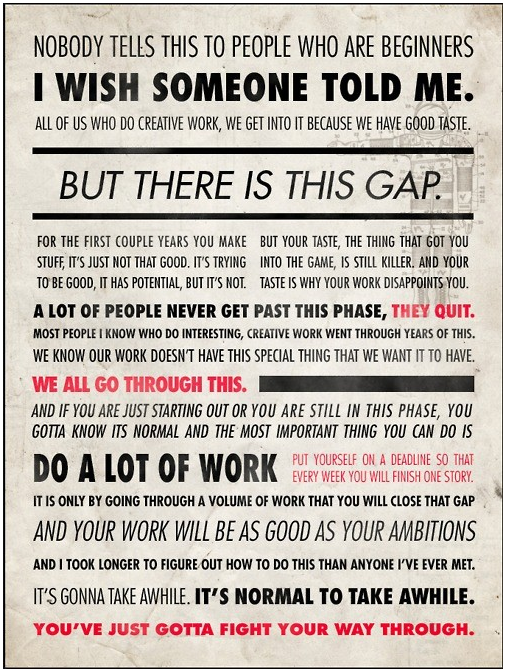
Camp Nanowrimo has rolled around again, which means the corners of the internet I frequent are full of cheerleading and wordcounts and interesting snippets of advice from published authors. As I am currently more in the editing stage of several projects as opposed to the frantic amassing of words, I thought I’d share some of the things that have caught my attention in the last week or two:
How to Train your Inner Editor by Mary R. Kowal
I watched this right before making notes for critiquing two pieces for my writers’ group, and it did really make me think about the kind of feedback I give, as well as the feedback I’ve gotten. I’ve done the beta-reader thing in several different ways, by email and in person, for strangers, acquaintances, and friends, and I do enjoy it, but now I get to appreciate it as a training exercise for my own writing in a way I’d never considered before.
Quote by Ira Glass, Lovely layout by artist unknown. If you know whom to credit, please let me know! (Google’s reverse image search failed me)
For a deeper look at that idea-to-editing-to-just-publish-already zone, Kowal and her fellow authors from the podcast series Writing Excuses have a new anthology called Shadows Beneath, featuring 4 short stories in first draft and revised versions, with discussions of the editing process. I haven’t read it yet, but it looks like fun.
How Amazon and Goodreads are changing literary criticism – Do you write Goodreads reviews? Do you follow book bloggers? Whose opinions do you trust? I had a bunch of books on my ‘to read’ list based off bloggers’ book reviews that were *panned* on Goodreads–so what now? I moved them from my ‘buy if you see them’ to ‘see if they’re at the library next time you’re there’ list. But I won’t ditch them entirely until I read the first few chapters. How do you react to online reviews?
Slowing down the brain with calligraphic text messaging? Since much of this post is about being aware of your writing as you’re writing, and being a more mindful reader/responder, I thought it would be fun to wrap up with this entertaining article from a woman who spent a week replying to text messages with hand-written photographic replies.
What do you do to make yourself a more mindful reader and writer?
Last week I had the pleasure of attending a workshop hosted by the folks over at Mass Poetry as a reward for supporting their Poetry on the T campaign. (and I happened across some of said poetry just this week on the Red Line, which made me extra happy!) The workshop was appealingly titled “Super Writing Fun Time” and was led by Jill McDonough.
I’ve been working on several projects recently (which is why I haven’t posted as much this month, oops!) and those projects have had me thinking a lot about editing, both prose and poetry. One of the hardest things to do is look at a piece of writing and say, “You know, there’s really only one good line in that whole passel of words.”
Ouch.
Sometimes, though, it’s worth just hanging on to that one good line and rebuilding around it, and that was made abundantly clear in McDonough’s workshop.
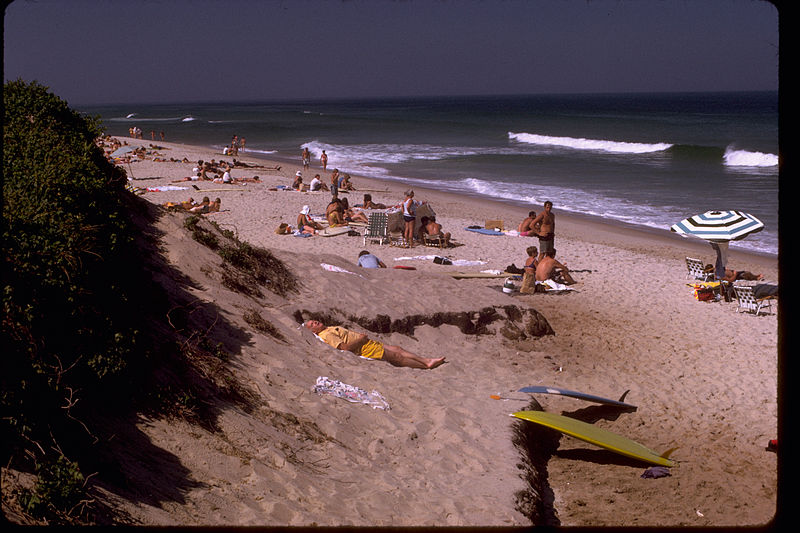
Cape Cod National Seashore, National Park Service (public domain)
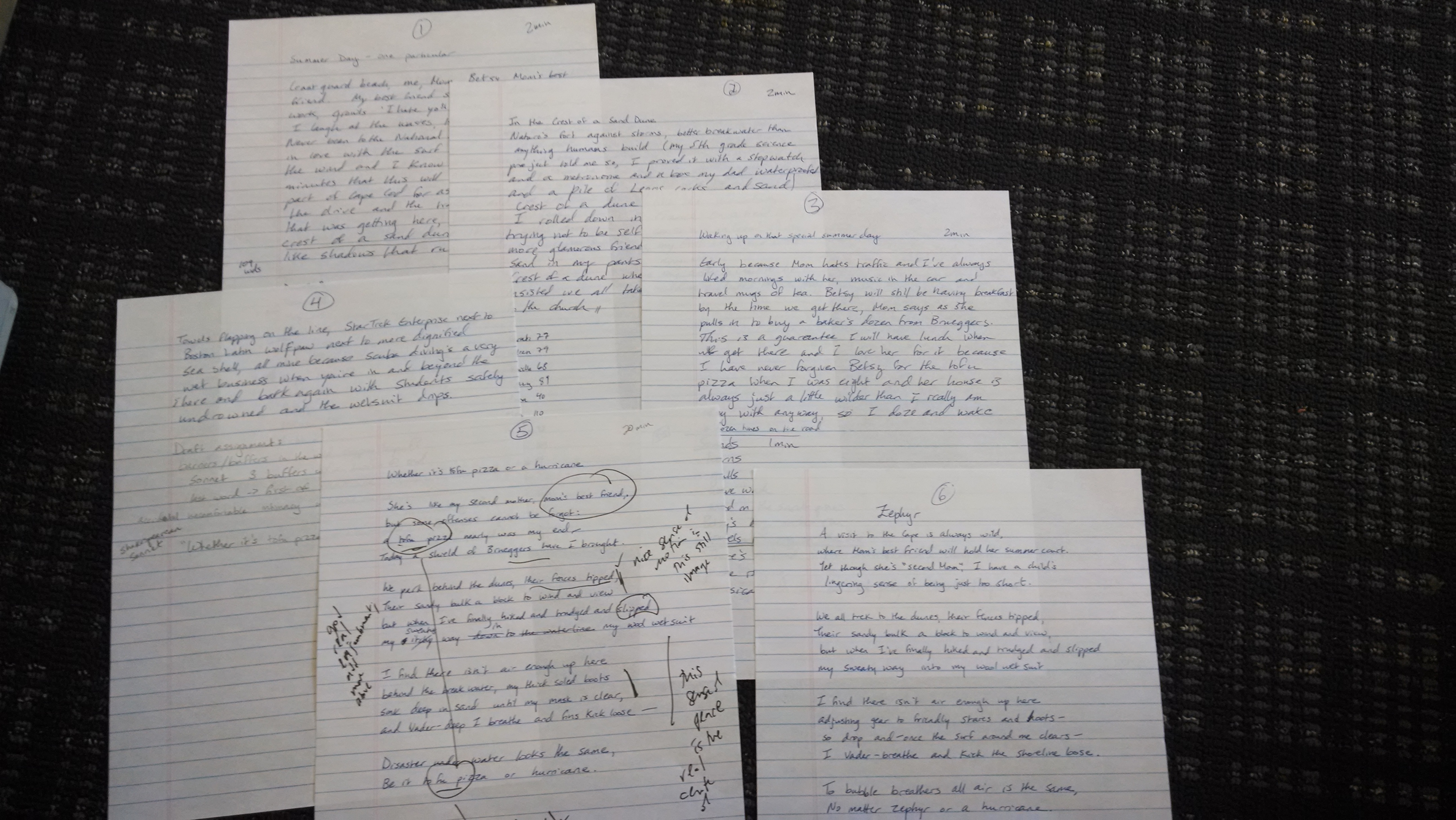
In a series of word-spilling sprints, she urged us to write about one particular summer day, read our result aloud, and then run on again from whichever phrase she highlighted as the most interesting part of our rushed verbiage. After several iterations, we had to look back through everything we’d written and give ourselves an assignment to create a more thoughtful poem draft using themes or language we’d found in our earlier efforts. Where we were stuck, she offered help by way of a format or a title or a direction, and then came around to ‘mess with’ our work if we indicated we wanted help/critique. I ended up writing and rewriting a Shakespearean sonnet in about 25 minutes, and it was an enormously confidence-boosting evening.
A passel of words thanks to McDonough’s workshop!
So why was it so effective? Beyond McDonough’s humor and generous handfuls of Hershey’s kisses, she created a judgement-free zone. Spilling all those words on the page in the beginning, without worrying about quality or phrasing overmuch meant it was easier to let those words go in favor of the best ones–and it’s a device I think I’ll adopt in future. I’ve never been much of a ‘drafter’ by personal preference: I like spending the time and thought to feel like I’ve got it ‘right’ the first time around, but what works in an essay or a professional memo is really not conducive to the creative process, which is almost by definition iterative. And carrying that mindset over from the workshop has been helping me edit the rest of my writing, as well.
If you’d like to find out more about McDonough’s process in her own words, I recommend this article: “Primary Sources” hosted over on the Poetry Foundation website. Between that evening and this article, I’ve spent not a little time recently seriously entertaining the idea of going back to grad school, and then smacking myself on the back of the head, a little. (Is there an Academia Anonymous? ‘It’s been two years since my last graduation…’)
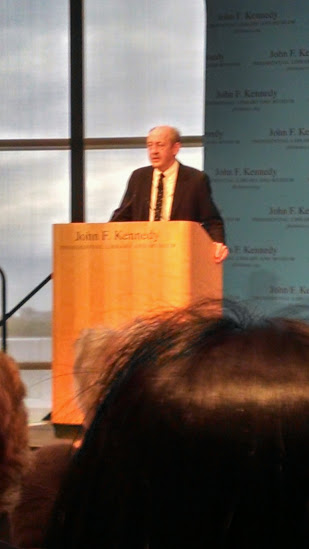
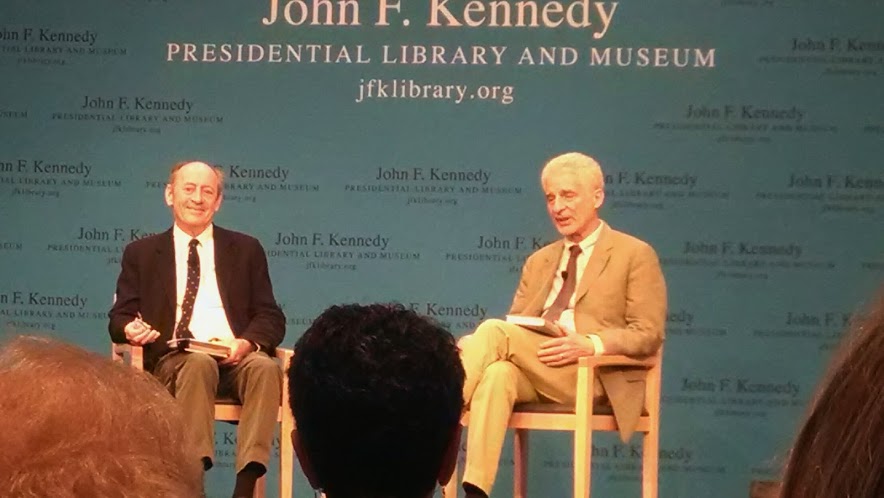
The JFK Library and Museum runs fabulous and fascinating evening events, and last month I was thrilled to go hear Billy Collins (former US Poet Laureate, a title he enjoys saying, apparently, and who can blame him?) read some of his work and have a conversation about poetry and writing and reading of same.
And, of course, the view of the city and harbor out the windows behind the speaker was as stunning as always.
Billy Collins reads at the JFK Library, May 2014
Collins was entertaining from the very start, declaring that it was an honor to be mentioned in the same breath as Robert Frost, as “compared to Frost, my poems are like an unmade bed in a dorm room.”
Other highlights from the discussion–
On the surreal tone of some of his poems and how not to lose readers: “start in Kansas, but end up in Oz.” Start with an idea, set the tone, start out ordinary and develop into something interesting and strange
Domesticity is interesting, to start with a common experience and then dive ‘down and in’ to the more subjective point of view
To be alone with the reader is not the same as being lonely
When ‘finding the way through’ the poem, Collins looks at it like a map: ‘how does it move’ as opposed to ‘what does it mean.’
Collins’ writing ‘persona’ is very present in his poems – open, ready to be pleased (though not always succeeding), and with ‘little capacity for misery.’ According to Collins, all poetry needs/involves persona, which is not the same as personal – he denies any explicit autobiography in his writing. (And, indeed, is not fond of overtly familial poems as reading matter, either)
One doesn’t exactly choose to become a professional poet, it is more like ‘a hobby that swallows you up.’
At the end of the evening, there was a little time for Q&A. I’m not a big fan of getting up to ask questions in front of a microphone (I don’t mind public speaking, but public interrogation is somehow harder!) Since Collins was signing books after, however, I did get to ask him about one of his comments from earlier in the evening. He had stated that the majority of poems (not to mention poetry collections), he doesn’t even read all the way through, so I asked which poets, if any, had writing which he did read all the way to the end.
That’s a name I recognized, though I couldn’t put words to the name, so I did a little research and reading, and now know enough to put him on the list of poets’ names to scan for when I’m in a bookstore.
As much reading and writing as I do in front of a screen these days, it’s still nice to curl up in a sunny corner that has *just enough* shade and enjoy the feel of a book in hand. (I get so much reading done in the spring!) Here are a few of the books I’ve read and enjoyed in the last week or two:
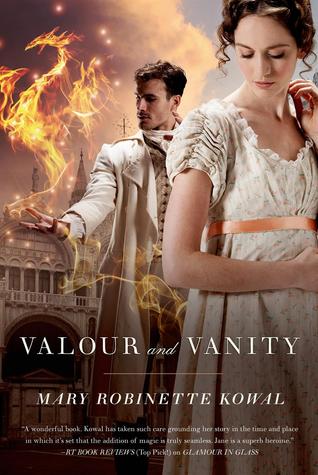
Valour and Vanityby Mary Robinette Kowal – I’ve loved this series from the beginning (Shades of Milk and Honey), and this latest installment was just as entertaining, full of the joy of someone who really loves both the period and the universe she’s created within it. Unlike some authors who lose interest in their characters once they’re married, Kowal gives us a plot with well developed characters undergoing understandable relationship growing pains even well into a married partnership. Jane and Vincent have always reminded me of the best of Elizabeth Peters’ Amelia Peabody and ‘the irascible Emerson,’ so it was fun to return to their dynamic. Plus, heists! Cons! A Doctor Who cameo! As a bit of light reading after a steady diet of poetry for the last several weeks, it was perfect. I highly recommend it if you’re fond of historical fantasy, Regency England, bonus Venice and glassblowing, and/or magic. Plus, Kowal is the mind behind the awesome Month of Letters I’ve mentioned before, and she wrote me a really awesome response to the letter I sent her main character, Jane, Lady Vincent.
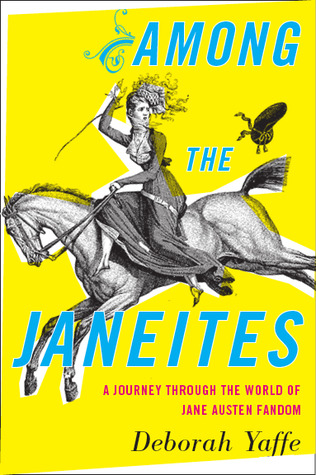
Among the Janeitesby Deborah Yaffe – I do a fair amount of research at work, so when I’m off duty I tend not to read a ton of nonfiction, but a friend lent me this book and I was excessively diverted. While not purporting to explore the entirety of Austen’s popularity, her fans, or global fandom, this book did a pretty admirable job of exploring the many ways people relate to Austen and her work, the possible reasons they are drawn to her, and the history of the founding, growth, and eventual membership explosion of the Jane Austen Society North American branch. Fandom history is always entertaining to me, and while I did not recognize a ‘me’ style fan in Yaffe’s accounts, I certainly have encountered some similar personalities among other Austen fans or fans in general. (I did, after all, declare in high school that ‘Everything in life relates to Jane Austen. Or Star Wars. And possibly both.’) If you have any affection for Austen’s work or any curiosity about the phenomenon that is her pop culture presence, this is a quick and enjoyable read.
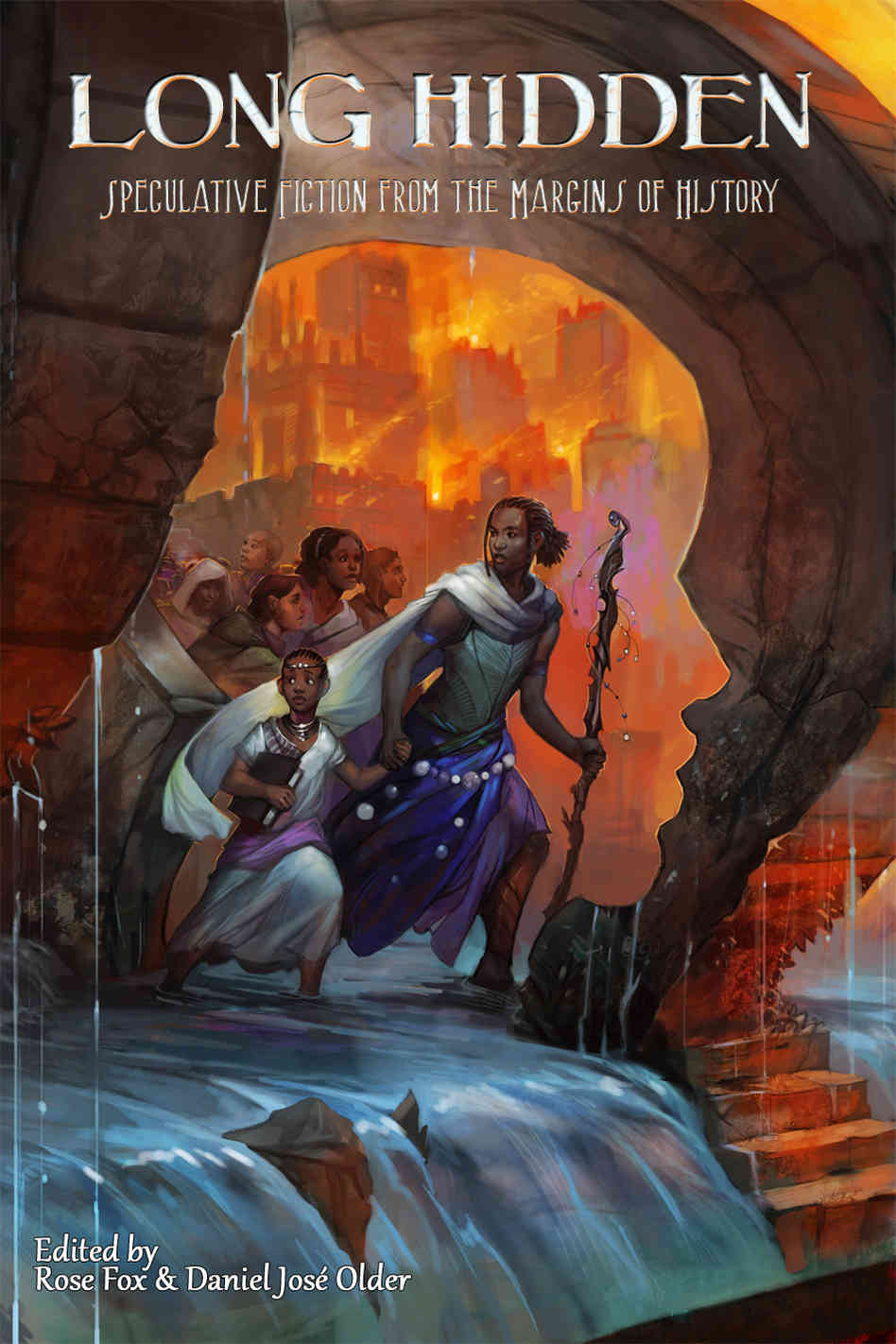
Long Hidden short story anthology from Crossed Genres – I’m actually only partway through this anthology so far, but I’m having a fascinating time while reading. The voices are as diverse as the editors proclaimed, the vocabulary rich, and the assorted magic systems and other fantastical elements so far have a lot of emphasis placed on dreaming. I can’t tell yet whether that last element’s due to editorial bias, something that non-Western stories have in common, the product of small sample size, or simply what happens when the author/main character exists in a tradition where their voices and actions are belittled in a prejudiced or oppressive society. It’s certainly giving me a lot to think about! My one quibble with the anthology so far is physical–the margins on each page are nearly nonexistent, meaning one opens the book to a wall of text with little white space for either ocular rest or helpful marginalia. I don’t write in my books much, but I can see where one might be prompted to with a collection like this, and would be forced to resort to post-its instead.
Did you get through all that? Then I present to you, a moment of cute:
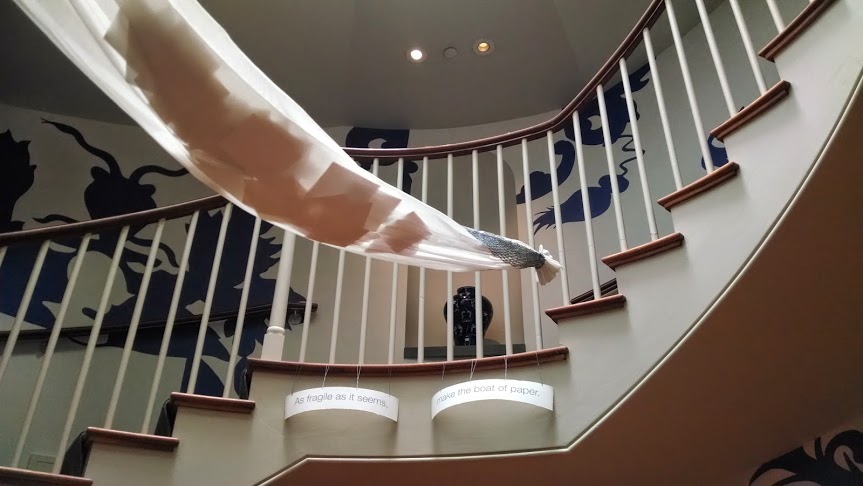
Leading up to the Line Break room at PEM, installation by Colleen Michaels and Lillian Harden
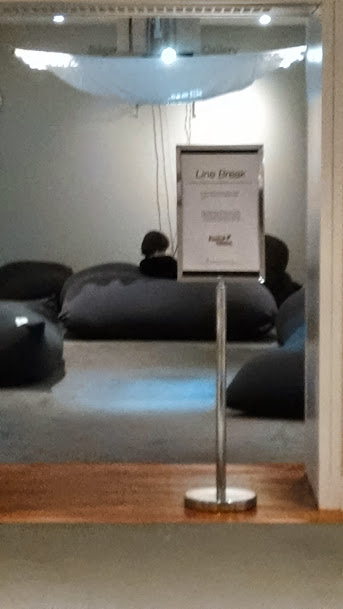
You know that a public space is inviting if there are people in there every time you walk by. When that space is a quiet area in a back corner of a museum set aside for poetic contemplation and respite, you make invisible fist pumps of joy and plan to come back later when you can abuse your staff privilege of getting in there before it opens to the public.
This is exactly what happened with Line Break, an installation at PEM for the Mass Poetry Festival. (Read more about the background of the two artists and plans for the space here: Line Break on masspoetry.org)
When Colleen and Lillian first approached my colleague and I about a poetry installation during the festival, we were eager to try to make it happen, but neither of us suspected, I think, how successful they would be at creating the atmosphere they described: the soft hum and click of an old slide projector, the feeling of floating as you lay beneath the hammock of words, the wordless invitation of blank books and pure white pencils.
(Blank books always call to me, I always answer.)
Poetry hammock catches words in Line Break
My favorite lines I saw float across the net/hammock were:
“if your net
were knit
by bloom
would it feel
like raised hands?”
And, based off another quote from a few lines later, I wrote this poemlet:
Transformations
Almost feather, almost fin
almost heaven, almost in.
Almost always, almost lost–
What’s the danger? What’s the cost?
Almost sorry, almost wise,
almost perfect in your eyes.
Really, the floor cushions were the part my inner child liked best.
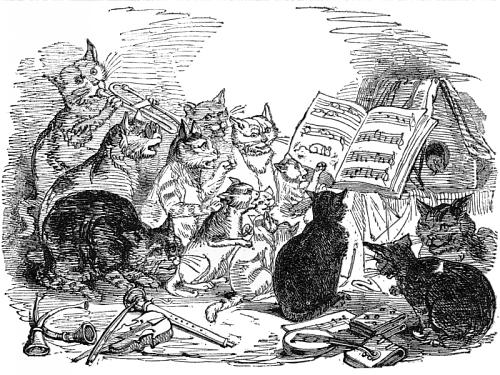
Leading a workshop can be like trying to get cats to sing in tune, but here are a few suggestions based on what worked and didn’t at the 2014 Mass Poetry Festival
Any teacher knows that a one hour window in which to teach does not actually involve a full hour’s useful time. If you’re lucky and you have dedicated learners, by the time you get everyone settled and have introduced the topic, you have maybe 50 minutes at best. I’m stating this up front, because I recognize how hard it is to fit everything you want to do and say into that kind of time constraint, and I value all the effort that goes into organizing a lesson, workshop, or conference session. It’s hard to do right, and of the three workshops I attended at the 2014 Mass Poetry Fest, two knocked it out of the park and one was fairly disappointing when it didn’t have to be.
What Doesn’t Work (because it’s always worth getting through those first)
1) Actual session activities don’t match what’s described in the festival program – Yes, between when you submit a conference proposal and when you give your presentation/lead your program, ideas can morph. But if your session description asks people to bring their own works in progress, and when you start the workshop you make no mention of that and work with writing prompts instead, you will confuse people even if they are willing to go with it. If you also fail to address anything else listed in the description beyond the vaguest overarching theme, you will end up with at least vaguely dissatisfied participants.
2) What you outline (promise) at the beginning of the session doesn’t happen – Even if you’ve changed your mind about what you want to do in your session, if you don’t follow through on your newly announced plan, your vaguely dissatisfied participants will end up disgruntled. If it’s important enough to you to look at everyone’s work during the session that you say you’ll do it, then actually do it. Otherwise, no matter what other interesting information you dispense, the people who get skipped over will feel like they’ve wasted their time.
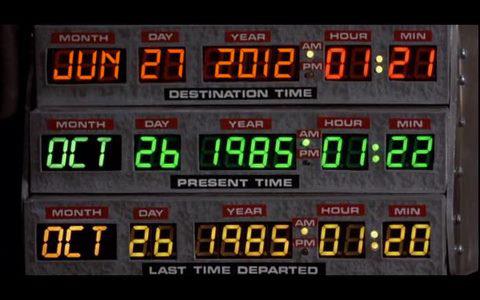
If you have a flying Delorean or a Time Turner or a TARDIS, I will take your workshop and not mind time management issues at all. Otherwise, make sure you have a timeline for yourself and stick to it as closely as you can.
3) Wasting time – Be realistic about how much you can get done in an hour, hour and a half, two hours. If you’re used to giving three day long intensive writing workshops, think back over how long your introductory activity takes, and that’s probably about as much as you can cover in this kind of time window.
4) Self-advertising – Not actually a terrible thing if you make your living as a writing coach or a consultant, so long as the session’s gone smoothly and you have a good sense of the temperature of the room. But if you’ve had issues with any of numbers 1-3, promoting your next course is likely to backfire.
What Works! (Yay!)
1) Group participation – Chances are good that most of the people in the room don’t know each other all that well, but a bunch of them likely do belong to writers’ groups and are familiar with both reading their work aloud and collaborative writing prompts. If you don’t have time to have everyone read, that’s fine and people won’t expect it unless you tell them they will, but a writing exercise as simple as Exquisite Corpse works great as an icebreaker. And it makes everyone feel included without taking any more time than you might have given to any other writing prompt, sometimes with bonus hilarious results.
2) Handouts – Seems pretty common sense, but if you’re referencing a bunch of works, poems or otherwise, having at least a bibliography and at best a set of full text, along with whatever prompts or resources you’re using in your presentation. It frees people up from stressing about taking notes, so they can pay more attention to what you’re saying and really take it in. Plus it’s helpful when they want to go back and reflect after. I’m really looking forward to reading carefully through the poems provided by Elisabeth Horowitz in the intensely enjoyable “Writing the Sea.”
Bonus suggestion: I used to make sure I had ’emergency sugar’ in my desk when I had tired afternoon seventh graders in my classes. Stick with stuff that’s free of the most likely allergens (or with caffeine) and your audience will perk right up.
3) Spare paper and pens – Okay, at a writers’ event, this may be superfluous. But notebooks fill and pens run out of ink, so having extras makes you look sweet and thoughtful. Because you are!
4) Personal touch – Best practices and survey data and such are useful, but the reassurance of a personal success story shouldn’t be undervalued. And admitting where things went wrong is as interesting and useful as the list of things that went right along the way.
5) Interesting, diverse writing prompts and/or discussion questions – Form, theme, vocabulary, cultural context – there are so many options for cool prompts, and even mixing up the general (‘rivers’) with the specific (line beginnings and ends must match) can lead to really interesting variation that makes people think fast and write fast and be more willing to share, in general, than the things they’ve slaved over and have more invested in. And it’s not all about the writing either – time for questions is equally important!
Homework is way more fun when you are only being graded by your inner editor.
6) Homework assignments – In the corporate world, these are called ‘action items,’ but the point stands: especially if you’re leading a session on practicalities or logistics, like Susan Rich’s excellent session this weekend on “From Manuscript into Book: Demystifying the Process,” giving participants ideas on what next steps they can be taking once the session is over is great. I have a number of ‘assignments’ to add to my running to-do lists thanks to Susan, and I’m actually really looking forward to it. Who knew a task like ‘list the titles of the poems you know you still need to write’ would be such a spur to creativity?
Have you attended any particularly good (or regrettable) conference/festival sessions? Any helpful hints to share in the comments? Please do!
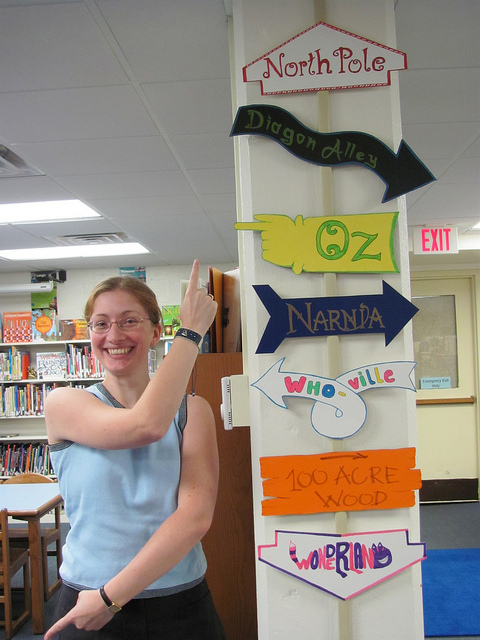
Library directionals, designed and created by Kathleen and Meg Winikates, 2012
What is it about a place that grabs hold of the imagination? Is there some magical combination of language and association and vista and memory that makes a place ‘real’? Is one city the same to different people and are we the same person in one city as we are somewhere else? Just what do we get when we gaze out over the water, anyway?
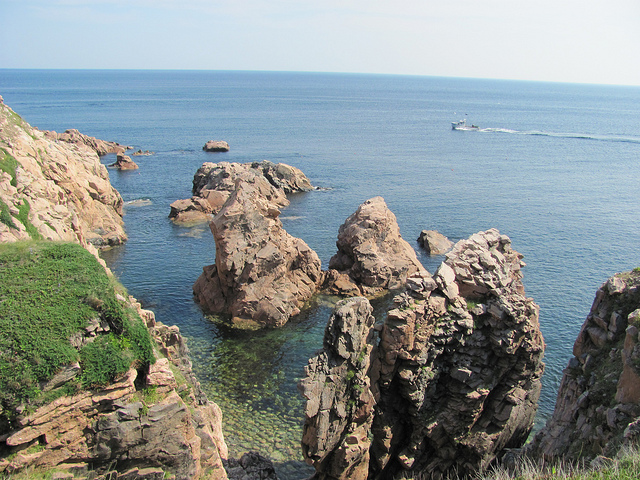
White Point, Cape Breton, by Kathleen Winikates, 2013
Two different sessions I attended at this year’s Mass Poetry Fest dealt with the themes of people in places – the reading “Poetry of Place,” with poets Cammy Thomas, Julia Lisella, Theodora Stratis, and Rosamond Zimmerman, and “Writing the Sea: Poetry of the New England Coast” with poet/professor Elisabeth Weiss Horowitz. They were both incredibly thought provoking in their own ways.
This is the place. Stand still, my steed,
Let me review the scene,
And summon from the shadowy Past
The forms that once have been.
The Past and Present here unite
Beneath Time’s flowing tide,
Like footprints hidden by a brook,
But seen on either side.
– Henry Wadsworth Longfellow, “A Gleam of Sunshine” (excerpt)
“Poetry of Place” featured a lot of different ways to think about how we locate ourselves. The poets involved offered readings of their own poems that dealt with place as a way to connect to memory, to family, to the present, to a collective cultural heritage, to the structures we inhabit, and even to the boundaries of our own physical bodies.
Are you still yourself in a leopard’s skin?
How does living abroad change the way you see your home and your relationship to it?
Why is New England different from New York, and why are our pasts so much more present here?
Can the paper of a poem be a place, with poems nested within each other? (Admittedly, that last one required some brain bending on my part, but that’s what this kind of event is good for, and using color to identify an inner poem within the overarching poem was a neat experiment.)
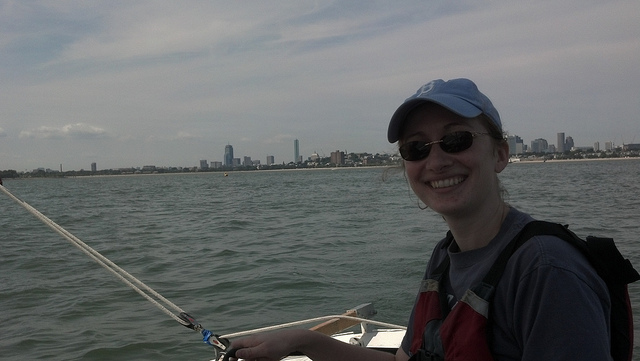
Sailing in Boston Harbor, photo by Kathleen Winikates, 2012
This session made me think a lot about the grounding I get from living here in Massachusetts, only an hour’s drive or so from where I grew up. I’ve always been a Boston Girl, but why is that? As I’ve been rereading and organizing my poetry for a project, the prominence of place has grown pretty evident, as I was writing about it even when I wasn’t thinking about it consciously. I’m looking forward to going back into some of those poems to think harder about why where they are and where I am is so important.
“Writing the Sea” was definitely the most immediately effective at getting me to put pen to paper. I’ve always been drawn to water (*squints at blog title*), and Horowitz assembled an impressive array of historical and contemporary examples of poets inspired by stints along one New England shore line or another, including riverbanks and lake sides as well as ocean beaches. I’ll breakdown why this was such an effective workshop in my next post, but it certainly helped that she maintained an excellent balance between highlighting particular lines, themes, and commonalities within and among the poems with a set of great writing prompts. Even the simplest instruction to write a word bank of as many water-related words as we could, from any discipline, led to my dredging up words I haven’t used since I worked at the New England Aquarium. Some of them have a lot of evocative possibility: “pelagic,” “phytoplankton,” “undertow.”
One of my favorite prompts was inspired by an Inuit form of poetry, in which the last word of the line becomes the first word of the next, and we were asked to write a flowing poem about rivers in a handful of minutes. This is my attempt, though in a second draft I think it would need more actual focus on the water as well:
On the Charles
I haul on the mainsail sheet,
the sheet that shivers in my hands,
these hands that rein the wind
winding through my city.
City buildings soaring high
and higher above their echoes,
echoing in slices under my hull.
Hull cupping me as I brace
the bracing wind, balanced on the mainsail.
Do you have a favorite poem that is grounded in a particular place? Please share in the comments below, I’m always looking for the next great read!
If you follow me on Twitter, you know I spent the past weekend in a whirlwind of poetry and art during the Mass Poetry Festival. It’s my fourth year attending the festival, and the third I’ve been in charge of running family friendly activities that stand at the intersection of the visual and verbal arts. Each year it’s been an interesting challenge to balance my role as a museum educator with my interests as a writer, but I always end the weekend inspired. This year was no different.
As with any good conference, I ended up with days’ worth of things to think about out of a few packed hours, so my next few posts will be reactions to some of the sessions I attended, but I thought I’d start by sharing some favorite moments from select readings I heard.
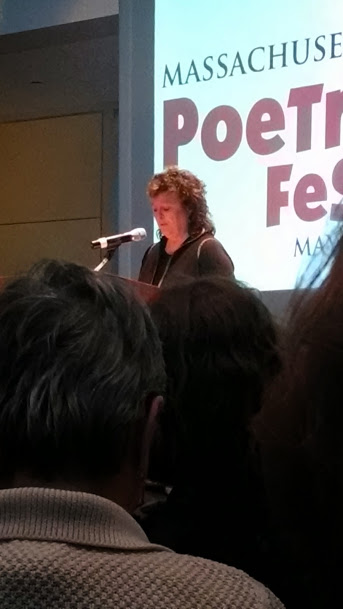
Carol Ann Duffy at Mass Poetry Fest 2014
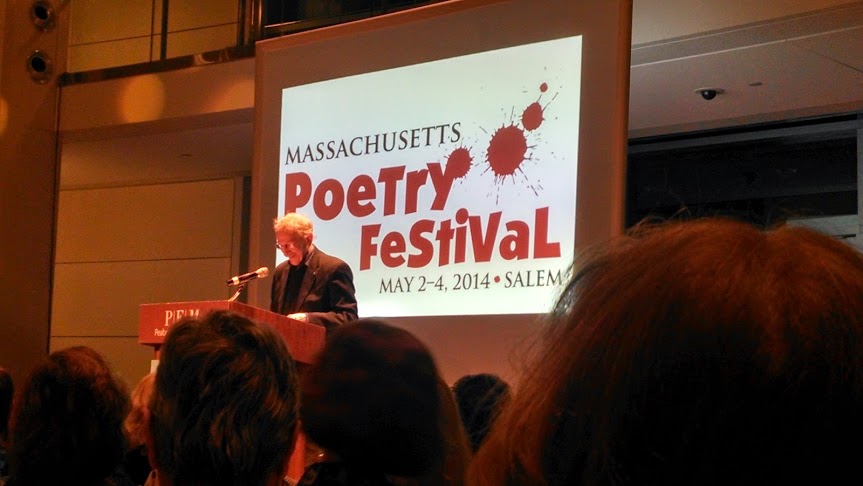
Friday’s headline reading, with Carol Ann Duffy, Phillip Levine, and Heather Treseler was amazing. There was a packed house in PEM’s Atrium, with lots of great energy, and the readings were fantastic. I’ve been an admirer of Carol Ann Duffy since first reading some of her work when she was named the British Poet Laureate, so I expected to enjoy her pieces, but Phillip Levine was a pleasant surprise–I’ve never thought that his poems had a lot to say to me, but there were a few he read that won me over, as did his manner and humor from the podium. I’ve linked to two of my favorite poems I heard that night below:
Phillip Levine’s “Gospel” (Source of the lovely quote used in the post title above!)
Carol Ann Duffy’s “Mrs. Midas” (Brought the whole atrium to a sort of rueful laughter)
Phillip Levine at Mass Poetry Fest 2014
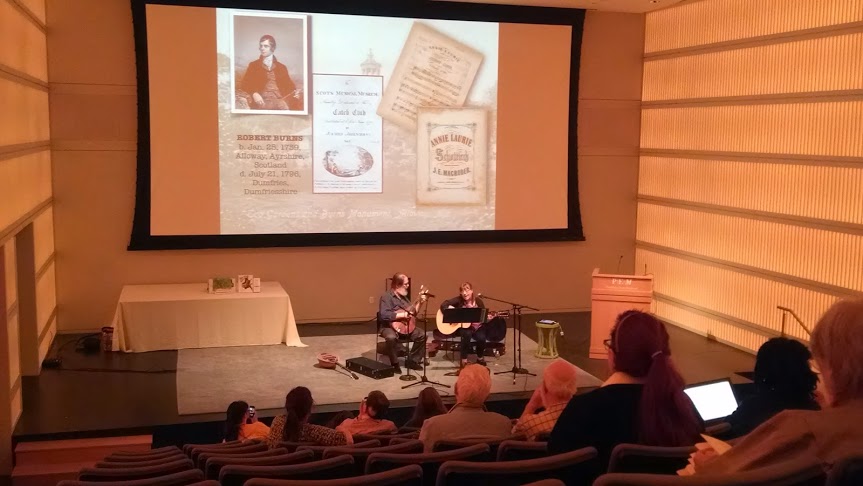
And though I unfortunately didn’t get to hear the entire session as I was about to be running a haiku story time of my own, I really enjoyed the “Celtic Songs” selections read and sung by Jim and Maggi Dalton. They invited audience participation (always an interesting risk!), and had I had a little more time, I would have read this one:
The part of the session I heard was heavy on the Robbie Burns–never a bad choice when one is talking about Celtic poetry and song, and I was amazed and impressed by the sheer volume of instruments the two of them were able to play. Made me want to pick up my flute again!
Jim and Maggi Dalton perform a selection of Celtic music and poetry at Mass Poetry Fest 2014
Still to come: thoughts on ‘poetry of place,’ the connections between poets and water, art installation as breathing space, demystifying the book making process, and what makes for a frustrating or successful workshop experience in this kind of setting!






 Sea Dreams and Time Machines