
Uncategorized

What felicity! A day to speak like Miss Austen

“Our family are great Novel-readers and not ashamed of being so.” Jane Austen, Letter to Cassandra, 1798

It is a truth universally acknowledged within my sphere of close acquaintance that I may find relationships between the works of Miss Jane Austen and daily life at the smallest opportunity or provocation.  Therefore I encourage you to consider with what delight I greeted the idea of celebrating the day of my birth with an Austen themed party, only to discover that the chosen day corresponded perfectly with “Talk Like Jane Austen Day,” this Saturday the 30th of October.

Cassandra Austen (1773-1845). Portrait of Jane Austen (c. 1810). Watercolor and pencil. National Portrait Gallery, London: NPG 3630

If you choose to follow the link I have provided above, you will arrive at a page describing the intent of the event and several helpful suggestions as to grammar and vocabulary.  For your further edification and delight I have compiled a few other destinations you may seek out at your leisure:

Take Back Halloween: Jane Austen — It is my belief that Miss Austen would approve of the efforts of these enterprising women, who seek to offer the costume-deprived with more interesting and intellectual alternatives to the ubiquitous ‘Sexy ____’ costumes for women.

Jane Austen’s World — I must list this as among my favorites of the plenitude of blogs available discussing the life, times, and works of the great Miss Austen.

Austen Films Underestimate Her Heroines — Here is truth indeed!  I readily admit that I have often claimed Mansfield Park as my least favorite of Miss Austen’s works, but this critic has convinced me that I ought to look beyond my ‘first impressions’ and give Fanny Price another chance to demonstrate her worth.

And so on the occasion of my birthday, what has the lady herself to say?

It sometimes happens that a woman is handsomer at twenty-nine than she was ten years before.
Jane Austen, Persuasion

And as I shall be but eight and twenty, it seems I have yet much to anticipate.  Thank you, Miss Austen.  That is a great comfort. 

Uncategorized

Fun and Interesting Writers on Writing

Lots of people who write like to write about writing.  Oftentimes what they say is contradictory, sometimes it’s too obvious to be truly useful, and yet occasionally you come across things which are genuinely interesting, entertaining, and elucidating.  Here are a few I’ve come across recently:

Scott Adams, creator of Dilbert, on “How to Write like a Cartoonist,” breaks down some of the basic elements of writing humor.

I have long loved Patricia C. Wrede’s novels, and her blog often has really interesting posts on elements of the writing process.  One of my favorites so far was on the difficulty of multi-person point of view and big complicated stories: “Complicated Webs”

The bloggers over at Writers’ Digest also can offer up interesting nuggets (assuming one doesn’t mind the plugs for the books available through the WD shop, etc.)  One post which  encapsulated one of the problems I had with Rick Riordan’s newest book, The Red Pyramid, was “The Biggest Bad Advice about Story Openings,” pointing out the weaknesses in the old advice ‘Start with action.’

Portrait of Chaucer by Thomas Hoccleve in the Regiment of Princes (1412). Click for link

And for sheer geeky writer glee, I must pass along the link which a fellow writer friend shared recently: Geoffrey Chaucer Hath a Blog.  It’s written in Middle English (with a few modern adaptations) and is several levels of hilarious, if you’re anything like me (By which I mean ‘spent a whole semester reading almost nothing but medieval romances and the like.’  An understandably small percentage of you, I’m guessing).

Uncategorized

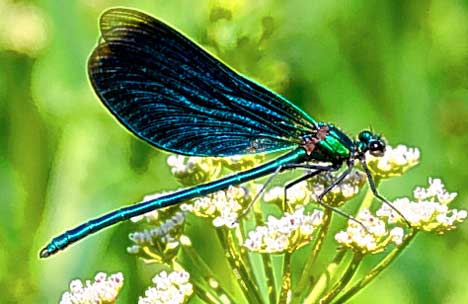
Dragonfly Summer

It’s a dragonfly summer, all red, blue and green,
All sizes dart fast and crouch still.
Hundreds more dragons than ever I’ve seen,
Blithe masters of aerial skill.

It’s a dragonfly summer, big-eyed and lean,
Rainswept and sunbaked by turn,
But prism-bright dragons on fencepost and tree
seem to preach a creed we’ve yet to learn.

Cruise when you can and rest where you may,
And hover a while, just for fun.
Winds fall and rise and directions will change–
In the end there is only the sun

Of a dragonfly summer and its flash of four wings
and the zip-sliding, slow-gliding of time,
Of emeralds and rubies, sapphire gleams–
Deep-dreaming, eternal, sublime.

Uncategorized

A More Interesting Author Interview

One of the things I find frustrating when reading or listening to interviews with artists, illustrators, authors, actors, etc. is that so many times the questions are cookie-cutter in their predictability and thus so are many of the answers. If you’re looking for a fun take on interviews with authors, check out Questions That Authors Are Never Asked for some fun conversation.

Uncategorized

Reflection I

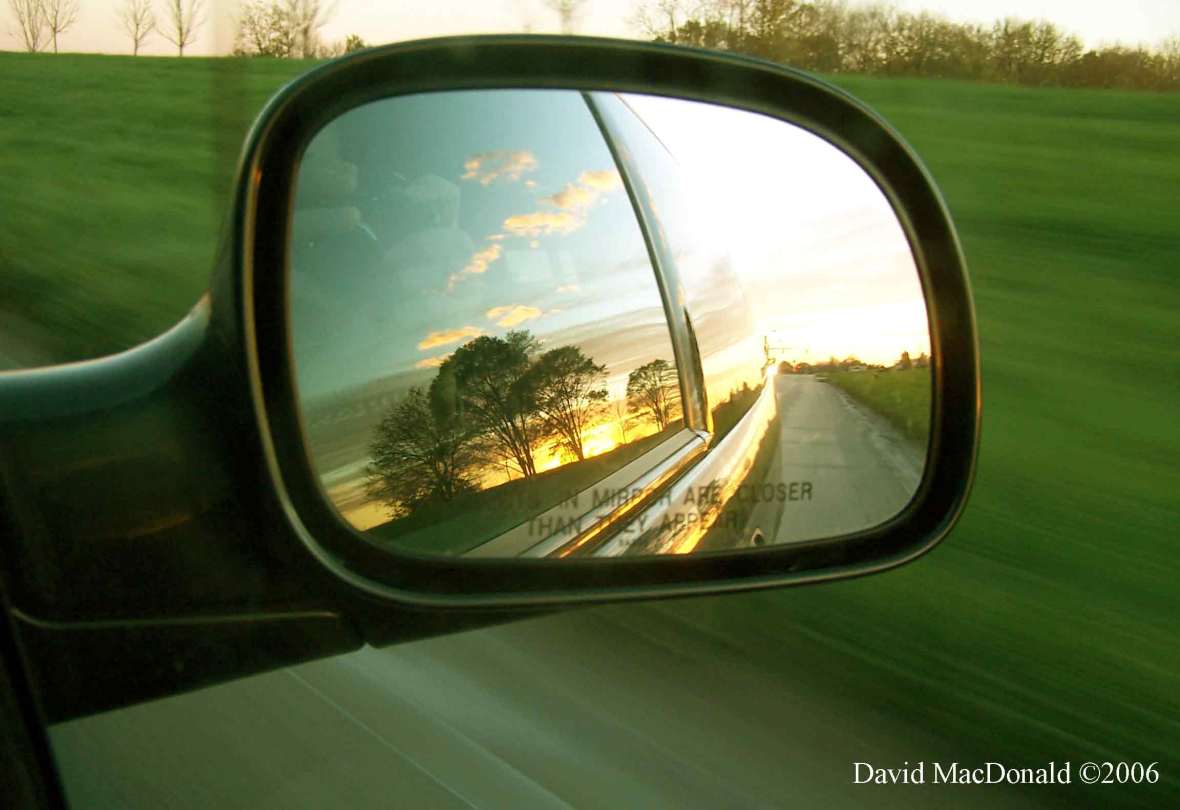
Photo by David MacDonald. Click for link to his site.

Reflection I

In a mass of metal, moving.  Moving
fast and slow along a worn black ribbon,
worn and wondering on words all born from ‘drive.’
Through glass, blue sky and clouds are breezing by
inviting fresh-brewed castles in the air.
A flash of dream is trapped in mirrored glass,
trees’ shadows caught by window, then by chrome.
Reflection of reflection, distance born
of two pale degrees of separation–
Sky-high freedoms bound in rearview’s plastic scope.
Yet the universe’s words of hope show clear:
“Objects in mirror are closer than they appear.”

-Meg Winikates, 12/09

Uncategorized

One of those words I’ll gladly appropriate

I love words that have unique sounds (and no, that doesn’t mean I dislike homophones, I just really love words that are fun to say).  I have a whole collection of them, in fact, but this one turned up in my inbox this morning and I decided I had to share.

Definition and quotes courtesy of Anu Garg over at A Word A Day

steenth

MEANING:

adjective:
1. Latest in an indefinitely long sequence.
2. One sixteenth.

ETYMOLOGY:

Alteration of the word sixteenth.

NOTES:

The formation of the word “steenth” from “sixteenth” took place through a process called aphesis (from Greek, literally “a letting go”). Aphesis is when an unstressed sound from the beginning of a word get lost over time. Some other examples are:
“cute” from “acute”
“’tis” from “it is”
“gypsy” from “Egyptian”, from the belief that Gypsies came from Egypt (they actually came from India).USAGE:

“And for the steenth time I wondered why he hadn’t phoned me.”
Robert A. Heinlein; The Cat Who Walks Through Walls; Putnam Publishing; 1985.

A THOUGHT FOR TODAY:

The highest result of education is tolerance. -Helen Keller, author and lecturer (1880-1968)

Uncategorized

Ravel(ing)

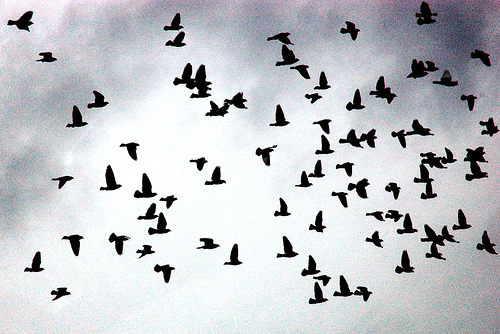
Photo Credit: Picture Perfect Pose

Above my car, forty seabirds wheel and arc
in time with Ravel’s swooping Barque
sur l’Ocean

as if they too can hear it pouring from my
radio into the frigid winter sky.

It is the most freedom I have ever felt
sitting at a stoplight.

(2/12/10)

Uncategorized

Autumn Love

Holly in Autumn
Holly in Autumn, by Meg Winikates, 2009

Utter Love
by Meg Winikates
December, 2005

I am in utter-love
With autumn light
In love with the air
That burns each golden
Leaf to crisply glowing shards
Of jagged sunlight.

I am in blue-deep love
With the belly laugh of
Autumn wind
In love with the tickling
Gusts of sharp amusement
Teasing hair and clothing into dance.

I am in rawboned love
With rosy boughs
Of baring trees, blushing
In the bright regard
Of afternoon, flaunting burnished
Colors to the whirling, yearning sky.

Uncategorized

Happy National Day on Writing

Yes, technically November is NaNoWriMo, which continues to look like a bad idea when one is working full time and taking two grad school classes.  However, for those of us with the spirit but also the time crunch, today is the first ever National Day on Writing, hosted by NCTE (Nat’l Council for Teachers of English), and signed into officialdom by a Senate resolution.

Educational Brick Letter W letter R letter I t45 letter e

The website, hosted by NCTE, invites you to submit your writing to a National Gallery of Writing, and also participate in the day-long webcast led by various authors, etc.   They’re also running all kinds of commentary, re-tweets, etc. on writing through Twitter, under #ndw.  I think this is all very cool–I just wish I had known about it sooner!  The first I heard of it was this morning, when I got my daily BU email, talking about all the cool writing-related activities going on at the student union. So I went and did a little digging.

Curiously, the mission statement on the NDW homepage reads:

Established by NCTE, the National Gallery and the National Day

  • highlight the remarkable variety of writing we engage in today;
  • provide a collection for research on whether writing today has risen to new highs or sunk to new lows; and
  • help us help others to write better.

I find this an odd assortment of goals.  Encourage people to enjoy writing? Showcase the many uses and forms and beauties of the written word?   Spread the word about ways to improve your writing?  Generally support the practitioners of what has often been deemed a ‘solitary craft?’  Great!  All good stuff.

But…provide a collection for research on whether writing today has risen to new highs or sunk to new lows?  This makes my critical-thinker’s brain sit up and say ‘really?’   Compared to what and when?  Are we looking at word-length, acceptable use of grammar, flights of metaphor and allusion, variety of vocabulary and reasonable spelling?  Logic, support, and originality?  Are we seriously looking at the efforts of a bunch of random people on the internet as compared to the letters of John and Abigail Adams?  As I didn’t see anything else related to that particular goal on the site, I’m just going to hope that the NCTE knows what it’s doing.  Certainly the proliferation of LOLspeak iz srsly scary, if also occasionally amusing.

And so, despite my intellectual question marks of the above paragraph, I am thrilled to see a day in celebration of writing.  Therefore, I say: Go forth!  Put pen to paper or fingers to keyboard or marker to whiteboard or pencil to post it note or stylus to clay tablet!  (No, seriously, why not?)  Twitter a haiku, send a letter to an old friend, drop some Shakespeare into your next staff bulletin.  Revel in the ridiculous rules of language, break a few, read a book, share some really really bad puns.  It’s the write thing to do.  😉

Uncategorized

Origins

photo credit to gnotalex

Origins
By Meg Winikates, April 2009

I love to guess the origins of myths,
say, ‘man stands under tree in thunderstorm,’
becomes ‘by the wild wrath of gods punished’
when lightning-struck, his grave unearthly warm.

Or, perhaps, a wailing waterfall
contains the tears of a heartbroken bride,
kept from her love across a chasm caused
by family rifts which rent the earth so wide.

For how else to explain a shooting star,
a face of stone, or two trees grown as one?
Why choose to see things as they are
if faith or fairy dust makes life more fun?

I’ll still give science preference by day–
but in the wilder hours let dreams hold sway.