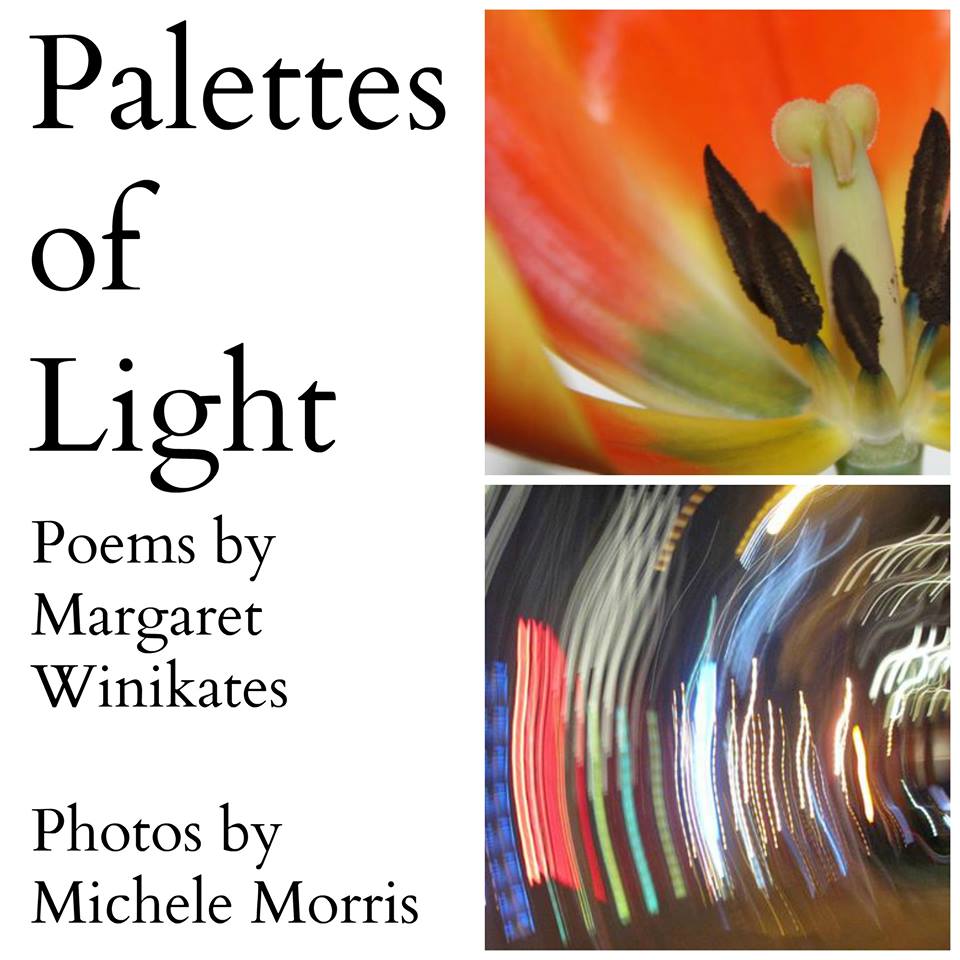
Last spring, I had a very intriguing conversation with my cousin, photographer and producer Michele Morris. She was looking to put together a book of her photography and wanted to give it some extra spice–preferably with poetry. Out of that conversation grew a number of ideas, several of which coalesced into our collaborative project, Palettes of Light. (You may have seen me talking about this project elsewhere, if so, sorry for the repetition! I’m working on this multi-platform social media balancing act.)
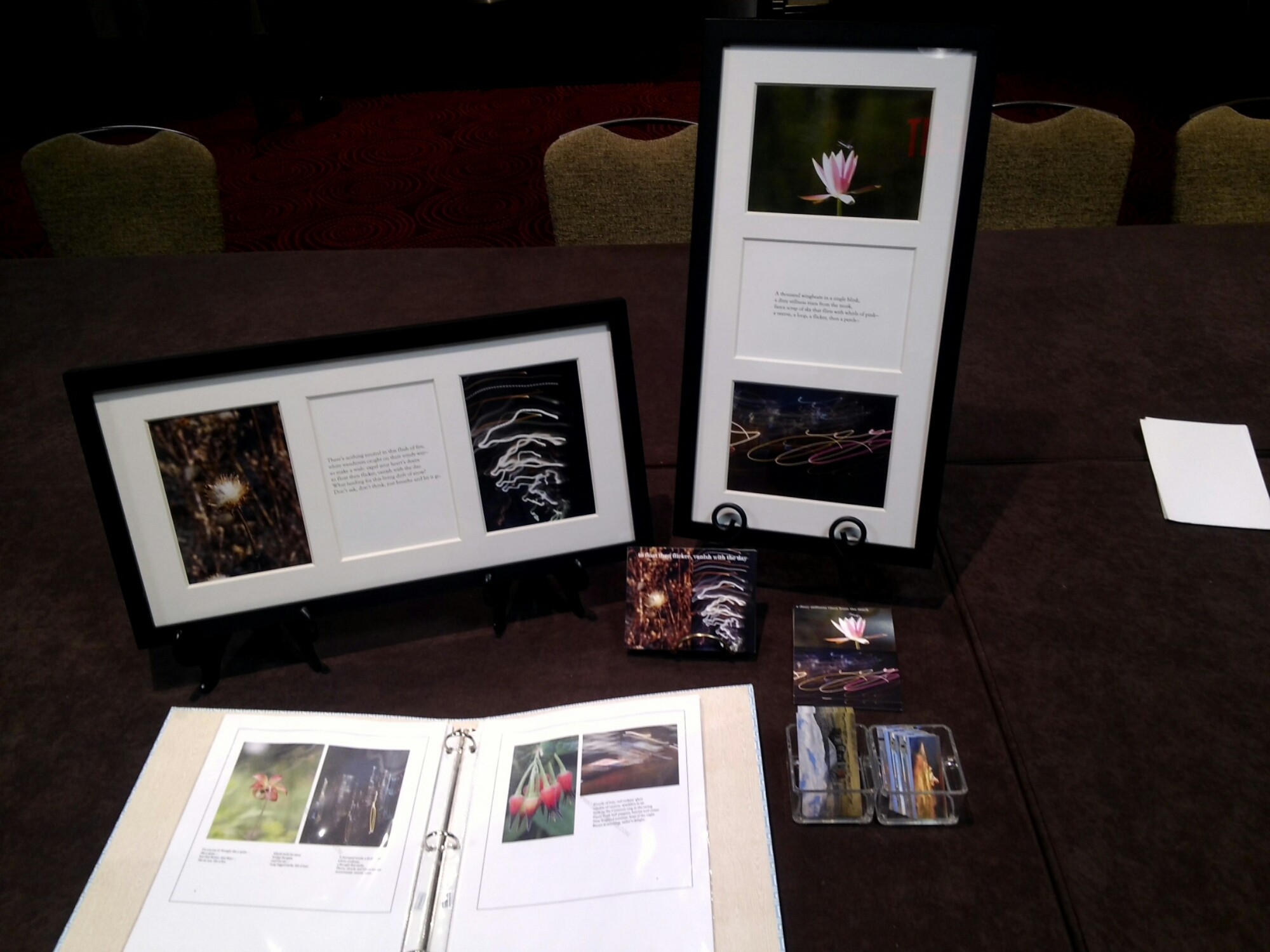
This project pairs Michele’s photos from two very different photography series based on colors, moods, and motion, and then incorporates my poetry as a way to tie the two together and provide a different way of looking at them individually. So far, one of our triptychs has been part of the Venice Arts 21st Anniversary gala show, and we’re working hard on finalizing the book’s layout.
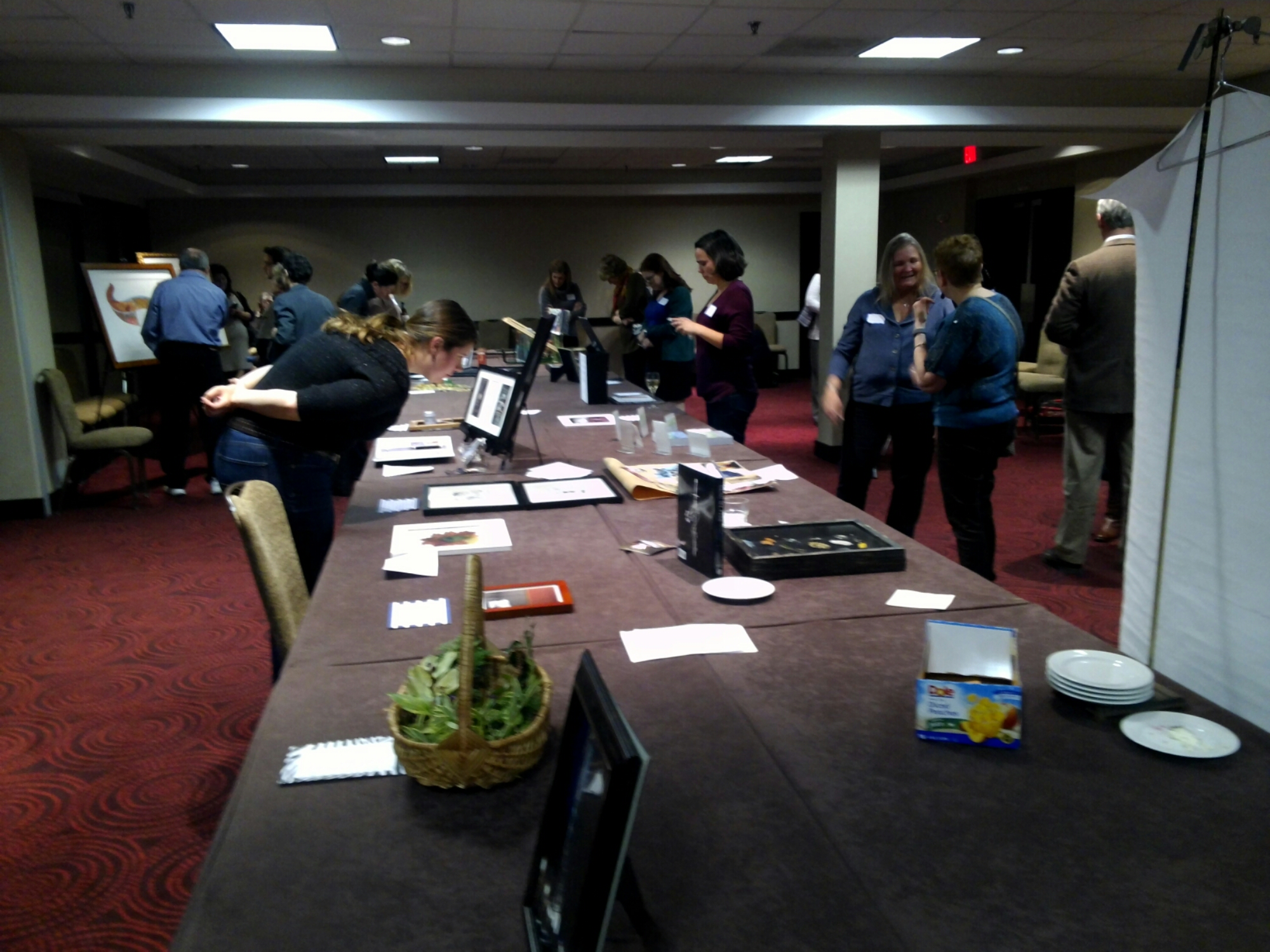
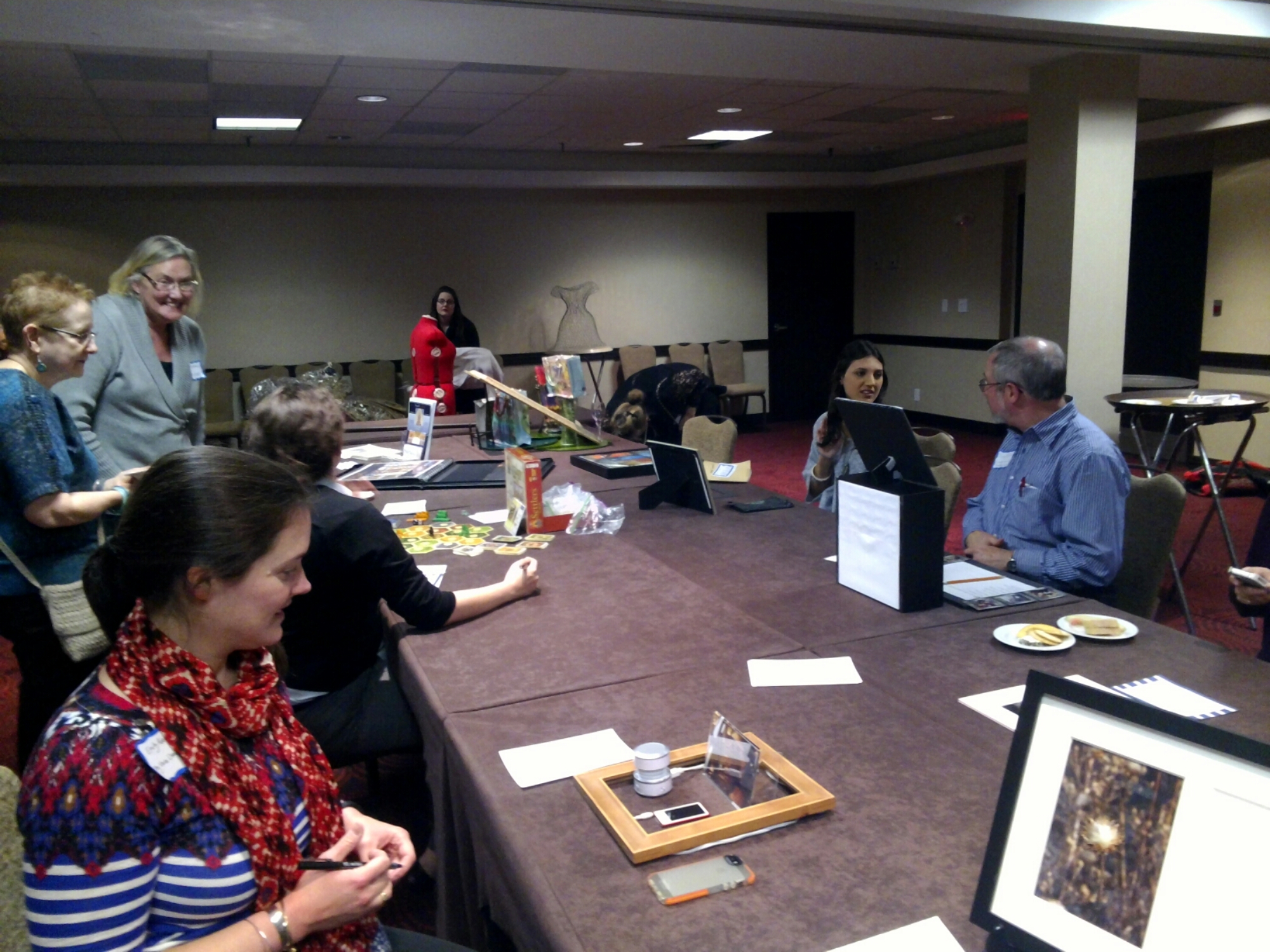
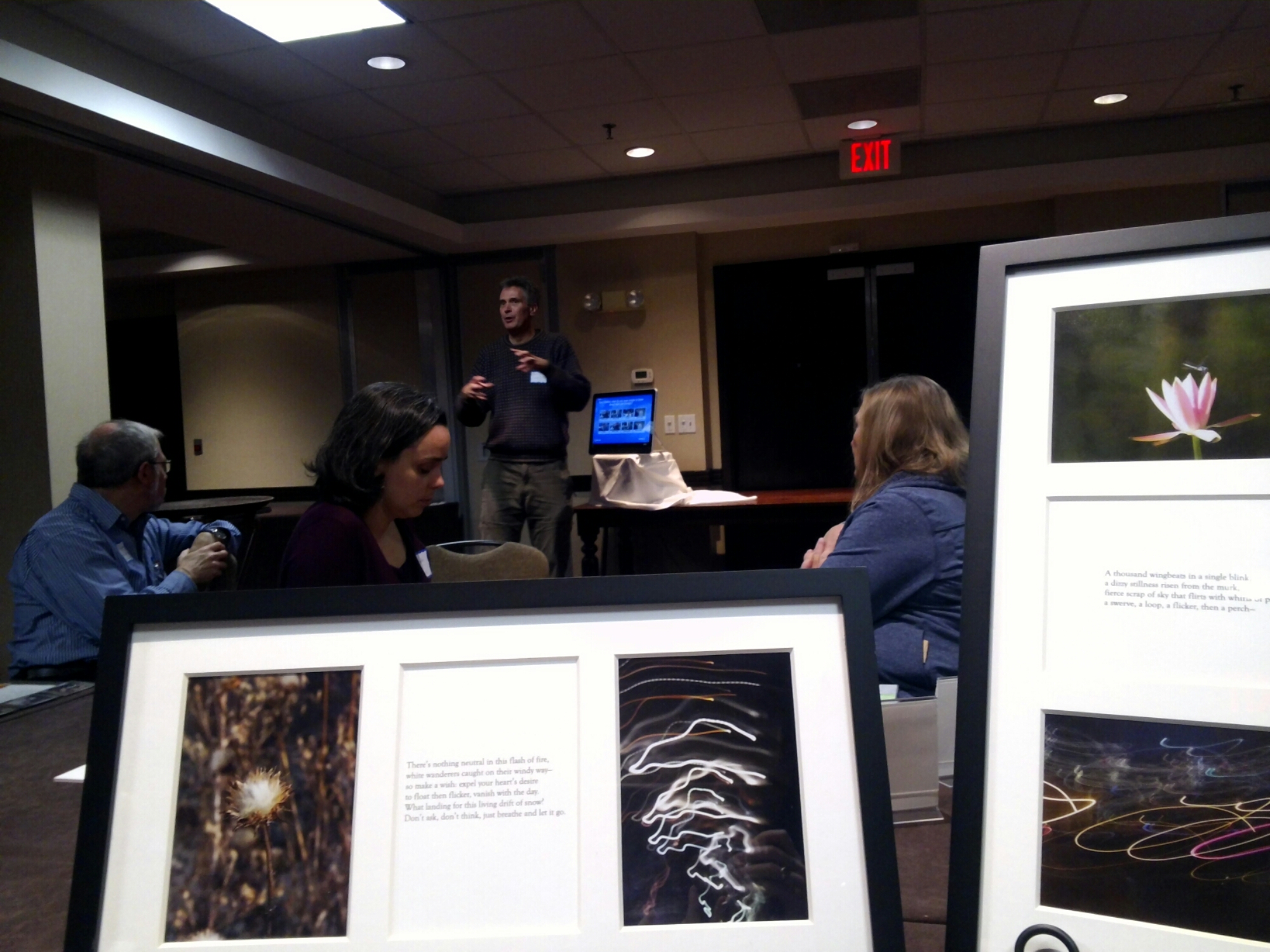
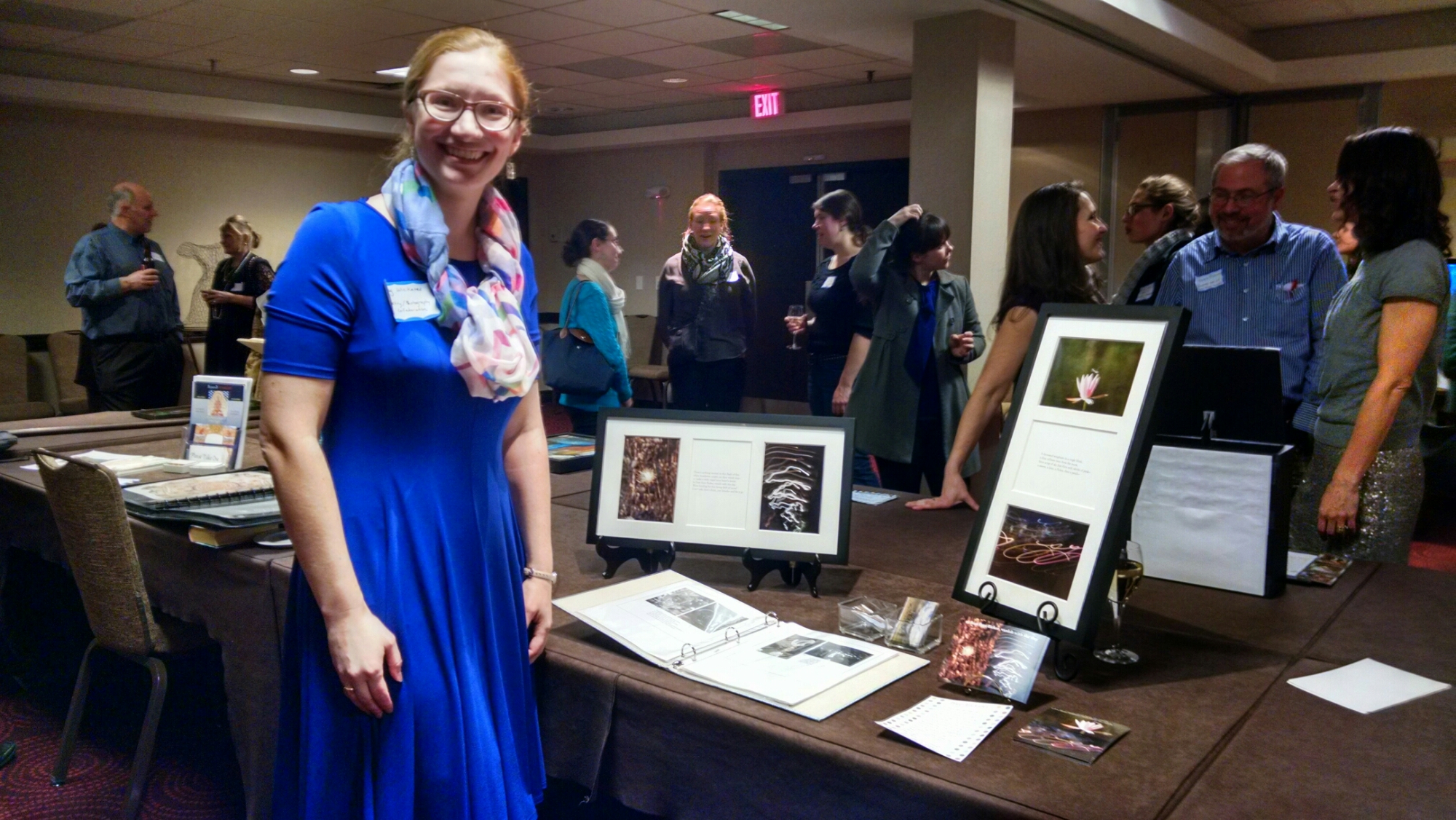
I also got to play a little ‘show and tell’ about Palettes of Light at the New England Museum Association’s ‘Pop-Up Museum’ event last night. I’ll be posting about the Pop-Up Museum experience as a museum/education thing over on Brain Popcorn, but I wanted to get to do the author/poet geeking out here.
It was a real pleasure to get to see all the creative means of expression people brought with them: everything from a collection of Bond novels to Settlers of Cataan, from knitted handwarmers to a fully authentic 18th century dress and undergarments, from photography to painting to a playlist of radio and exhibition voiceovers. In such an eclectic mix, a pairing of photography and poetry fit right in, and it was fun to toast to the submission process with a painter, to talk haiku cycles with an interactive media designer, and to discuss dramatic diction with a science museum staffer. And, of course, to share Palettes of Light with people, which was really gratifying.
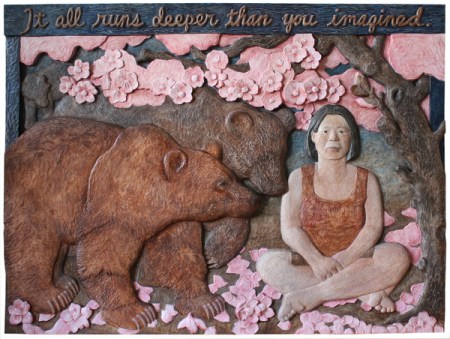
Deeper Than You Imagined, by Sachiko Akiyama (featured artist in Branching Out), click for source.
If any of you follow my museum education blog, Brain Popcorn, you’ll know I’ve been working on a show that opened just a few weeks ago called Branching Out: Trees as Art. In the course of researching for that show, I was introduced to the work of Suzanne Simard, a forester who works with tree root/fungal networks, which form an underground communication chain between trees of all ages and species in a forest. Her research inspired me to write a speculative flash fiction story which has now been published on PEM’s blog, Connected.
Many thanks to Rinat Harel for inviting me to join in on this wide-ranging blog tour! I met Rinat through our Davis Square writers’ group, and was immediately impressed by the poetic intensity of her work, even though I have only read examples of her prose pieces. They are always gripping–and generally quite eye-opening, since Rinat is often inspired by events and experiences that are far outside my own. So if you’ve come here from there, welcome, and if you haven’t read any of her stuff, do go check it out at the link above.
As is the way of this particular stroll through the writers’ blog-garden, there are several questions we’re all answering, and then I get to pass you along to one or more other writers I know and admire, so here we go!
My desk, which currently features everything from dip-pens and paint brushes to a TARDIS topped pencil and dueling computers. (And a Death Star mousepad, because who doesn’t need one of those?)
What are you working on?
Whoo, baby, that’s a more exciting question than usual! There are two computers on my desk at the moment because I’ve been Skyping while typing like mad with my creative partner in LA, Michele Morris, with whom I’m working on a manuscript for a book of paired photography and poems, called Palettes of Light. One of our pairings from the book is a piece in the Venice Arts 21st gala show as a beautifully framed triptych, so I’ve been putting a lot of work into that manuscript and all the logistical wahoo that goes with launching a piece of your work publicly. (More on that in an upcoming post!)
Squeezed into the interstices of working on that poetry project there are a few other things, chief among which is Dragon’s Midwife, a ecological time travel dragon-inhabited adventure starring Erin, an admitted fantasy nut and mythology nerd. She is doing a summer internship in a tiny Welsh historical society, climbs through a cave in a cliff and ends up in the 1740s at the feet of a dying woman and a pregnant dragon. She’s pretty good with dragonlore, fairly fuzzy on historically accurate details, and her woodcraft is nonexistent, so ending up in a place without her cell phone or a ready supply of Cadbury’s bars is not her cup of tea. Hijinks ensue, naturally.
And, of course, I’m lining up my ducks to figure out what I have available and appropriate for the next round of poetry and short story submission deadlines, and tweaking where necessary.
How does your work differ from others of its genre?
I’ve never thought this was a fair or easy question. (Genres exist for a reason!) There are writers I admire and hope something of what works in their writing appears in mine, for sure. Like many of the writers I like to read, I enjoy mixing my favorite elements from a lot of genres. I love reading mysteries, fantasies, sci-fi, historical fiction–and some of my very favorite new discoveries in the last few years have been the gaslight fantasies, worlds of Regency era history reinterpreted through a magical lens, etc.
But to attempt to answer the question–unlike some others who write fantasy/sci-fi/historical/adventures and poetry, I write
absolutely nothing involving zombies or vampires. Nothing I write in that vein could ever be as terrifying as Lloyd Alexander’s Cauldron Born, and I’m not in the habit of giving myself nightmares anyway if I can avoid it. So no undead.
a hint of old wild magic in just about everything. I can’t write pure sci-fi. I’ve tried. Even the stuff that involves hard science grown directly out of things that are current research ends up with a touch of implied magic.
a close connection to the environment. Partly a product of spending so much time up trees in the backyard as a kid, partly due to being raised in National Parks (thanks, parents!), partly due to my current job, I’m really aware of the natural world. It is most apparent in my poetry, but I think it works its way into my prose as well, even when that’s not the main point of the piece.
happy endings. There’s a lot of grimdark apocalyptic or post-apocalyptic stories out there right now. Mine aren’t. The closest I get to an unhappy ending is an ambiguous one.
Why do you write what you do?
Like the icon says, the world is full of (and my brain is full of) too many stories not to try to put a few down on paper, digital or otherwise. I actually get a kind of itchy feeling around the edges of my brain if I haven’t been writing for a while, which is the writing equivalent of getting cranky if one hasn’t gotten enough physical exercise. I write because I love words, because I experience the world through story, because sometimes iambic pentameter is the only way to bottle up that explosive thing under one’s sternum and release it into the world.
Why write fantasy/sci-fi/historical/adventures? Because they’re fun, and all those authors that say ‘write the books you want to read’ are totally right.
Why write poetry? Because I’m better at it than at painting or sculpture, which are the only other art-forms I can think of that express as much emotional ‘oomph’ in as compressed a fashion.
How does your writing process work?
It evolves like a virus. 🙂
Seriously, though, I’ve tried a number of different methods, and what works well for one project doesn’t always help me on another.
With poetry, I always write with pen/pencil and paper. I can’t write poetry on a screen. It all comes out boring and trite. There’s something important about the rhythm of the words and the motion of the hand across the page and the reduced speed that all works together. It’s hard to be contemplative looking at a blinking cursor, but a blank page just looks inviting by comparison. I make sure I always have a pocket-sized notebook and a pen with me. (This usually leads to a pile of pens at the bottom of whatever bag I’m carrying, but fortunately they’re not heavy.)
Prose is more varied. For some stories it helps to try to flesh out the characters a bunch in advance, using some of those profiling prompts one can find online. For others I fill them in as I go along and discover things about the character along the way. Plotting I keep really general, and often end up moving scenes around to try to figure out pacing and character development. It’s more fun to write if I know where it’s going but not precisely how we get there, and I hope to fix it and smooth it out after. Sometimes I have a character just waiting for a story that fits him or her, and they can wait for years. Sometimes I have a great concept for a world, but don’t know who lives in it or what throws them into enough peril for there to be a story. That too can take a while to unravel. I have a lot of filled-up notebooks, and because I suffer a little from what I call ‘crafter’s ADD,’ notes about one project will be on the opposite side of a page that has a whole scene from an entirely different story, and then there’s a poem on the facing page and the scene picks up on it’s reverse. On the off chance anyone but myself ever attempts to read some of these notebooks, I pity them in advance.
The thing I’ve found best recently to keep the writing process moving is breaking up tasks and goals into manageable chunks and making to do lists with deadlines. I write them out on paper and tape them to my front door so I can see them all the time, and I transfer the most immediate (within a month) into my Evernote so I can get at them from anywhere. I take great satisfaction in using leftover reward stickers from my teaching days to fill up the pages with little ‘Great!’ and smiley face stars and whatnot, because visible progress can be hard to come by, and this is the way that works for me.
So now I tag other writers:
The charming Charlie Cochrane and I met through a shared love of the age of sail (especially Horatio Hornblower), the creations of Dorothy Sayers, and history in general. Charlie writes witty, gracious romances and mysteries that are a touch silly, a touch sweet, and a touch sad, and full of great period-accurate detail and feeling. She has numerous novels based on her two best known characters, the irrepressible Jonty and the awkward but endearing Orlando, and has written a number of fun and varied shorts as well, including ‘gay werewolves – albeit highly respectable ones.’ (If I remember right, at least one of them is a librarian.) So you may expect her writing process post next week, but I highly recommend that you swing by and check out what she already has on offer, including a series of interesting posts tied in with the centennial remembrance of the beginning of World War I.
And since I want you all to go visit Charlie’s blog and read her stories, I’m not tagging anyone else. I will, however, point out that author Patricia C. Wrede has an incomparable blog focused entirely on the writing process, and she though she herself writes mainly fantasy, her thoughts and suggestions about writing are useful no matter what genre. So if you’re looking for more cool process stuff, go there too.
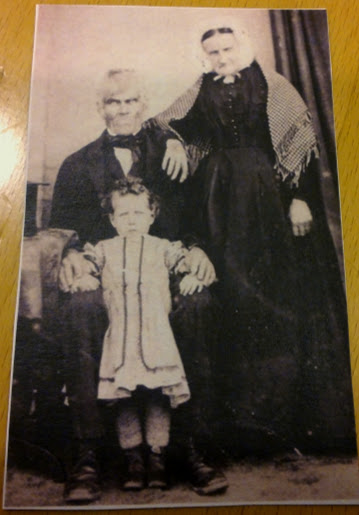
October is a good excuse to let the spooky side of your imagination have freer range than usual. Writing prompts at group this week offered a perfect jumping off point too–this rather creepy family portrait!
Possibly once a daguerreotype?
I’ve always found the whole Portrait of Dorian Grey thing rather fascinating, so here’s my attempt to play with that photos-capture-your-soul concept, featuring a very modern lad with a very old problem:
Camera Obscura
Casey stared at the daguerreotype in his hands in the kind of horror and fascination usually only experienced by people watching trains pitch off of bridges in disaster movies. “No way!” he insisted, fully aware he’d said that at least twice before, but unable to stop himself. “That absolutely cannot be me.”
“It’s the photo that was in your file at the orphanage,” the detective –what was her name, Kerrigan?–said, way gentler than any cop in a procedural ever did. “Casey Abbot Harrington, born 1869. Age four at the time this image was taken. There are records of you–aging, and forgetting, every time you hit your fifteenth birthday, and then you revert to the age you are in this photo.”
“And–are those my parents? They’re…like zombies.”
Detective Kerrigan’s face twisted like a Tim Burton jack-o-lantern. “We’re investigating the possibility that they were practicing some kind of magic,” she admitted. “Or possibly were being practiced upon by someone else. It would help explain how they look compared to you, if someone were drawing on them.”
Casey couldn’t let himself follow that line of thought too far–movie creepy was awesome, real life creepy mimicking movie creepy made him sick to his stomach.
“And what about me? I just turned fourteen a week ago. Do I only have a year to live?”
“We don’t know for sure. There have been a lot of advances in forensic magic in the last decade, there may be some treatments we can try that weren’t available last time around. And some spells do wear out, you know.”
“Why would I know that?!” Casey yelped. “None of this was real until you fished me out of that quarry two days ago!”
Kerrigan closed the folder and put her hand over it so that Casey’s view of his really horrific baby hairdo was inaccessible, thank the gods. “We’re here to help, Casey, just have a little faith.” She stood and headed to the door, pausing with her hand on the handle. “You just hang tight, okay, and I’ll see if they can send you up some lunch.”
“I’ve lost my appetite,” he grumbled, but pulled the tray table up to his waist anyway as the detective closed the door behind her. Her voice echoed in his head and shifted to something more familiar but no more comforting as it filled in the phrase that Casey shouldn’t know, but somehow did:
Some spells do wear out, you know–but curses never do.
Muse of Poetry by Alphonse Mucha, file courtesy of wikimedia commons
A good friend informed me that it is National Poetry Day in the UK today. It’s a long time until April, so one might as well enjoy a day while waiting for the month, therefore happy National Poetry Day to you all, UK denizen or otherwise. This year’s theme is ‘Remember,’ and if you’re interested in finding out what they’ve got planned to celebrate in the UK, here are a few handy resources for you:
It looks like they’re taking the ‘remembering’ theme both ways–‘which poems do you remember by heart?’ and also ‘poems with a theme of remembrance.’ As sometimes happens in autumn I’m feeling a bit sentimental today, so here’s a snippet of a poem I’ve been working on, remembering my grandmother.
Anne Rita Carter
Nana’s Bathrobe by Meg Winikates
Could probably use a wash by now,
but I’d rather inhale last year’s
germs than lose you again,
curious scent of cookies and
old cotton, the bath powder you
opened with a gleeful
“Won’t I stink pretty?”
A sentiment I never understood
until I wrapped myself in fuzzy blue,
years after your last hug.
I never get tired of being impressed and surprised by my friends. My friend and former colleague Kyle Browne is an environmental artist, and has been remarkably busy this summer, with artist residencies, a piece from which is appearing in PEM’s Art & Nature Center show opening next week, Branching Out: Trees as Art, and apparently also walking the coastline on the North Shore, reading and writing the landscape there.
I’ve been thinking a lot about the New England coastline myself, between a project with my photographic collaborator on the West Coast, and my trip to Provincetown earlier this summer. [There are poems brewing!] I’ve always appreciated the kinds of patterns one gets on the sand in shallow tidal water, or rippled into the rocks of a bouldersome stream, but Kyle’s latest work gives me a new appreciation for the subtle curves and breaks of the rocky shores that are such a pain to carry scuba gear over. They look like brush strokes, and make me want to spend more time on my favorite rock down at Collins Cove, watching the stones as well as the sea.
Check out the video of Kyle’s piece below or related photography on her site here.
I always appreciate it when my writers’ group offers up a prompt that makes you consider a new perspective. This week’s best prompt was to write from the point of view of “someone who works at an airport.”
“Logan Airport, Terminal A at night” by Alan Myles. Creative Commons, click for source
At the Info Desk (Logan Airport, 10 pm)
by Meg Winikates
Departures, arrivals, wheels up, wheels down,
conveyor belts creak round and round,
handles up, wheels down.
“Cup of coffee? That’s three fifty,”
and her sigh’s a lonely sound–
Ten pm at Logan: parking up, buses down.
“Did I miss the Silver Line?”
“Five more minutes, head on down–
last exit on the left,” and
the wheels go round and round.
“Left my passport at the hotel!”
Customs up, taxis down.
Peculiar sort of silence as
the last flight touches down
and the echoes of the travelers
pulse like heartbeats round and round.
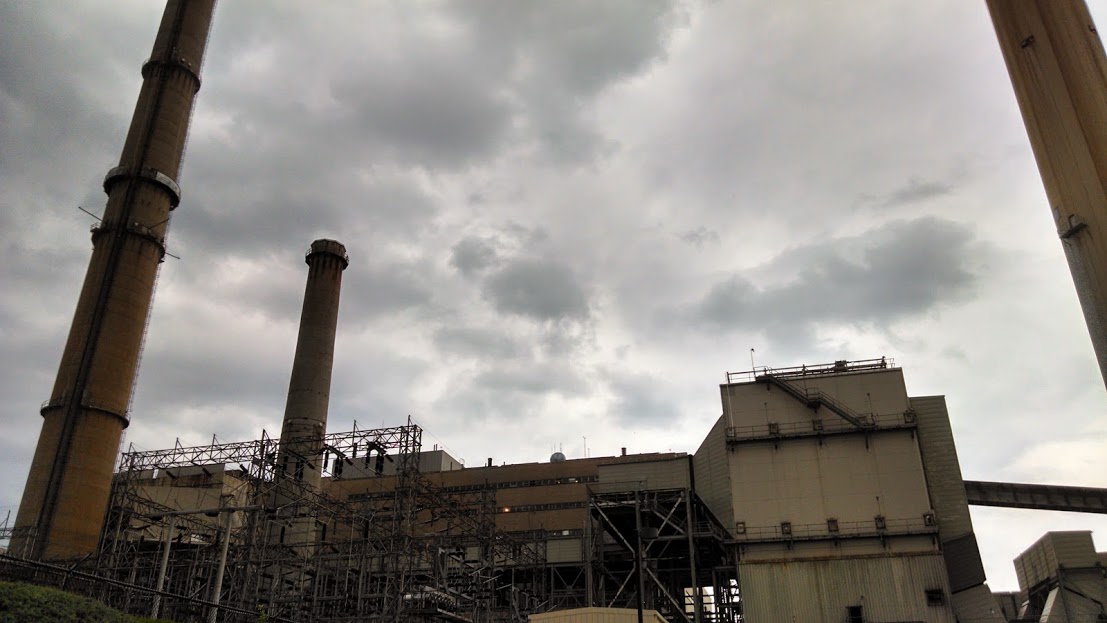
Poet Colleen Michaels is the brain behind the Montserrat College of Art’s Improbable Places Poetry Tour. And this past Thursday, the improbable location for the latest set of poetry readings was Footprint Power’s recently decommissioned power plant on the edge of Salem Harbor.
Thunderclouds gloom over the quiet power plant. Photo by me.
I was initially dubious and simultaneously drawn. Having lived in Salem for over 4 years, just on the opposite side of Collins’ Cove from the familiar smokestacks, I’ve absorbed their shadows into the folds of my understanding of the local landscape, and grumbled occasionally about wind direction and sooty windows. Like most people I know around here though, I’d never been inside. Hydroelectric plants and windmills at Niagara and in the Netherlands and elsewhere? Sure! Coal and oil-fired behemoth in my backyard? Nope.
So while I wasn’t sure what an evening of readings about ‘the work of power and the power of work’ would sound like, I was totally in for the chance to tour.
As it turned out, the readings were a fantastic variety. Ranging from reflections on both the grit and the worth of daily grind to the concept of living on or off ‘the grid’ to poems inspired by this very power plant and the future of energy in the 21st century, the poems and poets offered a beautiful and thought-provoking set of mental images.
Check out more of the ‘cathedral of steel’ and its unusual evening occupants in the gallery below:
This slideshow requires JavaScript.
Local poet January O’Neil also has a nice write-up of the event, where she too highlights one of my favorite moments: the reading ended, not with a headliner or a speech, but a moment of silence that was filled by a recording of the actual crackle-rumble-hum of the turbines when the plant was operating. It was a very cool kind of ghostly and really made me want to go home and write.
In the meantime, however, have a draft of a poem inspired by my own workplace, and what it’s like on a festival weekend as the visitors are heading out and you’re waiting for that last performer to finish packing up their gear, thinking about attendance numbers and what you’ll put in your program evaluation come Monday…
8 days a week
By Meg Winikates
I tell myself it’s a good ache,
the dull burn in my heels that says
the miles I’ve walked circularly
over this granite floor have made
a lasting impression on me.
My calves recall the frequent dash,
sore hands avert another crash
ff child and chair, of floor and phone,
and whisking fingers vamoose trash—
rub buzzing ears, block joyous drone.
Duty’s done, but wonder lingers—
Did I meet just eyes and fingers?
Save one bad day, help one smile grow?
Made one growler’s heart a singer’s?
Or worn my footprints on this stone?
Enough would be one ‘yes’ alone.
Have you ever encountered poetry or art in an unusual place that helped you to look at it differently? What places inspire you?
Camp Nanowrimo has rolled around again, which means the corners of the internet I frequent are full of cheerleading and wordcounts and interesting snippets of advice from published authors. As I am currently more in the editing stage of several projects as opposed to the frantic amassing of words, I thought I’d share some of the things that have caught my attention in the last week or two:
How to Train your Inner Editor by Mary R. Kowal
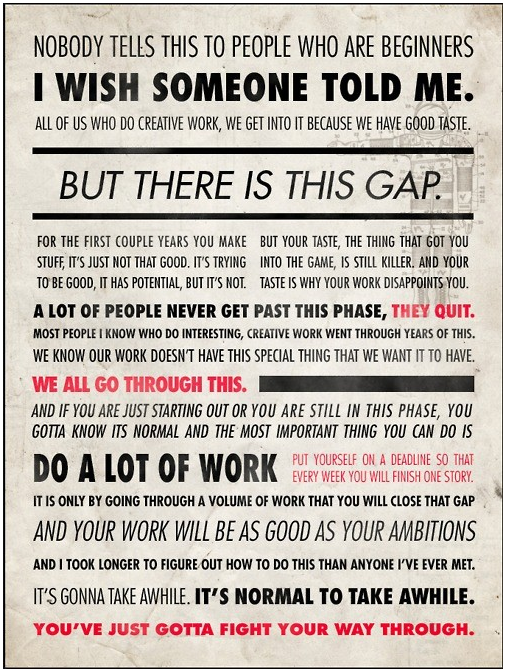
I watched this right before making notes for critiquing two pieces for my writers’ group, and it did really make me think about the kind of feedback I give, as well as the feedback I’ve gotten. I’ve done the beta-reader thing in several different ways, by email and in person, for strangers, acquaintances, and friends, and I do enjoy it, but now I get to appreciate it as a training exercise for my own writing in a way I’d never considered before.
Quote by Ira Glass, Lovely layout by artist unknown. If you know whom to credit, please let me know! (Google’s reverse image search failed me)
For a deeper look at that idea-to-editing-to-just-publish-already zone, Kowal and her fellow authors from the podcast series Writing Excuses have a new anthology called Shadows Beneath, featuring 4 short stories in first draft and revised versions, with discussions of the editing process. I haven’t read it yet, but it looks like fun.
How Amazon and Goodreads are changing literary criticism – Do you write Goodreads reviews? Do you follow book bloggers? Whose opinions do you trust? I had a bunch of books on my ‘to read’ list based off bloggers’ book reviews that were *panned* on Goodreads–so what now? I moved them from my ‘buy if you see them’ to ‘see if they’re at the library next time you’re there’ list. But I won’t ditch them entirely until I read the first few chapters. How do you react to online reviews?
Slowing down the brain with calligraphic text messaging? Since much of this post is about being aware of your writing as you’re writing, and being a more mindful reader/responder, I thought it would be fun to wrap up with this entertaining article from a woman who spent a week replying to text messages with hand-written photographic replies.
What do you do to make yourself a more mindful reader and writer?
Last week I had the pleasure of attending a workshop hosted by the folks over at Mass Poetry as a reward for supporting their Poetry on the T campaign. (and I happened across some of said poetry just this week on the Red Line, which made me extra happy!) The workshop was appealingly titled “Super Writing Fun Time” and was led by Jill McDonough.
I’ve been working on several projects recently (which is why I haven’t posted as much this month, oops!) and those projects have had me thinking a lot about editing, both prose and poetry. One of the hardest things to do is look at a piece of writing and say, “You know, there’s really only one good line in that whole passel of words.”
Ouch.
Sometimes, though, it’s worth just hanging on to that one good line and rebuilding around it, and that was made abundantly clear in McDonough’s workshop.
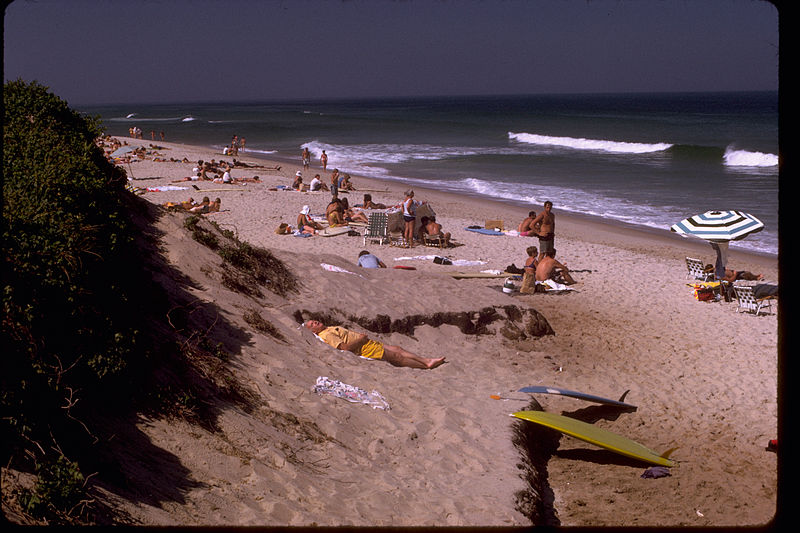
Cape Cod National Seashore, National Park Service (public domain)
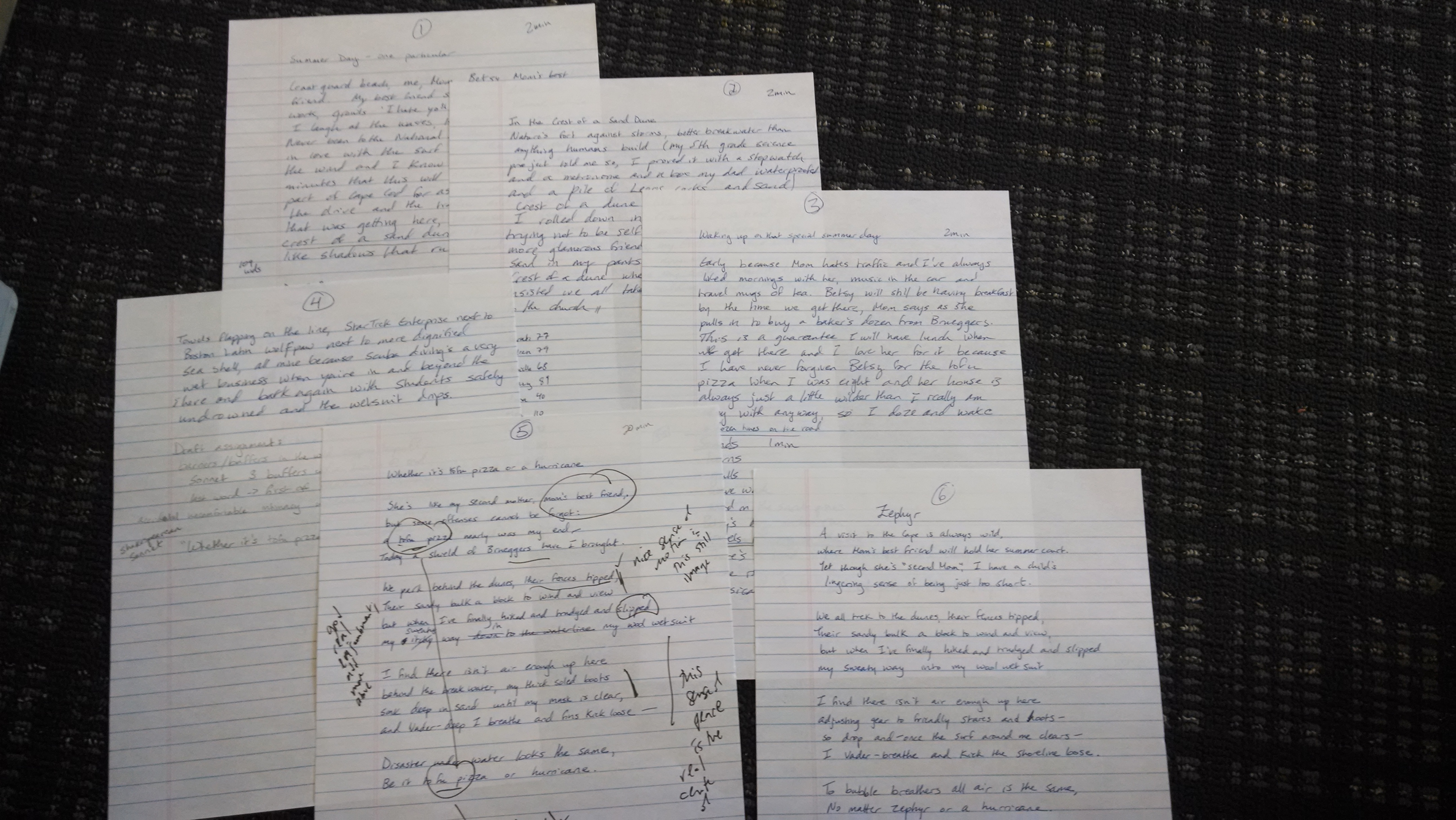
In a series of word-spilling sprints, she urged us to write about one particular summer day, read our result aloud, and then run on again from whichever phrase she highlighted as the most interesting part of our rushed verbiage. After several iterations, we had to look back through everything we’d written and give ourselves an assignment to create a more thoughtful poem draft using themes or language we’d found in our earlier efforts. Where we were stuck, she offered help by way of a format or a title or a direction, and then came around to ‘mess with’ our work if we indicated we wanted help/critique. I ended up writing and rewriting a Shakespearean sonnet in about 25 minutes, and it was an enormously confidence-boosting evening.
A passel of words thanks to McDonough’s workshop!
So why was it so effective? Beyond McDonough’s humor and generous handfuls of Hershey’s kisses, she created a judgement-free zone. Spilling all those words on the page in the beginning, without worrying about quality or phrasing overmuch meant it was easier to let those words go in favor of the best ones–and it’s a device I think I’ll adopt in future. I’ve never been much of a ‘drafter’ by personal preference: I like spending the time and thought to feel like I’ve got it ‘right’ the first time around, but what works in an essay or a professional memo is really not conducive to the creative process, which is almost by definition iterative. And carrying that mindset over from the workshop has been helping me edit the rest of my writing, as well.
If you’d like to find out more about McDonough’s process in her own words, I recommend this article: “Primary Sources” hosted over on the Poetry Foundation website. Between that evening and this article, I’ve spent not a little time recently seriously entertaining the idea of going back to grad school, and then smacking myself on the back of the head, a little. (Is there an Academia Anonymous? ‘It’s been two years since my last graduation…’)







 Sea Dreams and Time Machines