Many thanks to editor and judge Ivan Taurisano, who selected my piece. Check out his manuscript wish list and share it with any authors you know who might have a manuscript to share! There are also lots of other great books and projects from the rest of the guest judges and prize donors here.
This summer, my son was old enough to participate in the town library’s summer reading program, and as I like to lead by example, that meant I got to read a lot this summer too, and we both logged our books in Beanstack, a purpose-built reading app for schools and libraries. Part of me definitely missed the old paper summer reading logs of my youth, but my son got excited every time he reached a new badge or completed an activity for another virtual sticker, and I admit being able to scroll through and see cover art for all those books we read together is pretty enthralling. He’s already looking forward to the October “Boooooooooks!” bingo challenge, so that’s a good sign too.
Looking at the list of what I read, there was definitely an unintentional (but not the slightest bit surprising) marine/nautical theme to the novels I picked up for the summer, with a secondary theme definitely being fantastical academia. Here are a few that really stood out for me:
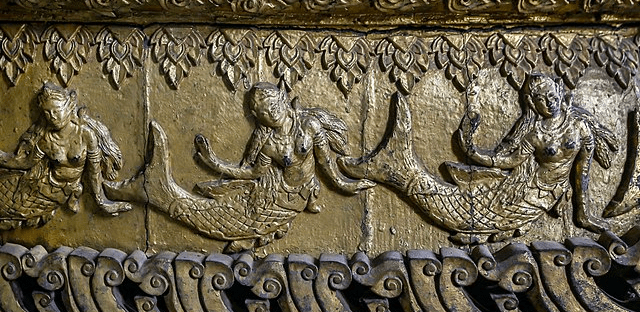
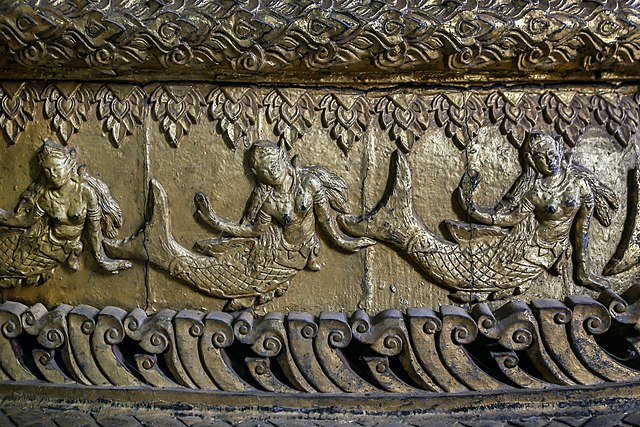
Carved decorative motif of mermaids from the Southeast Asian version of the Ramayana. Wat Xieng Thong, Luang Prabang, Laos. Photo by David Clay, used with permission through Creative Commons
Mermaids and Pirates
The Mermaid, the Witch, and the Sea by Maggie Tokuda Hall – Piracy, coming of age, star crossed love, self-reflection, non-binary characters, criticism of imperialism and colonial economic policies, this was a chock-full read that barely took a breath from start to finish and I thoroughly enjoyed it.
Tress of the Emerald Sea by Brandon Sanderson – Weird but satisfying. High seas adventure, working girl goes off to rescue her lordling in distress, piracy and questing and curses and wordplay. This book is impossible to explain, largely because it’s told by an unreliable and probably slightly unhinged narrator, but I’m very curious to find out what else Sanderson has planned with his other “secret Covid books” he wrote in this same universe.
The Adventures of Amina Al-Sirafi by Shannon Chakraborty – Probably my favorite thing I read this summer, this was densely delightful world building, really fun historical fantasy, non-Eurocentric, dryly hilarious, and featuring a 40-something retired-pirate mom who gets to go adventuring again to save her family and reunite with her old crew. I was so sorry when I turned the last page. I recommend this one highly.
American Mermaid by Julia Langbein – This promised to be a critical look at writing, Hollywood, and the cost of fame with a healthy dash of magical realism thrown in, which sounded really fun. Sadly, it was a little more cynical than I was really up for, and had far less magical realism than I would have liked, but there are definitely some scenes that linger in my memory, so it was an interesting read.
Fantastical Schools and Libraries
The Golden Enclaves, by Naomi Novik – The final volume in the Scholomance series, which deserves a deep-dive post of its own, probably after I have a chance to re-read them all (though not right before I go to bed, yikes. So many nightmares.). Fascinating reflection on what it takes to really change unjust systems, from both outside and within, and I loved so many of Novik’s character choices. One of my favorite writers for so many reasons.
Ink Blood Sister Scribe, by Emma Torzs – This one was on everyone’s recommendation lists this summer, and I can see why. Fascinating magic system, well developed characters, satisfying plot, just enough humor to offset how very dark things can and do get at points. I turned around and recommended it myself to various folks as soon as I finished it.
Akata Witch by Nnedi Okorafor – This has been on my backlist to read for years, and I was happy to grab it finally. I loved the Binti trilogy by Okorafor and this has a lot of the same: beautiful language, very fierce and charming protagonists, marvelous and immersive worldbuilding with science and magic. I definitely want to pick up the next in the series when I get a chance.
A Novel Disguise by Samantha Larsen – Historical fiction that I did not pick up with any real expectation of historical accuracy, as it was mostly a cozy mystery featuring a single woman who goes undercover as her dead half-brother to save her cottage and find out who poisoned him. Definitely a ‘potato chip’ sort of book, but amusing, and set earlier than the Regency period one could have easily assumed it would be, so the details of wigs, powder, and beauty patches to cover pox marks were all fun additions to the disguise.
Mooncakes by Suzanne Walker – A cute YA graphic novel about a late teen witch who works in a bookstore with her amazing witchy grandmothers, and her werewolf girlfriend who comes back to town to deal with something creepy in the woods. Great intergenerational team up, sweet illustration style, funny and creepy in a good balance, probably should have saved it to read in October for some Halloween fluff.
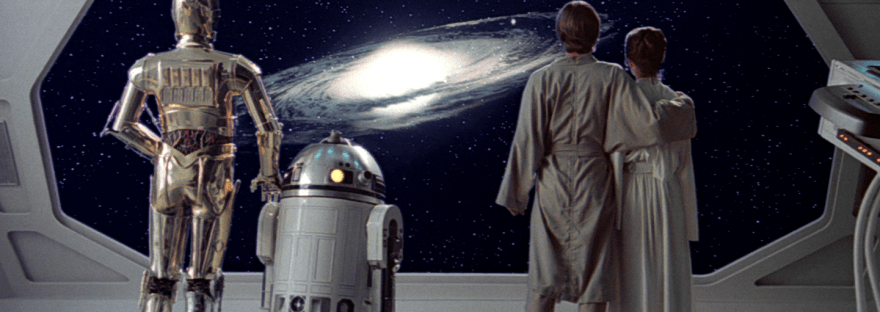
I don’t write about a lot of fannish things here, but anyone who knows me knows that I grew up a Star Wars fan, and certain stories at certain times have a really formative effect on the way you see and create stories from there on. As my witness, see all those Pixar artists and storytellers who are my age and grew up on R2-D2, C-3PO, Johnny 5 of Short Circuit, and various other tragi-comic helpful robots of the 1980’s (SpaceCamp and Flight of the Navigator and Asimov’s Norby series)…and who then went on to create Wall-E.
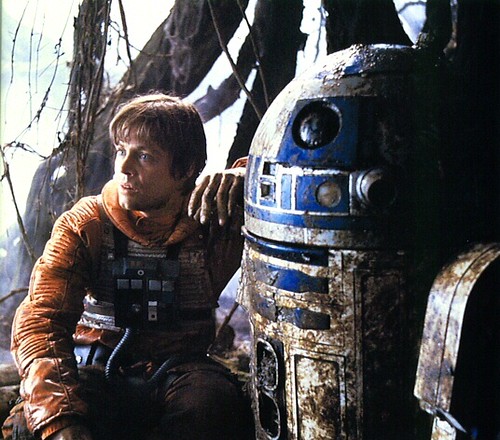
So some stories really stick with you, and good books do too, and since reading Carriger’s The Heroine’s Journey I have not been able to stop thinking about it in relation to that first deep love of mine, Luke Skywalker and his rebel space family. Luke has been the epitome of ‘heroic’ to me since I was tiny; kind, hopeful, sometimes clever and sometimes just lucky, a bit of a mix of brash and bashful as the situation demands, and–most importantly–to a fault loyal to his friends and family, regardless of their species or model number. (“Your droid’s pretty beat up, want a new one?” “Not on your life, that little droid and I have been through a lot together.”)
Very glad the swamp shark didn’t eat you, my friend.
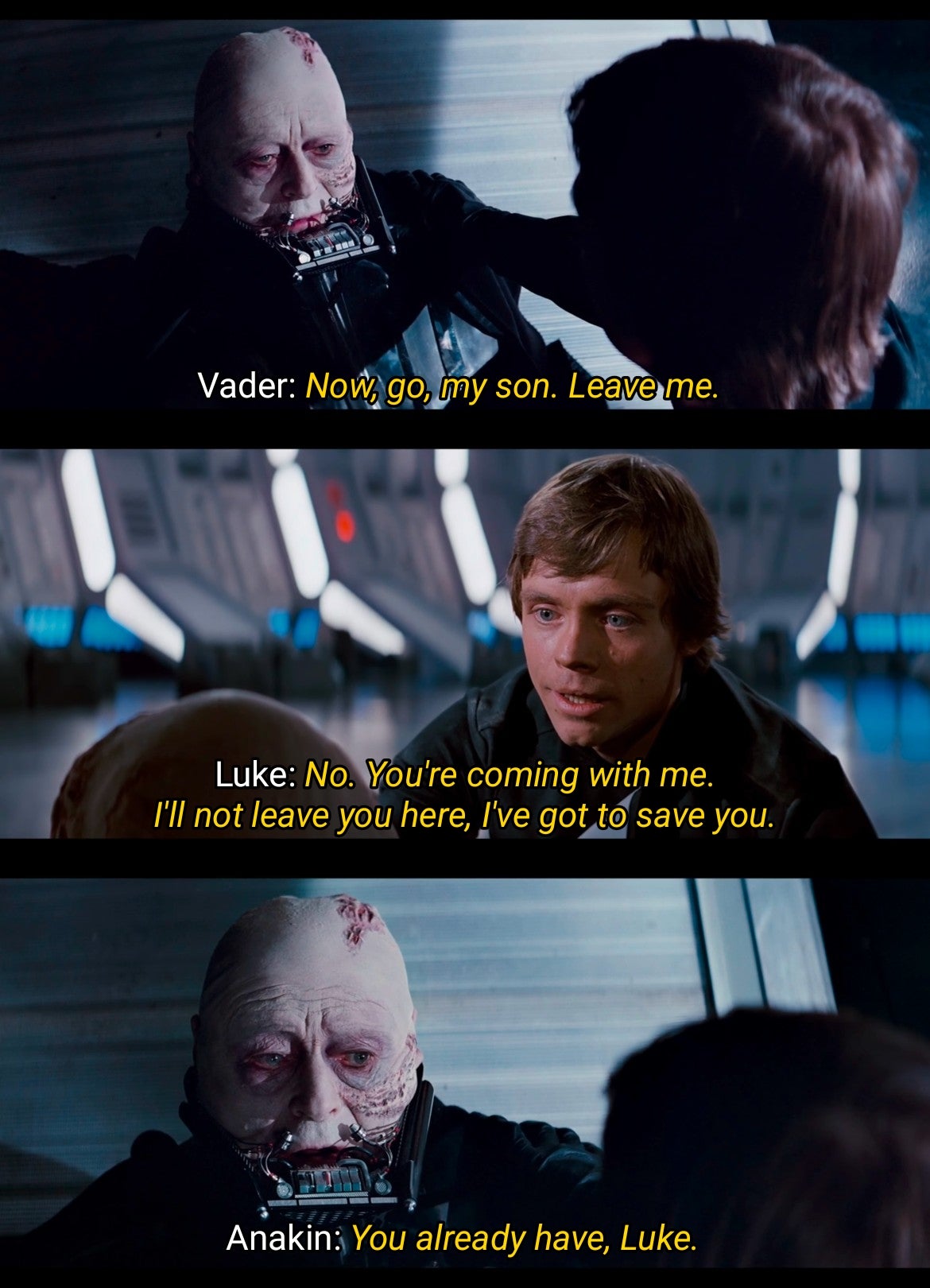
In the fannish corners of the internet that I occasionally haunt, there was a lot of upset about Luke’s arc in The Last Jedi, followed by some breaths of relief and recognition in his brief appearance at the end of The Mandalorian Season 2. People (including Mark Hamill, apparently) didn’t feel like the Luke they saw hiding out on that wild Irish island reflected the Luke of the original trilogy. He was too bitter, too cynical, too lonely, and too judgmental to feel like the same man who tossed his lightsaber away in the face of hatred and greed personified, who saved and forgave his father, and who never lost faith in his friends. There was hope, then, when he seemed a little more familiar as he came to collect Grogu to become a Jedi student.
And those same corners of the internet were not terribly happy with Luke’s characterization in last week’s episode of The Book of Boba Fett, even as there were justified giggles of glee over Force-skipping Grogu on a walk through a bamboo forest. Fans (myself included) who love Luke Skywalker for the gentleness, forgiveness, and hope that he embodies in the original trilogy were not super keen to see him forced into the same failings of previous Jedi generations, making a functional toddler attempt to choose between the traditional (lonely, failed) Jedi path and his affection for Din Djarin, walking disaster and accidental space dad. People watching this storyline felt betrayed.
And here’s where we get to my theory. Carriger says in her book that one of the best way to lose your readers (viewers, listeners) is to make them think they’re in for one kind of story, and then giving them something that doesn’t follow the signposts they expect. Story structures, themes, tropes, they all help build expectations that support and explain character growth, plot decisions, etc.
George Lucas has repeatedly talked about the influence of Joseph Campbell and the Hero’s Journey on his writing of Star Wars, and people map that journey onto Luke Skywalker all the time. Refusing the call (“I’m not going to Alderaan, I’ve got to stay here and take care of the harvest…”), magical aid (“your father’s lightsaber”), journey to the Underworld (trash compactor), death of the mentor (Obi-Wan’s sacrifice), and victorious battle/showdown (blowing up the Death Star) are just a few of the traditional signposts of a Hero’s Journey.
However, in the ultimate run of the trilogy, I would argue that Luke is a Heroine, not a Hero. Certain elements appear in both journeys, including trips to the underworld, gaining and losing of allies and power, delays, and ultimate confrontations – but the motivations and the strengths of the hero and heroine are different, not to mention the resolutions. Luke is constantly relying on and returning to his friends when they’ve been separated over the course of the original trilogy, and some of them are nearly inseparable regardless (hi, Artoo!). He prioritizes rescuing his friends from Cloud City over his training with Yoda, against both Yoda’s and Obi-Wan’s advice. He chooses to leave Han, Leia, and company on Endor and go to the second Death Star, not out of a ‘I must do this alone’ motivation of a Hero, who prioritizes isolation and individual strength, but because he’s the best person to try to reach Vader and reawaken Anakin Skywalker, rebuilding a family connection. Plus, he trusts his friends to complete their parts of the mission with their own strengths. That faith in his friends, so strong that the Emperor cannot help but needle him for it, is the same strength that lets him throw away his lightsaber and seek reconciliation with his father rather than revenge. That is a pure Heroine’s Journey resolution — compromise, forgiveness, rather than destruction. And in the last scene, when it looks like Luke might end up alone in the forest with the Force Ghosts, it’s his family who draw him back into the (fire)light. Subtle, that symbolism is not, especially in the light of the prequels that posit ‘family’ as Anakin’s reason for his fall into darkness (oversimplification, but still).
In summary: ultimately it’s Anakin who has the Hero’s Journey here, not Luke.
I’m not crying, you’re crying.
And so we get back to how betrayed and annoyed Luke Skywalker fans are right now. Because Dave Filoni, who directed the episode in question, clearly thinks George Lucas hangs the moon, and I would venture to guess has completely bought into the “Luke is on the Hero’s Journey” idea. (I can’t explain Rian Johnson beyond the impression that his directorial motivation was that meme about “I will pee on everything you love.” There were a handful of good things in that movie, my favorite was the little stablehand holding their broom like a lightsaber, my second favorite was the potential of Rose Tico, and that’s another post entirely. But still: they let someone who hates Star Wars direct Star Wars and that was dumb.)
So fans are expecting Luke post-Return of the Jedi, the triumphant heroine who supports his family (found and otherwise), values connections, prioritizes understanding and forgiveness, who has learned something from the mistakes of his mentors. And in the recent Book of Boba Fett episode they are getting…the opposite of that. Luke looks to be going down the same (Hero’s) lonely and repressed road as that of the Jedi at the end of the New Republic, asking ridiculous emotional sacrifices of children too young to understand the choices they’re being asked to make, training a new generation of Heroes who think attachment is a weakness and solitude a strength.
(Honestly, it would serve *this* version of Luke right if Grogu decided to go back to the Mandalorian and ride along in the starfighter-with-babyseat. Do you know any toddler who will pick a shiny toy over their parental figures when the chips are really down? There’s a reason parents everywhere lament being unable to use the restroom in peace.)
I’m writing this Tuesday night, so there’s still hope they turn it around for the end of this series/season. We’ll see what tomorrow’s episode brings. Like Luke (and, because I cannot end this post without saying so, like Leia, whom I love equally), I choose hope.
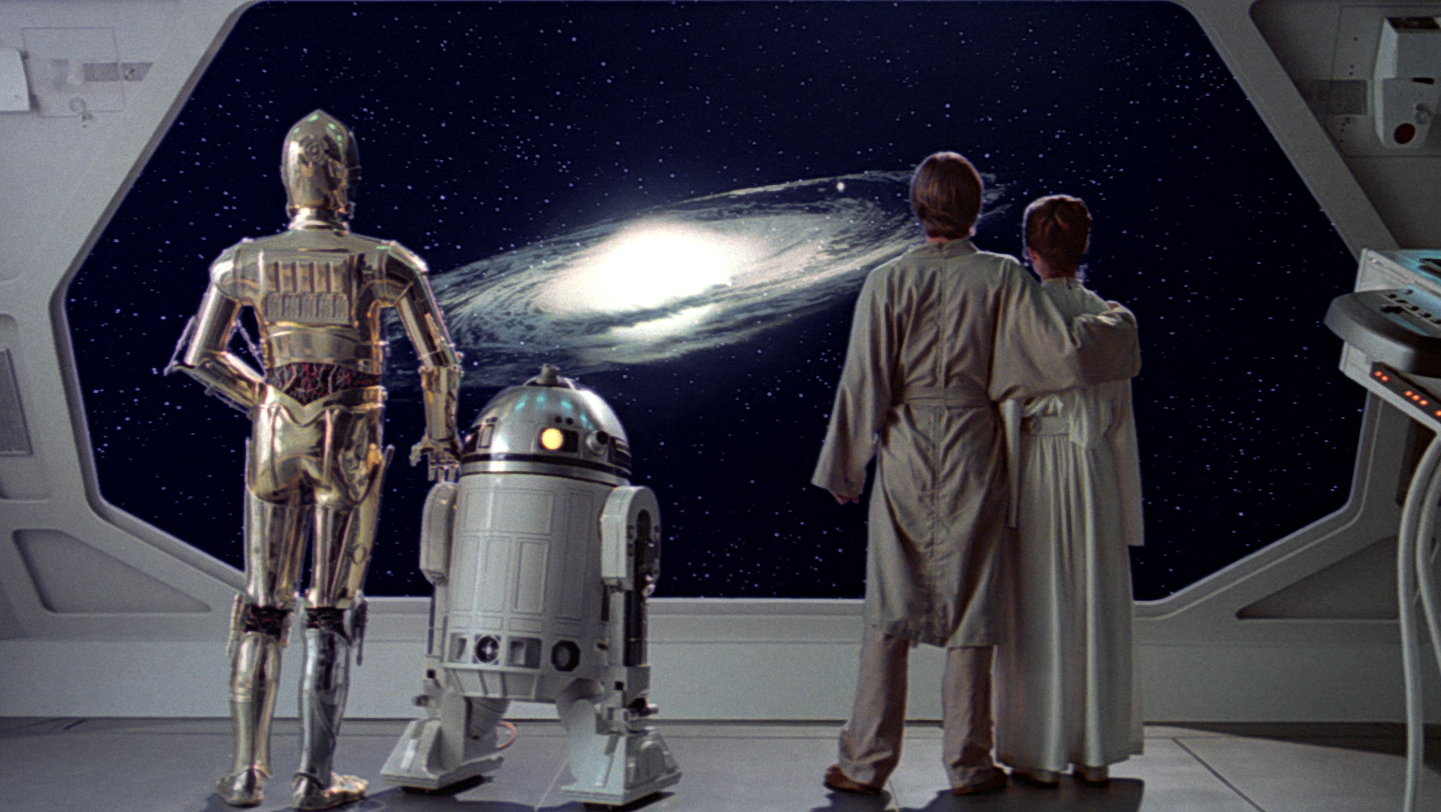
When things look bad, Heroines rely on each other.
This Christmas I wished for and received a copy of The Heroine’s Journey by Gail Carriger, and having read it, I have been bending the ear of anyone I know remotely interested in story structure, literary or pop culture analysis, or who has been simply willing to let me enthuse in their general direction for 5-10 minutes.
Like a lot of people, I ran across (and I think I wrote a paper on?) Joseph Campbell and “the hero’s journey” in late high school or early college, and have run across it with reasonable frequency ever since. Granted, I took a fairly high number of mythology and folklore classes in college, and have been going to sci-fi and fantasy readers’ and writers’ conventions in the years since, so my exposure has been higher than your average duck, but still. The Hero’s Journey saturates a lot of narratives in the popular imagination, with perfectly good reasons. Individuals triumphing through adversity, going on journeys, learning self-reliance, rescuing and losing people and causes along the way, all very exciting.
However, I first heard mention of an alternate narrative, the Heroine’s Journey, at a writing panel a few years ago, and was instantly fascinated, so when I found out there was a book, by a hilarious and clever writer to boot, I had to read it.
To hear the author describe the differences herself, I recommend this excellent podcast (transcript also provided for those who’d rather read). The short list of differences, however, boils down to motivation, strength, and resolution. Heroes (whatever their gender) often need a push to get going, are seeking an external reward, see seeking help as a weakness and civilization as a hindrance, “must do this alone,” and often end up, even when victorious, still alone. Heroines are prompted by a loss or separation within their family, often start out alone because their pleas for help go unanswered, and then collect knowledge, friends, found family, and other assistance along the way, seeking reunion, compromise, and connection as ultimate goals. Heroes go on inspiring, exciting, but often bittersweet or downright depressing journeys. Heroines go on journeys that have more room for humor, connection, and comfort, and are most often found in genres and story forms that have been traditionally undervalued in modern Western/European cultures.
Where things get really interesting, from the point of view of writing or story structure analysis, is what happens when you get mashups of the two story structures. In Marvel’s recent movie, The Eternals, for instance, Ikaris is on a hero’s journey and Sersi is on a heroine’s journey. Ikaris can’t adapt to be part of the victory of the heroine’s journey and accept reconciliation, and so literally flies himself into the sun. (Waste of a good actor, but oh well.) In Carriger’s book, she posits that Harry Potter is on a heroine’s journey, and that much of the conflict many readers have with Dumbledore’s actions towards Harry stems from the fact that Dumbledore is trying to play the role of mentor to a hero, not a heroine. He seems to be positioning Harry for the road of lonely sacrifice, when Harry’s inclinations and strengths all come from relying on his friends and extended network.
Like so many people, I’ve found my creative work stymied by the stresses of the pandemic, but reading this book has helped me think through some of my stories in progress, and given me new energy to get back to them. Whether you’re a writer or just like to think about the themes, tropes and structures of the media you consume, I highly recommend this book!
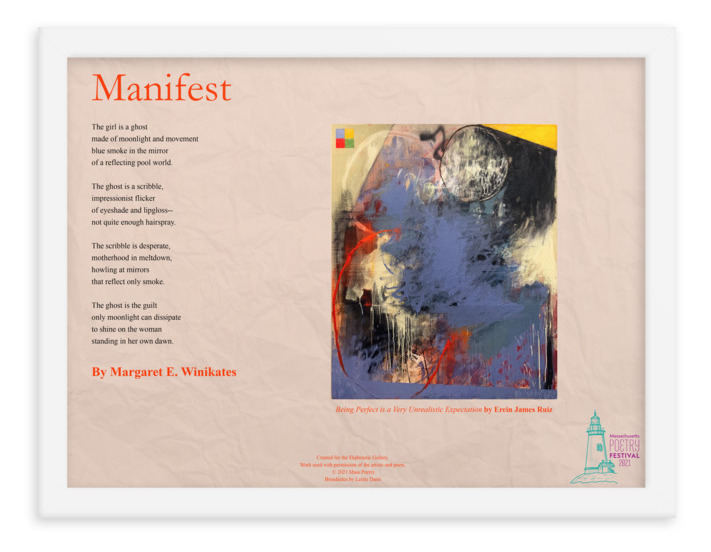
I was incredibly thrilled to hear that the Mass Poetry Festival was returning for 2021, as it has been an incredible source of inspiration and community for me for years. I was even more happy to see that as part of this year’s festival, they were running a contest for the creation of ekphrastic poetry (a personal favorite). They invited any and all to respond poetically to any of 12 works of art from those in the Montserrat College of Art community, and the top poem for each piece would be exhibited online and also be sold as broadsheet posters to support MassPoetry.
I am honored and excited to say that my poem, “Manifest,” inspired by the painting “Being Perfect is a Very Unrealistic Expectation” was chosen to be part of the exhibition and the broadsheet publication.
The girl is a ghost made of moonlight and movement blue smoke in the mirror of a reflecting pool world.
You can use the link above to jump straight to my poem, or you can visit the whole exhibit here:
It’s National Poetry Month again, and I am bringing you a few cool links to events and ideas that are inspiring me this April.
What happens when you gather together a bunch of politically active artists? The Poetic Address to the Nation. Happening on April 22, at 7pm, this event is an artists’ compilation of and reaction to “the interlocking crises of systemic racism, eviction, poverty, access to healthcare, and more laid bare by COVID-19” You can register for it here. (Full disclosure, this event is being co-sponsored this year by MassCreative, an advocacy organization with which I am affiliated.)
NPR wants your Twitter poems! (Or TikTok, apparently, which has turned into a hotbed of spoken word poetry, which is cool.) Use the hashtag #NPRpoetry for a chance to catch their eye and get featured on All Things Considered.
Get a look at rarely seen items from the Emily Dickinson Collection at Harvard’s Houghton Library (where they keep the cool, old, rare stuff).
Longfellow National Historic Site has released their schedule and registration for their virtual summer poetry readings.
And okay, this isn’t technically poetry, but I just can’t stop listening to Perseverance rolling across Mars. There’s definitely a poem in there somewhere.
It’s been a while. Like a lot of people, I found writing incredibly difficult in the last year, and what I did write was more private processing than blog-worthy and interesting. Also like many of us, I have had an intermittently hard time giving myself grace when it felt like I was ignoring my writer-identity, but I am trying hard to recognize that what I made in the last year was no less valuable than a poem or a story. When I did have a creative impulse, I picked up my flute, stitched a Christmas stocking, or made a box fort with my toddler.
And it turns out that there’s a poem in all that, too. I’m still working on it.
Poet and potter M.C. Richards says it better:
The creative spirit creates with whatever materials are present. With food, with children, with building blocks, with speech, with thoughts, with pigment, with an umbrella, or a wineglass, or a torch. We are not craftsmen only during studio hours. Any more than a man is wise only in his library. Or devout only in church. The material is not the sign of the creative feeling for life: of the warmth and sympathy and reverence which foster being; techniques are not the sign; “art” is not the sign. The sign is the light that dwells within the act, whatever its nature or its medium.
Read more about her at the ever-brilliant Brain Pickings here.
For other really interesting reads, check out this really cool essay about the way the King Arthur legend is a collection of reinventions that invites further reinvention, by Tracy Deonn. I’ve always been drawn to the many variations of Arthuriana, and clearly I’m going to have to read her book too.
The author, third from right, at Museums Advocacy Day 2020, February 25
Dear Senator Warren,
Thank you.
Thank you for the small things, like hiring staff for your senatorial office who demonstrate the same level of graciousness, dedication, and desire to help that you show daily. I’ve interacted with many of them on advocacy days down on Capitol Hill in the last several years, and it’s always a pleasure.
Thank you for the big things, championing the rights of everyday people, and bending your remarkable intellect to using government to protect people from the power money buys banks, big business, and special interests. I believe in your big structural change, and I believe you’ll help us get there in whatever role you inhabit.
Thank you for serving the citizens of Massachusetts with such energy, enthusiasm, and earnestness. I am proud to have voted for you, and proud to call you my senator. I would have been thrilled beyond words to call you my president. I have no doubt you are the president this country needs and far better than we currently deserve.
Thank you for showing the world the power of a passionate woman. In a society that wants us to be small-voiced and conciliatory, you stand up there and use your platform to show us that women can be passionate in public; that sometimes that passion looks like anger, and sometimes it is anger, and sometimes that anger is more than justified. I will not apologize for voicing my passion anymore.
Thank you for throwing yourself out into the public arena daily. Thank you for your tireless grace, your optimism, your perseverance. In the last year, when I collapsed on the couch, exhausted from trying to run a household, keep a full time job, raise a toddler whose cardiologist father couldn’t be around, I would see pictures of you in the selfie line and think, “Senator Warren’s out there, wearing out another pair of running shoes.” And I would get up.
I’m going to keep getting up. I owe you that much. I donated, I convinced friends to vote for you, I shared your plans and your ideas in person and on social media, and it wasn’t enough. I’m sorry. But I am going to keep getting up, because that’s what you do, and if you can do it then so can I.
I know you’re going to keep fighting for me, for the future of my family, for the planet, and even for all the people who didn’t vote for you. So this is my pinkie promise: I’m going to keep fighting for you, and voting for you. I’m going to keep talking about the importance of intelligence, compassion, a willingness to listen and learn, and an articulate passion, about how those are the qualities we need in leaders.
Thank you for being an inspiration.
Please stick around, Senator. We need you more than you know.
I spend a lot of time on the road these days, and though I never used to be much of a podcast listener, I’ve become a convert, largely thanks to these several podcasts that keep me company on my peregrinations:
For a short thoughtful dose of poetry
The Slowdown, with Tracie K. Smith – a 5-minute daily dose of personal reflection and a single poem, read by a US Poet Laureate. She usually talks more about what the poem makes her think of, rather than the technicalities of the poemcraft, but sometimes there’s a bit of that too.
For the joy of listening to stories, with great voice acting and diverse authors/cultures
Levar Burton Reads – Reading Rainbow for grown-ups. Mostly speculative fiction, but with a dash of anything and everything else, with introductions and conclusions where Burton talks about what draws him to these short stories. (Dangerous to listen to on late night drives because his voice is so warm and comfortable it’s like a bedtime story, but great for keeping calm in rush hour traffic!)
Circle Round – Hosted by WBUR with the tagline “Where storytime happens all the time,” this is kid-safe folktales and fairytales, from many cultures, with fabulous guest actors/readers and great sound and music effects. It’s more like a radio play than a single-reader storytime, and while it’s pitched to kid listeners, with suggestions for conversations and activities to do with one’s family/friends after each story, the stories themselves are ageless.
For story-craft, author interviews, etc
Cooking the Books – Hosted by two authors, Fran Wilde and Aliette de Bodard, ‘where genre fiction meets food,’ each episode features an interview with an author talking about a recently published or about to be published book, with questions mostly focused on food and worldbuilding, but with fun departures into other parts of storycraft, personal interests, etc. I add a lot of books to my TBR list from this podcast. They also have a recipe from each author on the website, which is fun.
Imaginary Worlds – Hosted by Eric Molinsky, a show about the worlds we create, how, and why. It’s both about creators and fans, the experience of fandom in many forms, and across many platforms, including books, movies, games, and more. Not every episode speaks ‘to me,’ but there’s humor and interesting things to think about in every episode, even the ones that are initially more of a stretch for me to appreciate.
For word-geekery
Lingthusiasm – “A podcast that’s enthusiastic about linguistics by Gretchen McCulloch and Lauren Gawne.” I’ve always been fascinated with words and languages, and in another reality there’s likely a version of me that decided linguistics was the way to go. This universe’s version of me enjoys listening to people who know what they’re talking about be excited about things like the sounds you stop hearing once you’re no longer a baby, or the way concepts of color are constructed in languages around the world, or that ‘every word is a real word.’ It gives me thoughts about world-building, of course, but it’s also just fun and gives you random cool facts to bring up at the dinner table.
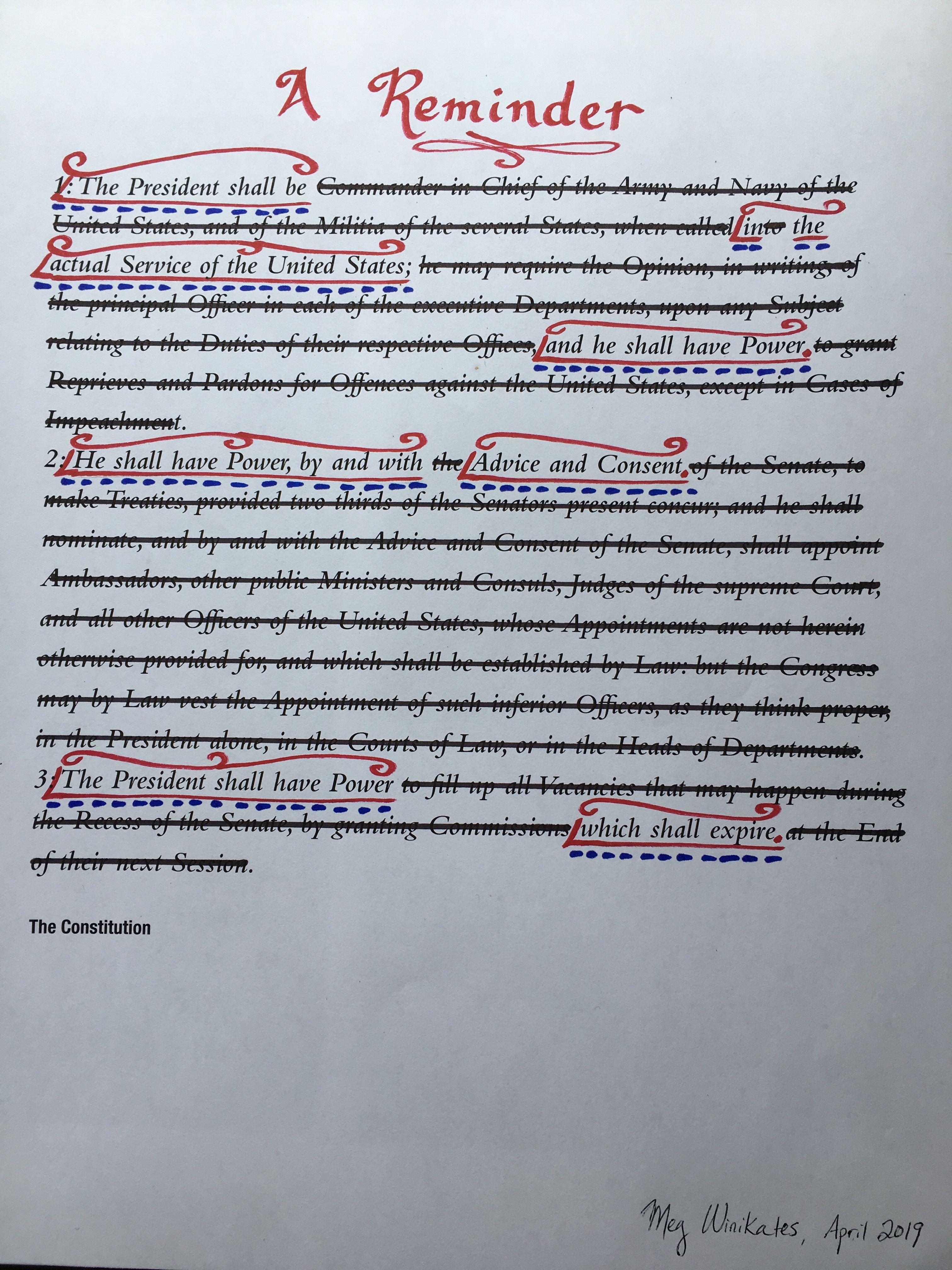
I’m really interested to see the results of the Poetry Coalition’s project “What is it, then, between us?: Poetry & Democracy.” I heard about it through MassPoetry’s call for participants, and while I didn’t get my submission in on time, I’m looking forward to reading and admiring the artistic erasure poems created from some iconic speeches and texts. These included selections from the US Constitution, Bill of Rights, Dr. King’s “Letter From a Birmingham Jail,” and the speech “Our books and our pens are the most powerful weapons,” which Malala Yousafzai delivered to the UN. Selected entries will be installed on the MBTA and other public locations, which should be a more thought-provoking set of signage than the usual T ads. I’d love to be able to overhear the discussions such things might generate on the Orange Line or elsewhere!
I enjoyed reading all the selections and while I was afraid it would be hard to pick, ultimately one stood out for me above all the others. I chose a piece from the Constitution which originally details how various kinds of powers are distributed between the executive and legislative branches of government, but thought that what was most evocative (and necessary, currently), was a reminder about those powers which are given to the President–but only temporarily. Since I didn’t submit mine, I’m sharing it here:
A Reminder
The President shall be
in the actual Service of the United States;
and he shall have Power.
He shall have Power, by and with
Advice and Consent.
The President shall have Power
which shall expire.


 Sea Dreams and Time Machines
.jpg)