
Uncategorized

Arisia 2016 Wrap-up

So Arisia was a big, busy, beautiful mess of a weekend. I didn’t make it to all the panels I intended, I accidentally ended up in sessions that were awesome, and John Scalzi made me cry (in the good way).

I am not going to even try to cover everything, but here are a few highlights from this past weekend:

Nonstandard Paths to Magic
Honestly, I thought there would be more discussion of cool non-Latinate, non-Hogwarts, non-Western magic systems, but it was mostly a series of thought-provoking questions about the assumptions we make about magic, how it works, and who uses it. Some of my favorites:

  • Is magic transformative? If so, how does it change the user? How big are the changes, and how much of that depends on where in society the magic user starts?
  • Magic as ‘spiritual technology’ – do you have to believe in the tools to make them work?
  • How does magic-as-mystery (Tolkien) stack up against magic-as-textbook (Sanderson) and what are the strengths and weaknesses of each? When can you get a magical solution to a non-magical problem, or a non-magical solution to a magical problem (haul that ring to the volcano and throw it in, ’cause nothing else will unmake it!)?
  • Do you always need the good/evil dichotomy, when referring either to magic or to the people that use it? Where is the line between them, and is it the same for all people in that system?
  • Standard magic almost always comes with a price; should it? Is it a human thing, to feel like things ought to have a price attached? [and a corollary not discussed in the panel, but which I want to explore now: what if magic were an exhaustible resource, like fossil fuels, rather than renewable/constant/growing like the Force?]
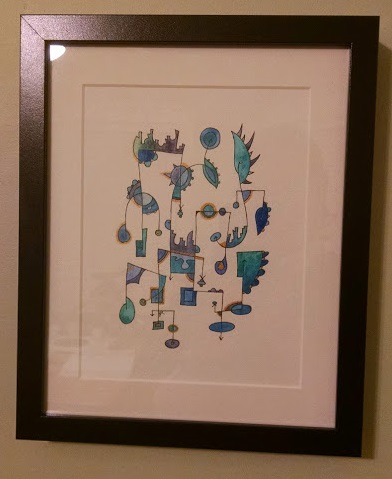
cities in the caves beneath the ocean
My new watercolor by Julia of Pelagiella Designs (link below)

Shifting the Language of SF
If you’re not super into the geekiness of language, scroll on. I *am* into the super geekiness of language, and there were points when I wanted to just throw up my hands and ask what the Klingon word for ‘surrender’ was. (I don’t actually think there is one, come to that. Klingons are not into surrender.)

This panel ranged wildly all over the discussion of language, from why you shouldn’t try to write dialect out phonetically, to the poetics of rhythm in language from different time periods, to what English might sound like if the Normans had never invaded (apparently you should read ‘Uncleftish Beholding‘ if you want to find out).

Here are a few of the panelists’ suggested ‘shortcuts’ to making your language not sound like 21st century English (with or without Tumblr-speak, a variation on netlanguage they didn’t get around to discussing, but I heard used by panelists in other sessions, because language):

  • Take an element of your speculative fiction (McDonald’s takes over the Western world and thus this fiction is all about fast food and consumer culture) and incorporate the ticks of that existing ‘language’ to create your new McPolitics, McFashion, and McTech.
  • Make it sound like a historical period instead. Have your aliens speak like Shakespeare, or your warp field engineers write reports like Fitzwilliam Darcy.
  • Use a poetic meter not standard to English (hexameter instead of pentameter). Caveat: Do not ever make your characters speak in rhyme, or your audience will hunt you down, if your editor doesn’t do it first.
  • Consider what the street slang of your alien/future tongue sounds like, as well as the cultured spaceship captain’s commands.
  • Mess around with the ‘easy’ grammar; change up prepositions, use synonyms not common in daily speech, use similes that don’t exist yet (“Your hair smells like freeze-dried rheolene fibers”). Use only the 1000 top words in the language and build the words you need additively like German does (‘glove’ translates to ‘hand-shoe,’ and no, I am not making that up).

Complexities of Voice
This built really nicely off the above language panel, and also one I went to on character interactions, which was a little basic but still interesting. (One did get the feeling that some of the folks in the audience asking questions were young, and as interested in getting ideas on how to interact in real life as they were trying to get their characters to talk to each other.) The best tips from this panel:

  • Read your work aloud. Have someone else read it aloud. Can you tell the characters apart?
  • Use styles that suit the kind of character you’re building. Think about levels of formality, slang and syntax, long sentences or short ones, incomplete thoughts or run-ons and tangents. Put all that info in your character cheat sheets with eye color, favorite food, and all that other background you need.
  • ‘Borrow’ a real-world person for your voice (may want/need to ask permission, if you know them personally!) or ‘fancast’ your characters with appropriate actors. Does your character sound like Alan Rickman? Maggie Smith? Will Smith?
  • Avoid infodumps and mansplaining. Even if it ‘sounds’ like your character, very few people get away with talking in paragraphs.
  • Find and then listen to/read the stories and conversations of people who come from the background you’re trying to write. The Smithsonian, NPR’s StoryCorps, and the Library of Congress are all good places to start for free oral history sources.
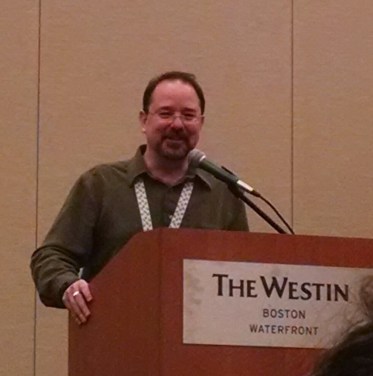
 

scalzi
John Scalzi at his Guest of Honor reading.

Other random bits of awesome:

  • Hearing the geek-folk group Murder Ballads sing “The Ballad of Captain America’s Disapproving Face”
  • Listening to John Scalzi read hilarious excerpts from some cool new projects we’re forbidden to talk about, and then hearing him read “Raising Strong Women,” which is the part where I cried. (So did he.)
  • I bought one of Julia Burns Liberman‘s beautiful abstract story/watercolor paintings (looks awesome in my dining room!)
  • Saw an incredibly cool wood-turning demo by artist guest of honor Johnna Klukas
  • Got a great list of recommendations for places to read speculative poetry (and some specific poems/poets to follow) from the folks on the “Speculative Poetry is Awesome!” panel. You can find a bunch of those recommendations collated on Twitter under the hashtag #poetrypanel (though some of the tweets seem to have disappeared? If you click through to AJ Odasso’s individual feed, they’re still there)

So how did you spend your long weekend?
 

Uncategorized

Narratives Found: A day of surprise and serious wordsmithing

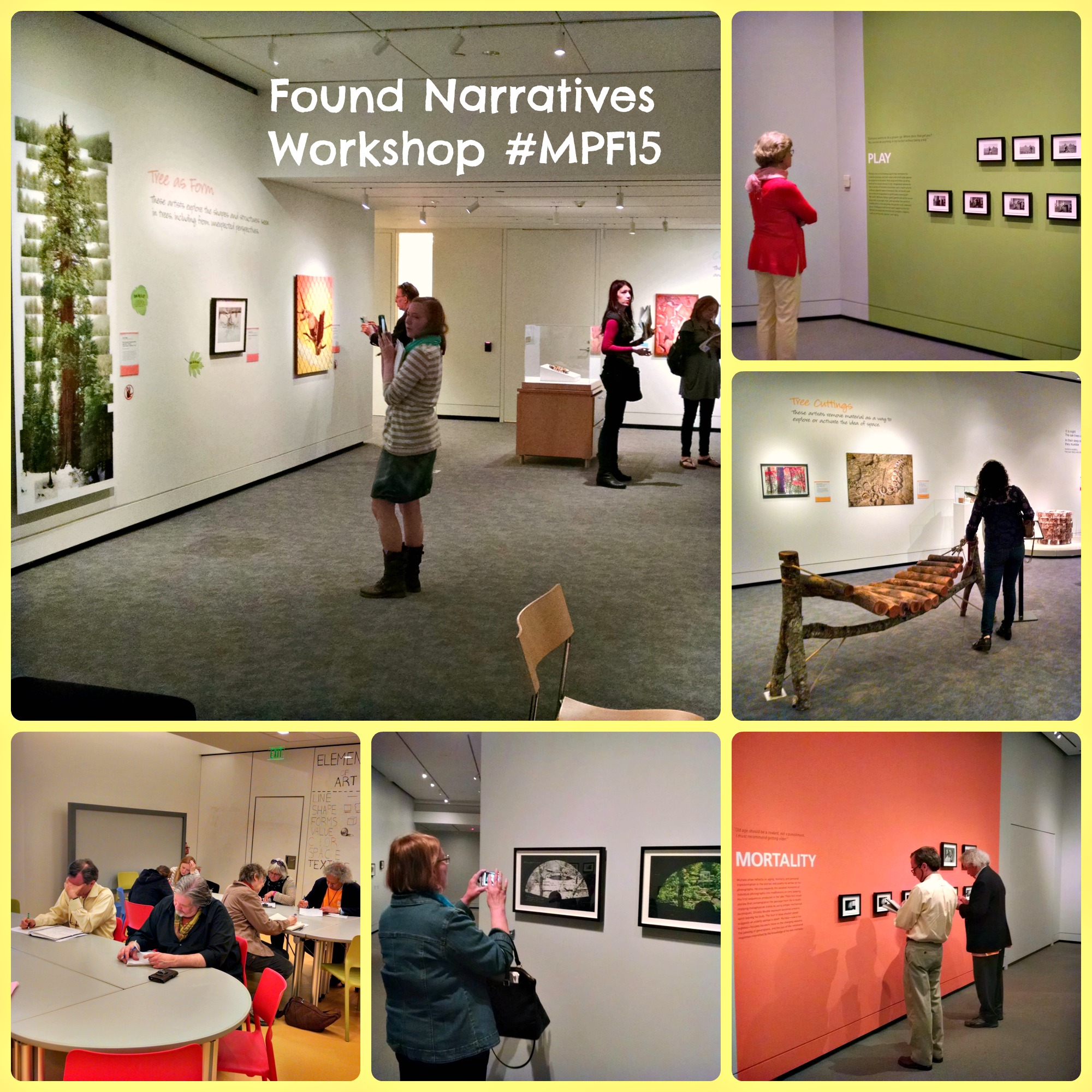
I have lots of thoughts about the last few days of the Mass Poetry Festival, so expect those in a subsequent post, but first I’d like to say ‘thanks!’ to everyone who attended my workshop “Found Narratives” on Sunday morning at the Peabody Essex Museum. I promised I’d put my presentation up online, so the slides are below, with a summary of the ideas that kicked off our writing session.

http://www.slideshare.net/mwinikates/meg-w-mapofest15foundnarratives

What is the role of curators in creating an exhibition, and how is that like (or unlike) the role of a poet?

Curators have a number of roles:

  • Caretaker/Historian/Preservationist – all exhibitions are a continuation of, response to, or rejection of previous history (art history, historical narrative, etc.)  By choosing to include objects, artworks, etc. in a show, curators demonstrate that they think these particular things are worth saving, displaying, and sharing.
  • Author/Editor – curators pick which exhibition elements will best help them tell the story of the person/place/time period/movement/historical event that they want to tell.
  • Interpreter – A good curator (through a good exhibition) poses questions, invites discussion, offers new perspectives, and has an impact on the viewers that gives them a brain-tingling set of new ideas and questions of their own.

Arguably, a poet has much the same set of roles:

  • Historian – all poetry draws inspiration from, responds to, rejects, or reworks the written (and oral!) canon and literary tradition that preceded it. Play and challenge are vital acts of the poet-as-historian.
  • Author/Editor – words are a poet’s tools, and which words you pick and which words you juxtapose, emphasize, etc. are the keys to creating a poem with impact.
  • Interpreter – “If it blows the top of my head off, I know it’s Poetry.” Emily Dickinson was right on, IMHO. Just like visual art, a good poem makes the reader think, question, observe, react, feel, breathe a little differently than before they encountered the words.

The power of both of these roles is in the choices that we make.

Blank walls, blank paper, blank screen. You can put anything there in any order, so where do you start? It all depends on the impact you want to have. Are you aiming for accessible or inscrutable? Mysterious? Open? Comforting or confronting? Your goal determines your choices as much as your natural voice does.

In the case of an exhibition, there are numerous voices involved, of course. Aside from the curator, there are exhibition designers, an interpretive editor, often an educator, all offering suggestions which will help highlight and shape the story the curator wants to tell.  The team’s choices form the bridges for the connections visitors will make when standing in the space.

Will there be long sight lines or lots of small spaces? Which pieces are in conversation with each other, whether in support or in opposition?  Do you hang them together or separately? What color are the walls?  How much extra information do you put on the labels/wall text? What style font do you use?

For poets, this correlates to choices about line length, word juxtaposition, rhyme and meter, form.  Where do you want your viewer’s/reader’s eyes to go next?

The Idea for the Workshop

All this discussion grew out of a collaborative project between myself and photographer Michele Morris, Palettes of Light, in which we paired images from two of her series and then I wrote a poem connecting the two. It seemed a natural progression to me that this would work with any pair of artworks, provided that the poet started with two pieces that resonated with them for one or more reasons.  Ekphrastic poetry has a long and proud history (Musee des Beaux Arts, anyone?), and this is a way to celebrate not only the creative efforts of the visual artist, but also the imaginative connective power of the viewer. (A workshop participant later described this exercise as ‘Next Level Ekphrasis’ and said she was going to teach it to her students, which made me very happy indeed.)

The Task: Find your Narrative

In preparation for spending time in two exhibitions, I asked the workshop participants to do the following:

  • Find 1-2 works in each of the exhibits that really sang to them, for any reason at all.
  • Brainstorm a list of words and phrases provoked by each work.
  • Take photos of the works to use for future reference.  (There was a hard limit of 10 minutes per gallery to make sure we had time to get back to the studio to write, and poetry and art appreciation both benefit from more time.)
  • Once back in the studio, find a connecting thread between the 2 works.
  • Write ‘the bridge,’ aka, draw out the connection and give it support using the inspiration from the two artworks.
  • If they hated everything from one exhibit, they could pick 2 from the same exhibit. (No one who chose to share their work at the end chose this option.)

How do we get there? The Source Material

Using Visual Thinking Strategies, we spent a few minutes in each gallery as a group looking at one art work.  I asked only three questions (“What do you see?” “Why do you say that?” and “What else?”), and let people build upon their own and others’ observations to discuss the work in front of them, then let them go to explore each gallery.

Stop 1: Duane Michals, Storyteller

I picked this show because Michals often treats his photographs as a storyboard: there’s a lot of narrative, sometimes with his own reflections, stories, memories, and poems written directly on the surface of the print. He has a playfulness to a lot of his work that I find appealing, and many of his themes tie easily into poetry (time, mortality, desire, wonder, discomfort, humor).

Stop 2: Branching Out, Trees as Art

This show focuses on the way artists use trees as both artistic material and as inspiration.  There are many more abstract works in this exhibition, and lots of themes about the ways humans relate to their environment.

On their own time, I encouraged participants to explore the rest of the museum as well and try this exercise again.

foundnarrativesmpf15

Possible Connections

There are a lot of ways to find a bridge that connects two seemingly disparate artworks.  The following list I had up on display for participants to consider as they began their writing:

  • Theme
  • Emotional reaction
  • Visual similarities
    • tone
    • texture
    • composition
    • color
    • movement
  • Resonances or dissonances
    • personal memories
    • references to artistic/literary tradition
    • using one artwork as a metaphor or frame for the other
    • timelines (cause and effect, before and after, etc.)

Participants then had about 15 minutes to work on their poems, and time at the end of the session to share their favorite lines (or the whole poem if it was short).  About half the workshop chose to share, and I was really impressed with the vivid language, the fantastic imagery, and the unusual connections they made.  I was also pleased, amused, and a little surprised that a few people chose an interactive element (an amadinda, similar to a log xylophone) instead of an artwork for their second piece.  I had, after all, asked them to find a piece that ‘sang’ to them–a few took me quite literally!

Do you find visual art a stimulus to your writing? Would you try this exercise or share it with your students/writing group? Have you tried it and do you have a result to share?  Add your thoughts to the discussion in the comments below!

Uncategorized

Inspiration or frustration? Workshop “do’s and don’t’s” from the MA Poetry Fest

Leading a workshop can be like trying to get cats to sing in tune, but here are a few suggestions based on what worked and didn't at the 2014 Mass Poetry Festival
Leading a workshop can be like trying to get cats to sing in tune, but here are a few suggestions based on what worked and didn’t at the 2014 Mass Poetry Festival

Any teacher knows that a one hour window in which to teach does not actually involve a full hour’s useful time.  If you’re lucky and you have dedicated learners, by the time you get everyone settled and have introduced the topic, you have maybe 50 minutes at best.  I’m stating this up front, because I recognize how hard it is to fit everything you want to do and say into that kind of time constraint, and I value all the effort that goes into organizing a lesson, workshop, or conference session.  It’s hard to do right, and of the three workshops I attended at the 2014 Mass Poetry Fest, two knocked it out of the park and one was fairly disappointing when it didn’t have to be.

What Doesn’t Work (because it’s always worth getting through those first)

1) Actual session activities don’t match what’s described in the festival program – Yes, between when you submit a conference proposal and when you give your presentation/lead your program, ideas can morph.  But if your session description asks people to bring their own works in progress, and when you start the workshop you make no mention of that and work with writing prompts instead, you will confuse people even if they are willing to go with it.  If you also fail to address anything else listed in the description beyond the vaguest overarching theme, you will end up with at least vaguely dissatisfied participants.

2) What you outline (promise) at the beginning of the session doesn’t happen – Even if you’ve changed your mind about what you want to do in your session, if you don’t follow through on your newly announced plan, your vaguely dissatisfied participants will end up disgruntled.  If it’s important enough to you to look at everyone’s work during the session that you say you’ll do it, then actually do it.  Otherwise, no matter what other interesting information you dispense, the people who get skipped over will feel like they’ve wasted their time.

If you have a flying Delorean or a Time Turner or a TARDIS, I will take your workshop and not mind time management issues at all.  Otherwise, make sure you have a timeline for yourself and stick to it as closely as you can.
If you have a flying Delorean or a Time Turner or a TARDIS, I will take your workshop and not mind time management issues at all. Otherwise, make sure you have a timeline for yourself and stick to it as closely as you can.

3) Wasting time – Be realistic about how much you can get done in an hour, hour and a half, two hours.  If you’re used to giving three day long intensive writing workshops, think back over how long your introductory activity takes, and that’s probably about as much as you can cover in this kind of time window.

4) Self-advertising – Not actually a terrible thing if you make your living as a writing coach or a consultant, so long as the session’s gone smoothly and you have a good sense of the temperature of the room.  But if you’ve had issues with any of numbers 1-3, promoting your next course is likely to backfire.

What Works! (Yay!)

1)  Group participation – Chances are good that most of the people in the room don’t know each other all that well, but a bunch of them likely do belong to writers’ groups and are familiar with both reading their work aloud and collaborative writing prompts.  If you don’t have time to have everyone read, that’s fine and people won’t expect it unless you tell them they will, but a writing exercise as simple as Exquisite Corpse works great as an icebreaker.  And it makes everyone feel included without taking any more time than you might have given to any other writing prompt, sometimes with bonus hilarious results.

2) Handouts – Seems pretty common sense, but if you’re referencing a bunch of works, poems or otherwise, having at least a bibliography and at best a set of full text, along with whatever prompts or resources you’re using in your presentation.  It frees people up from stressing about taking notes, so they can pay more attention to what you’re saying and really take it in.  Plus it’s helpful when they want to go back and reflect after.  I’m really looking forward to reading carefully through the poems provided by Elisabeth Horowitz in the intensely enjoyable “Writing the Sea.”

Bonus suggestion: I used to make sure I had 'emergency sugar' in my desk when I had tired afternoon seventh graders in my classes.  Stick with stuff that's free of the most likely allergens (or with caffeine) and your audience will perk right up.
Bonus suggestion: I used to make sure I had ’emergency sugar’ in my desk when I had tired afternoon seventh graders in my classes. Stick with stuff that’s free of the most likely allergens (or with caffeine) and your audience will perk right up.

3) Spare paper and pens – Okay, at a writers’ event, this may be superfluous.  But notebooks fill and pens run out of ink, so having extras makes you look sweet and thoughtful.  Because you are!

4) Personal touch – Best practices and survey data and such are useful, but the reassurance of a personal success story shouldn’t be undervalued.  And admitting where things went wrong is as interesting and useful as the list of things that went right along the way.

5) Interesting, diverse writing prompts and/or discussion questions – Form, theme, vocabulary, cultural context – there are so many options for cool prompts, and even mixing up the general (‘rivers’) with the specific (line beginnings and ends must match) can lead to really interesting variation that makes people think fast and write fast and be more willing to share, in general, than the things they’ve slaved over and have more invested in.  And it’s not all about the writing either – time for questions is equally important!

Homework is way more fun when you are only being graded by your inner editor.

6) Homework assignments – In the corporate world, these are called ‘action items,’ but the point stands: especially if you’re leading a session on practicalities or logistics, like Susan Rich’s excellent session this weekend on “From Manuscript into Book: Demystifying the Process,” giving participants ideas on what next steps they can be taking once the session is over is great.   I have a number of ‘assignments’ to add to my running to-do lists thanks to Susan, and I’m actually really looking forward to it.  Who knew a task like ‘list the titles of the poems you know you still need to write’ would be such a spur to creativity?

Have you attended any particularly good (or regrettable) conference/festival sessions?  Any helpful hints to share in the comments?  Please do!