Uncategorized

Readercon Wrap-Up

I had a fantastic time at Readercon, so much so, in fact, that I totally failed to take pictures or tweet more than about twice. I did take about a thousand pages worth of notes, not just of the thought-provoking things people were saying, but of ideas that I was generating for stories, and things to keep in mind when revising stories I’m already working on. And clearly, there was a lot to absorb, which is why it’s taken me nearly a week to write up my reactions.
readercon notes
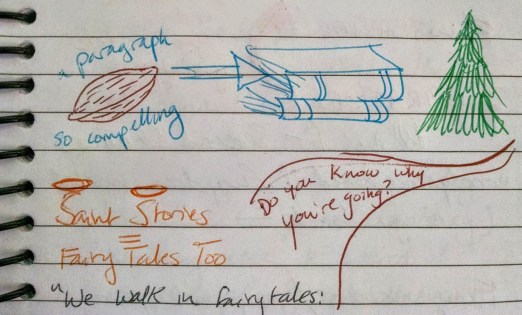
Not all my notes are this pretty. Many of them do contain doodles of rocketships, though.

Readercon is, of course, run by humans, well-intentioned yet possessed of blind spots, so there were a few moments in panels I attended where I winced. Others have covered those moments with more authority than I, however, and overall I was positively impressed with the level of dialogue and discussion in the panels I attended. (I wasn’t at some of the others that caused raised eyebrows.) Given Readercon’s reputation for listening to and responding to feedback, I hope next year will be better. Meanwhile, all my personal interactions with folks were fabulous, and I particularly enjoyed  my two shifts at the Broad Universe table in the Bookstore room, getting to know my fellow New England broads.

The highest hilarity of the weekend for me was the “My Character Ate What?” game show on sci-fi fantasy and food. I went because I so enjoyed watching that video of Mary Robinette Kowal breaking Pat Rothfuss’s brain, and I was sure she would not disappoint here either. She didn’t, and the rest of the panel of author ‘experts’ were equally hilarious, earnest, and full of beans in turn. (Both this and the engineering panel were led by Fran Wilde who also gets kudos for being a spiffing moderator.)
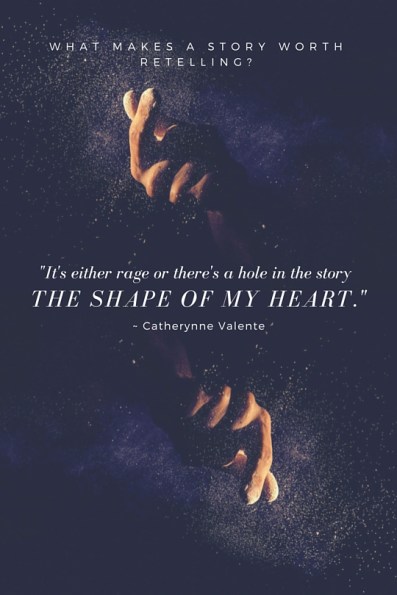
What makes a story worth retelling_

Guest of Honor Catherynne Valente was gracious, snarky, and inspiring by turns, and I thoroughly enjoyed all the panels I attended that she was on, as well as her solo reading. I even managed to get a couple of books signed and say ‘hi’ without making a complete fool of myself, so go me. (Author-encounter word-vomit is a thing, I’m sorry to say, but I did avoid it this weekend.)

I won’t attempt to transcribe my gazillion notes for you, but here are some highlights and particularly cool thoughts from some of the panels I attended.

Speculative Retellings – Fabulous kickoff to the con for me. Retellings of myths and fairytales and folklore are *so* much fun, and the folks on the panel clearly agreed. The quote from Cat Valente above was from this panel, as is the picture of my notebook. The conversation ranged from superheroes to saints, origin stories galore, the retelling  opportunities present in both senses of identification with a story and senses of confusion or other-ness (‘this story isn’t really meant for me, but what if it was?’).  We re-tell stories either because we love them or we hate them and want to fix them (hello, fandom!). Frustration as inspiration, and questions about the currency of sacrifice–what are you willing to give up, to walk the path of the hero? What are the stories or characters that need second chances? Or choices? (Cat Valente pointed out that no one ever asked Eurydice if she *wanted* to leave the underworld with Orpheus, after all. Maybe she wanted to stay…)

Strong Female Characters and ‘Lady Bromances’ aka Female Friendships in Literature – I’m lumping my summary of these two panels together, because for me one fed into the other. There was a lot in here, and there’s room for more. I liked Mikki Kendall‘s point about Zoe Washburn in Firefly, and how she’s a perfect example of how the fact that women who possess the ability to compartmentalize in crisis are often not given the narrative room to have their grief or other emotional reactions once the crisis is passed. This is a trope that disproportionately affects black female characters; based on the evidence of Melinda May in the Marvel Universe and a few others I would think it affects other female characters of color as well. After all, Peggy Carter (whom I love, even recognizing the flaws in the show) gets a very rare but very real and necessary moment of grief for her roommate, who dies in the first episode after about 2.5 minutes of screen time. It’s a great moment, and more characters regardless of gender or race deserve the narrative space to be fully-rounded human beings. In counterpoint, the discussion of female friendships was great, because friends are part of what help make us fully rounded characters, and show different sides than might otherwise come across. Girlhood friends, adult friends, intergenerational friends; it was a good list of stories and characters that the panelists mentioned, and there were both books I now have to read and stories I now have to write.

Engineering in Fantasy – Definitely one of my favorite panels of the weekend. “Buildings have to get built, regardless,” said  John Chu, and from there it was off to the role of engineering in worldbuilding (more than just how people get around; not only on what, but do they have roads? irrigation? cartographers?) and the way good engineering is invisible until it breaks. This means breaking your engineering is a good story point; when something fails, what takes its place? Was it working for its original purpose and only broke when it was repurposed? What happens to a society’s structure when new tech is introduced? How much engineering can your world have without the theoretical science to back it up? (Because you can make things work without knowing why…) What about social engineering, the structures that make feudal systems and militaries work, among other things? What about a kind of educational and cultural infrastructure, the role of political and religious elites in spreading and sharing knowledge? Plus there are the benefits of looking at the way different cultures find different ways to solve the same problems and what that tells you about them, which is engineering as a kind of cultural shorthand, ie. the bridges of the Elves vs. the bridges of the Dwarves in Tolkien. (Several people in that session now want to write the story about “OSHA goes to Moria…”) Many kudos to both the panelists and the people in the audience who asked brilliant follow up questions!

Magic in Space – Jedi are space wizards, and that’s a very fine thing. But who else is writing cool magic in traditionally sci-fi milieus? This was a really fun panel talking about working mythology and magic systems into sci-fi: techno-mages, for instance, or mythical monsters in charge of alien planets, the concept of interstellar travel as its own sort of epic fantasy. Mikki Kendall said something interesting about how the differences in sci-fi versus fantasy are essentially just a matter of tone: “You have power. Period. How you choose to use that power is up to you,” which led to a neat discussion about spellcasting equivalents to computer programming, fears as inspirations, about magic being about control or accepting the loss of same, and when is magic a science (part of the rules of how that universe works) or something else (which breaks or bends the established rules of that universe). Does magic or sci-fi better answer the questions of why we seem to be alone in the universe? Is it just because the scale of space and time is just so vast, or are we being avoided? Will we recognize life when we find it? What about that space-jellyfish in Star Trek? Hasn’t there been magic in sci-fi all along? And isn’t it an example of magical thinking just to imagine the ways that life could be better or different, the way sci-fi writers naturally do?

Keytars in SF – Music is such an integral part to culture; it’s as worth considering (or considering its deliberate lack) in worldbuilding as engineering is. Discussion in this panel included everything from Earth music of past times being re-interpreted in the future (Star Trek TNG‘s Riker plays jazz and Data plays classical violin, Doctor Who declared Britney Spears the fitting soundtrack to the final explosion of the Earth) to alien instruments (Spock’s lute/harp thing, Dixieland-style music in Star Wars ANH‘s cantina) to the challenges and benefits of describing music and mood and enviroment as opposed to being able to show/play it in live media. The major thought-provoking statement from this panel for me (which I’m pretty sure was one of Cat Valente’s points) was thinking about music starting point being in the body; dance, rhythm, the physical requirements of instruments that need breath or digits or tentacles. (Now I want to write about an alien rock band…)

Mary Robinette Kowal’s “Short Story Structure (for Novelists)” workshop/lecture was a real writers’ craft highlight. Unfortunately, as she said in the beginning, she had ‘2 hours worth of content and only an hour to deliver;’ had the program wizards given her a 2 hour block, we would surely all have stayed. [Much as I appreciate the rapid-fire blocks of 50 minute sessions, I’d actually argue for a few more longer sessions for this level of quality content.] Fortunately, she did get through all the content delivery, though our ‘workshop’ was limited to ‘write down a whizzbang idea.’ She did, however, mention that she has writing exercises available on her website, which I intend to use. The diagnostic tools she introduced (average wordcounts for introducing locations and characters, levels of complexity involved in number of plot elements) were really helpful; looking back at some of my stories that have ballooned past what could reasonably be considered ‘short’ I can now tell why! I will definitely be using the plot sequencing idea (open and close your plot threads like html tags) to revise some of my short stories as well.
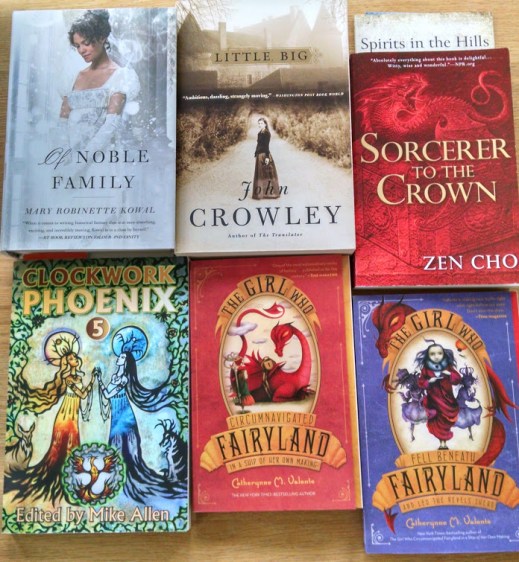
 

readercon bookpile
Books I either acquired this weekend or brought along to get autographs. My to-be-read pile just never gets any shorter…
Uncategorized

“A hobby that swallows you up” – An evening with Billy Collins

The JFK Library and Museum runs fabulous and fascinating evening events, and last month I was thrilled to  go hear Billy Collins (former US Poet Laureate, a title he enjoys saying, apparently, and who can blame him?) read some of his work and have a conversation about poetry and writing and reading of same.

The introduction featured a fun bit of historical context on JFK’s associations with poetry, including a clip from Kennedy’s Amherst College speech honoring Robert Frost, which I’ve linked below:
NEA recording and transcript of Kennedy’s Amherst College speech regarding Robert Frost
Amherst College web exhibition “President and Poet”

And, of course, the view of the city and harbor out the windows behind the speaker was as stunning as always.

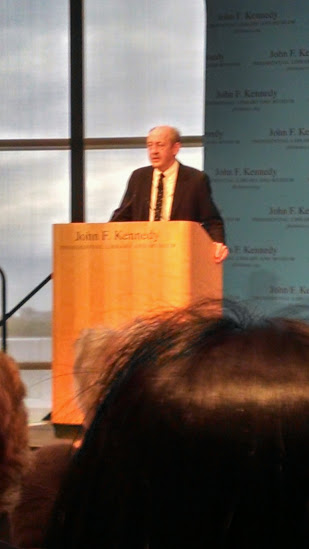
Billy Collins reads at the JFK Library, May 2014

Collins was entertaining from the very start, declaring that it was an honor to be mentioned in the same breath as Robert Frost, as “compared to Frost, my poems are like an unmade bed in a dorm room.”

Other highlights from the discussion–

  • On the surreal tone of some of his poems and how not to lose readers: “start in Kansas, but end up in Oz.” Start with an idea, set the tone, start out ordinary and develop into something interesting and strange
  • Domesticity is interesting, to start with a common experience and then dive ‘down and in’ to the more subjective point of view
  • To be alone with the reader is not the same as being lonely
  • When ‘finding the way through’ the poem, Collins looks at it like a map: ‘how does it move’ as opposed to ‘what does it mean.’
  • Collins’ writing ‘persona’ is very present in his poems – open, ready to be pleased (though not always succeeding), and with ‘little capacity for misery.’  According to Collins, all poetry needs/involves persona, which is not the same as personal – he denies any explicit autobiography in his writing.  (And, indeed, is not fond of overtly familial poems as reading matter, either)
  • One doesn’t exactly choose to become a professional poet, it is more like ‘a hobby that swallows you up.’

Want more?  Check out Collins’ Biography and large selection of poems on PoetryFoundation.org or one of the poems he read that night which I enjoyed quite a bit:  Fishing on the Susquehanna

A genial conversation

Want even more than my highlights?  Hear it from the man himself:  TED Talk by Billy Collins

At the end of the evening, there was a little time for Q&A.  I’m not a big fan of getting up to ask questions in front of a microphone (I don’t mind public speaking, but public interrogation is somehow harder!) Since Collins was signing books after, however, I did get to ask him about one of his comments from earlier in the evening.  He had stated that the majority of poems (not to mention poetry collections), he doesn’t even read all the way through, so I asked which poets, if any, had writing which he did read all the way to the end.

His answer?  Charles Simic.

That’s a name I recognized, though I couldn’t put words to the name, so I did a little research and reading, and now know enough to put him on the list of poets’ names to scan for when I’m in a bookstore.

A few poems of Simic’s I’ve found appealing so far:
In The Library
Autumn Sky

What of Collins’ statements above ring true to you?  Any quibbles? (I have a few, but that’s what makes life and literature interesting, right?)

Uncategorized

Fun and Interesting Writers on Writing

Lots of people who write like to write about writing.  Oftentimes what they say is contradictory, sometimes it’s too obvious to be truly useful, and yet occasionally you come across things which are genuinely interesting, entertaining, and elucidating.  Here are a few I’ve come across recently:

Scott Adams, creator of Dilbert, on “How to Write like a Cartoonist,” breaks down some of the basic elements of writing humor.

I have long loved Patricia C. Wrede’s novels, and her blog often has really interesting posts on elements of the writing process.  One of my favorites so far was on the difficulty of multi-person point of view and big complicated stories: “Complicated Webs”

The bloggers over at Writers’ Digest also can offer up interesting nuggets (assuming one doesn’t mind the plugs for the books available through the WD shop, etc.)  One post which  encapsulated one of the problems I had with Rick Riordan’s newest book, The Red Pyramid, was “The Biggest Bad Advice about Story Openings,” pointing out the weaknesses in the old advice ‘Start with action.’

Portrait of Chaucer by Thomas Hoccleve in the Regiment of Princes (1412). Click for link

And for sheer geeky writer glee, I must pass along the link which a fellow writer friend shared recently: Geoffrey Chaucer Hath a Blog.  It’s written in Middle English (with a few modern adaptations) and is several levels of hilarious, if you’re anything like me (By which I mean ‘spent a whole semester reading almost nothing but medieval romances and the like.’  An understandably small percentage of you, I’m guessing).

Uncategorized

Happy National Day on Writing

Yes, technically November is NaNoWriMo, which continues to look like a bad idea when one is working full time and taking two grad school classes.  However, for those of us with the spirit but also the time crunch, today is the first ever National Day on Writing, hosted by NCTE (Nat’l Council for Teachers of English), and signed into officialdom by a Senate resolution.

Educational Brick Letter W letter R letter I t45 letter e

The website, hosted by NCTE, invites you to submit your writing to a National Gallery of Writing, and also participate in the day-long webcast led by various authors, etc.   They’re also running all kinds of commentary, re-tweets, etc. on writing through Twitter, under #ndw.  I think this is all very cool–I just wish I had known about it sooner!  The first I heard of it was this morning, when I got my daily BU email, talking about all the cool writing-related activities going on at the student union. So I went and did a little digging.

Curiously, the mission statement on the NDW homepage reads:

Established by NCTE, the National Gallery and the National Day

  • highlight the remarkable variety of writing we engage in today;
  • provide a collection for research on whether writing today has risen to new highs or sunk to new lows; and
  • help us help others to write better.

I find this an odd assortment of goals.  Encourage people to enjoy writing? Showcase the many uses and forms and beauties of the written word?   Spread the word about ways to improve your writing?  Generally support the practitioners of what has often been deemed a ‘solitary craft?’  Great!  All good stuff.

But…provide a collection for research on whether writing today has risen to new highs or sunk to new lows?  This makes my critical-thinker’s brain sit up and say ‘really?’   Compared to what and when?  Are we looking at word-length, acceptable use of grammar, flights of metaphor and allusion, variety of vocabulary and reasonable spelling?  Logic, support, and originality?  Are we seriously looking at the efforts of a bunch of random people on the internet as compared to the letters of John and Abigail Adams?  As I didn’t see anything else related to that particular goal on the site, I’m just going to hope that the NCTE knows what it’s doing.  Certainly the proliferation of LOLspeak iz srsly scary, if also occasionally amusing.

And so, despite my intellectual question marks of the above paragraph, I am thrilled to see a day in celebration of writing.  Therefore, I say: Go forth!  Put pen to paper or fingers to keyboard or marker to whiteboard or pencil to post it note or stylus to clay tablet!  (No, seriously, why not?)  Twitter a haiku, send a letter to an old friend, drop some Shakespeare into your next staff bulletin.  Revel in the ridiculous rules of language, break a few, read a book, share some really really bad puns.  It’s the write thing to do.  😉

Uncategorized

Sorrow in the song for a three-dimensioned life

This morning was a Friday morning, and on Fridays I try not to let the news depress me.  On the other hand, it’s been a bad week, news-wise, for some of my heart-held causes, and the front page of The Boston Globe tipped me over the edge at breakfast.

Welcome to the library. Say goodbye to the books.

Excuse me? Cushing Academy is getting rid of all of their 20 thousand books in favor of 18 digital readers and a bunch of cubicles with power supplies?  They’re deliberating calling it a ‘learning center’ instead of a library?

Have they completely lost their minds?

In a week that has already had horrible news for the world of those who love to read (Reading Rainbow canceled after 26 years, a true heart-breaker for me, who grew up on public television, adored this show & LeVar Burton, and never grew out of loving read-alouds), this is just another example of how shortsighted people can be in the name of ‘looking to the future.’

I’m not even going to touch the (to the daughter of a librarian) extremely obvious issues about authority, editing, responsible use and citation, bias, and availability of certain kinds of information on the web.  The internet is not all-knowing, and it hasn’t got all the books in all the world.   Neither does a library, but they’re a heck of a lot better at getting them for you when you need them, usually for free.  I’m not arguing that there’s no place for digital resources–I use them all the time, and there are some incredible ones out there, like the CIA World Factbook that are an invaluable addition to the use of a standard atlas.  But the fact that books can be bulky and need dusting every now and again is not a valid argument for ditching them in favor of things that need power, cost more, and don’t necessarily last as long or work as well.

Ditching books, teaching phonics and mechanics to the exclusion of encouraging why and how to enjoy reading–Are we trying to make sure that in 20 years there’s no one left under the age of 40 who loves to read?  Have we let standardization and the all-powerful search button erase the pleasure of accidental discovery?

Reading a book of poetry isn’t just about reading the one poem you went looking for–it’s about how it’s laid out on the page, what poems are put on either side of it, the volume as a whole and what it says about the journey of the poet at that particular point in time.  Browsing Amazon.com is not equivalent to wandering the bookshelves of a library–‘viewers who purchased this book also looked at’ is not a substitute for a librarian’s assistance or the joy of coming across something interesting on your way to looking for something else.  Going directly to what you’re looking for is a bonus function of some electronic databases, sure, but the same goes for a card catalog.  And neither can replace the wonders of serendipity for a true reader, or for someone who has the potential to get there, assuming their library doesn’t get replaced by robots.

In conclusion, vivez les livres!

Exciting new technology: The B.O.O.K.