
Uncategorized

The World in a Grain of Sand

As always, the Mass Poetry Festival was awesome. The sun shone on the small press fair and the Poetry Circus, the readers were in good voice, and it was fabulous catching up with friends. I particularly enjoyed the “embodied creativity” yoga & writing workshop and the poets who read their works written in Emily Dickinson’s bedroom. My thanks and compliments to everyone involved in carrying out the festival: the hard-working staff at MassPoetry, PEM, and the scores of volunteers.

As part of the festival, I had the pleasure of leading another workshop at the Peabody Essex Museum on connecting poetry to visual art, this time focusing on the idea of incorporating scale. I had a group of about 30 people and loved getting to introduce them to the Art & Nature Center’s current show, Sizing it Up: Scale in Nature and Art.
IMG_20160430_154243772
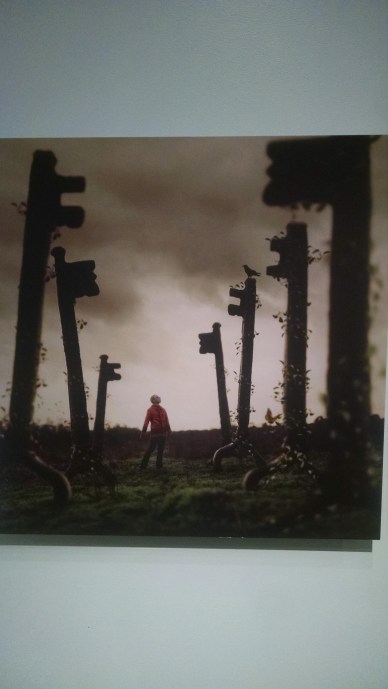
Led to Your True Path, Joel Robison, 2014. Part of the Sizing it Up exhibition at the Peabody Essex Museum

We started by defining ‘scale’ for the purposes of the workshop:

  • Visual (comparison to human scale)
  • Extra-visual (too extremely small or large for human perception)
  • Physical (in relation to your body)
  • Constructed (in relationship to your page or canvas)

To get our brains in gear, we did a ‘constructed scale’ poetry writing exercise, where people picked a piece of paper that was not their usual notebook size (register tape, index cards, post-it notes) and drafted a poem where the lines fit the size of the paper exactly, no line breaks too short or too long for the physical space.

Then we went into the gallery to read a few poems that use scale, next to visual art works that evoked the same feeling.

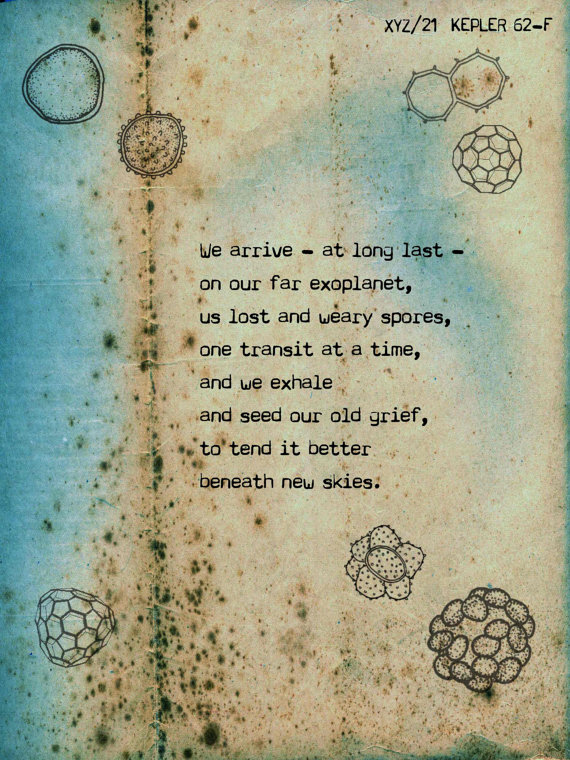
Searching for Goldilocks, by Angela Palmer, is an artwork that depicts all the exoplanets (planets found outside our solar system) including ones in the ‘Goldilocks zone’ that might contain recognizable life like our own Earth. (You can read more about planets in the Goldilocks zone here) Next to Searching for Goldilocks, we read “Kepler 62-F” by xYz, which is the pen name of Joanna Tilsley.
xYz kepler62F

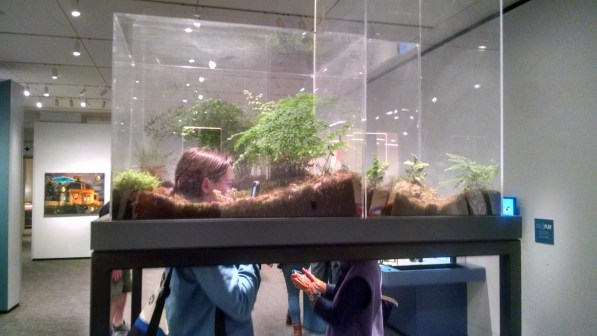
Metropolis, by Vaughn Bell, is an artwork that allows up to four people to get their faces at forest floor level by stepping under and up into a series of connected terrariums featuring local plantlife.
IMG_20160430_153942058_HDR
Workshop participants experiencing Metropolis.

Next to Metropolis, we read “The Scale of Things,” by Margaret Tait (originally published in The Hen and the Bees, 1960)

The Scale of Things
by Margaret Tait

There’s a whole country at the foot of the stone
If you care to look
These are the stones we have instead of trees
In the north.
Our trees all got lost,
Blown over or cut down
Long long ago, and some of them lie there still in the
peat moss
Or fossilized in limestone.
At the shady foot of trees
Certain things grow,
But at the foot of stone grow the sun-loving
wind–resisting short plants
With very small bright flowers
And compact, precise leaves.
The wind whips the tight stems into a vibration,
But they don’t break.
The full light of the sun reaches right down to the
ground,
And reflects obliquely and sideways in among and
under the snug leaves,
And settles on the stone too,
Makes a glow there,
A sufficient warmth and clarified light.
The stunning frequencies seem to get absorbed
And if you stare closely at the stone
It’s a calm light, not too blue,
Precisely indicating its variegated surface.
The great stone stands,
On a different scale, in a way, from the minute plants
at its base.
A proliferating green lichen
Grows on it
As well as round golden coin-patches of another
common lichen,
And only in the earth right up to the very stone but
not on it
Grow the crisp grass
And all the tiny plants and flowers
Which, together interlaced and inter-related,
Make the fine springing turf which people and animals
walk on.

Then I set the workshop participants free to spend about 20 minutes in the gallery brainstorming in front of one or more pieces of scale-related art, after which we shared our reactions and results. It was especially neat to hear which artworks drew people in, and how many participants felt the same dislocation as Alice or Gulliver, feeling themselves suddenly much larger or smaller than ever before. Several people also headed back into the gallery to spend more time with the art after the workshop, which felt like success to me.

You can download the handouts (writing exercise directions, poems, and more) here: The World in a Grain of Sand handout. I highly recommend a visit to the museum while you’re at it!

Finally, here are a few cool scale-related links I used in my research for the program, if you’d like to explore more:

Uncategorized

Found: Poetry, Art, and Longfellow connections

I had a great time leading two workshops at the Longfellow House/Washington’s Headquarters National Historic Site to help celebrate National Poetry Month.

“Something New, Something Strange:” Found Poetry Workshop

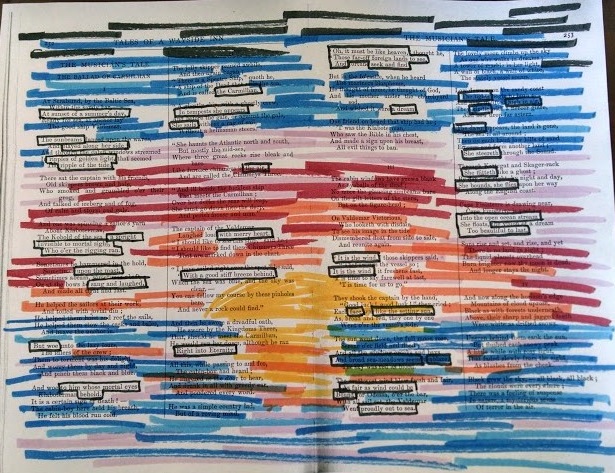
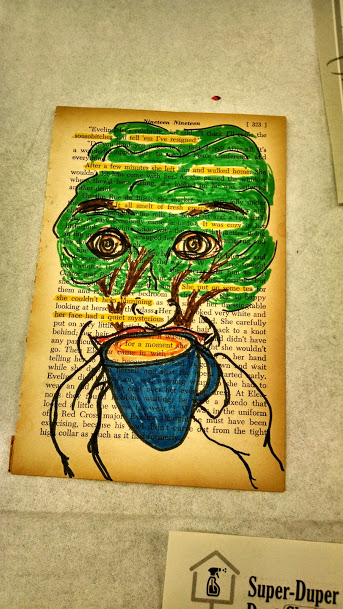
This workshop included lots of discussion of found poetry in the 21st century, including the many ways the internet has made found poetry more possible, varied, and hilarious. We tried illustrated found poetry using Henry Longfellow’s poetry, and also pages from a mystery novel and a historical fiction, and talked about fun everyday found poetry from sources like Pentametron and GooglePoetics.

longfellow shipwreck found poem
My found poem of a sea sprite, from Longfellow’s “Musician’s Tale” in Tales of a Wayside Inn.

“Grace Unto Every Art:” Poetry and Visual Arts Workshop

This included getting to talk about the Longfellow family connections to the visual arts (Henry’s wife Fanny Appleton had a brother, Thomas, who was part of the founding of the MFA. Henry’s older son Charlie collected a lot of Asian art on his trip to Japan, and Henry’s younger son Ernest became a painter.) and taking a tour of the first floor of the house. Many thanks to the fabulous rangers who kept an eye on us and answered our dozens of questions as we each picked an object that inspired us to write!

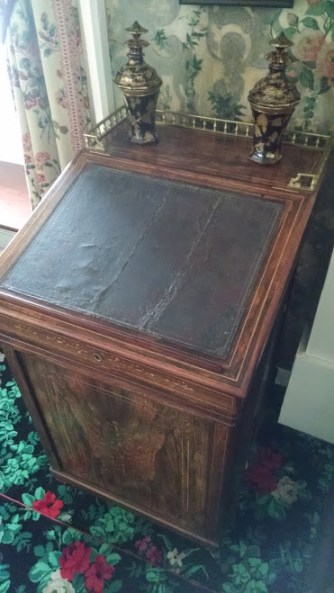
fanny longfellow writing desk
Fanny Longfellow’s writing desk in the parlor of the Longfellow National Historic Site

Inspirational Books
I brought these to the workshops for people to leaf through for inspiration; you can find them at your local library or bookstore (or museum gift shop!):

Missed out on the workshops? There’s lots of cool programs coming up at Longfellow for their summer festival, and the Mass Poetry Festival is this weekend in Salem, MA. I’ll be at the Peabody Essex Museum talking scale in poetry & art on Saturday afternoon. Hope to see you there!

Uncategorized

Should everyone write poetry?

It’s National Poetry Month! Lots of fun poetry news and discussion to share with you this month.

I recently re-encountered an article from 2014: “Everybody Should Write Poetry” by Peggy Rosenthal. I had bookmarked it because I was drawn to the idea that “everyone needs to nestle down inside language to get to know its ways, to get comfy with how playful it can be, how expansive, how unexpected in its openings to new experience.” It reminded me of the kinds of conversations I’ve had in the other part of my professional life, among those of us who work in museums and in education and in the arts. Participating in something; taking a class in glass fusing, for instance, gives you an appreciation for the process and the artistic choices and the intricacies of both which you keep forever, however lopsided or surprising your own* efforts turned out to be. (*Meaning, of course, my own!)

On the same day I apparently bookmarked an article with suggestions on “How to Read Poetry” – not requirements, but suggestions on ways to approach it without the apprehension of ‘getting it wrong.’ Again, a discussion that we keep having in museums and symphonies and similar venues; how do we best let people know that, barring actual destruction, there aren’t really ways to be ‘wrong’ in such spaces? (Perhaps we should take some marginalia notes ourselves.)

So what do you think? “Should” everyone write poetry? (or make art? or play music? or fix a car?) What’s your favorite way to approach a new poem or experience?

Finally, a shameless plug, because I firmly believe that while ‘shoulds’ are odious, ‘go for its!’ are necessary and beautiful.  Therefore, if you feel like writing poetry, go for it! and you can even do some writing with me:

“Something New, Something Strange: Found Poetry” at Longfellow National Historic Site, this Thursday, 4/7, at 6:30 pm

visitor altered page at PEM

“Grace Unto Every Art: Poetry from Visual Art” also at Longfellow National Historic Site, Saturday, 4/16, at 2 pm

p5250054

“The World in a Grain of Sand: Incorporating Scale in Poetry and Art” at the Peabody Essex Museum, Saturday, 4/30, at 3:15 pm (Part of the Mass Poetry Festival!)

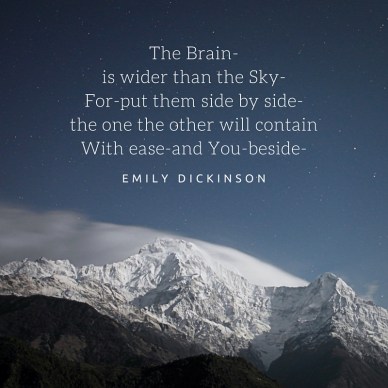
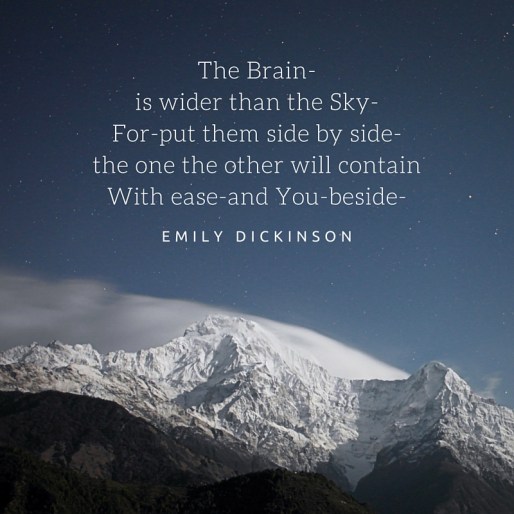
The Brain-is wider than the Sky-For-put them side by side-the one the other will containWith ease-and You-beside-

Uncategorized

Poetry Ahoy! Upcoming Workshops

National Poetry Month is still more than a month away, but I’m already in planning mode. (Meanwhile, did you know February is Library Lover’s Month? Go hug your favorite librarian!)

meg for emporium32 2015
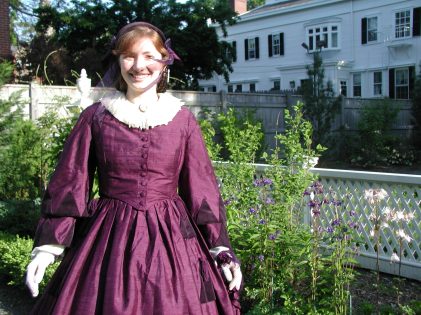
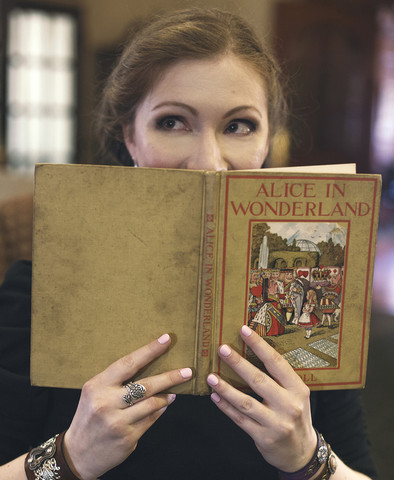
‘Found poetry’ from old books! Playing with scale in literature and art! April is going to be awesome. (Photo by Nate Buchman, http://www.natebuchman.com/ for Emporium 32, http://emporium32.com/ Go check them out if you like the jewelry I’m wearing in this photo.)

I’m very pleased to announce that I’ll be leading three poetry workshops in April!  If you’re in the driving-distance-from-Boston area, I hope you’ll stop by and join me for some playing with words and art.

Something New, Something Strange: Found Poetry
April 7, 6:30 pm, Longfellow National Historic Site, Cambridge

In Longfellow’s poem “Keramos,” a potter at his wheel says, “All things must change/To Something new, to something strange.” Recombine, illustrate, and give shape to old forms using found poetry techniques with poet and educator Meg Winikates as part of our celebration of National Poetry Month. Please call (617)876-4491 or email reservationsat105@gmail.com to reserve your spot!

Grace Unto Every Art: Poetry from Visual Art
April 16, 2:00 pm, Longfellow National Historic Site, Cambridge

Whether it was shipbuilding, smithing, sculpting, or singing, Henry Longfellow found poetry in all forms of art. Join poet and educator Meg Winikates to explore ekphrastic poetry, enjoy the Longfellows’ art collection, and write your own art-inspired pieces as part of our celebration of National Poetry Month. Please call (617)876-4491 or email reservationsat105@gmail.com to reserve your spot!

The Brain-is wider than the Sky-For-put them side by side-the one the other will containWith ease-and You-beside-

The World in a Grain of Sand – Incorporating Scale in Poetry and Art
Massachusetts Poetry Festival (April 29, 30 or May 1), Peabody Essex Museum, Salem

Galaxies and exoplanets, scanning electron microscopes, 4 million queries per minute on Google: in our ever expanding universe, is the human brain still ‘wider than the sky’ as Emily Dickinson said? What is the role of poet or artist in helping us understand how and where humans fit? Join poet and museum professional Meg Winikates to explore the use of scale in poetry and art in PEM’s Sizing It Up exhibition, experiment with physical and mental scale in your writing, and generate a poem idea (or three!) inspired by the artworks on view.
Buttons for the festival are not yet on sale, so keep checking the MassPoetry site for updates on button sales and scheduling!


Uncategorized

Arisia 2016 Wrap-up

So Arisia was a big, busy, beautiful mess of a weekend. I didn’t make it to all the panels I intended, I accidentally ended up in sessions that were awesome, and John Scalzi made me cry (in the good way).

I am not going to even try to cover everything, but here are a few highlights from this past weekend:

Nonstandard Paths to Magic
Honestly, I thought there would be more discussion of cool non-Latinate, non-Hogwarts, non-Western magic systems, but it was mostly a series of thought-provoking questions about the assumptions we make about magic, how it works, and who uses it. Some of my favorites:

  • Is magic transformative? If so, how does it change the user? How big are the changes, and how much of that depends on where in society the magic user starts?
  • Magic as ‘spiritual technology’ – do you have to believe in the tools to make them work?
  • How does magic-as-mystery (Tolkien) stack up against magic-as-textbook (Sanderson) and what are the strengths and weaknesses of each? When can you get a magical solution to a non-magical problem, or a non-magical solution to a magical problem (haul that ring to the volcano and throw it in, ’cause nothing else will unmake it!)?
  • Do you always need the good/evil dichotomy, when referring either to magic or to the people that use it? Where is the line between them, and is it the same for all people in that system?
  • Standard magic almost always comes with a price; should it? Is it a human thing, to feel like things ought to have a price attached? [and a corollary not discussed in the panel, but which I want to explore now: what if magic were an exhaustible resource, like fossil fuels, rather than renewable/constant/growing like the Force?]
cities in the caves beneath the ocean
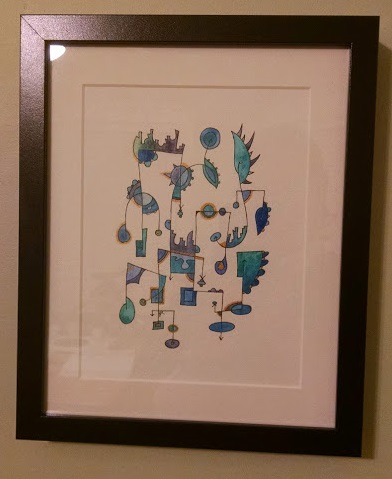
My new watercolor by Julia of Pelagiella Designs (link below)

Shifting the Language of SF
If you’re not super into the geekiness of language, scroll on. I *am* into the super geekiness of language, and there were points when I wanted to just throw up my hands and ask what the Klingon word for ‘surrender’ was. (I don’t actually think there is one, come to that. Klingons are not into surrender.)

This panel ranged wildly all over the discussion of language, from why you shouldn’t try to write dialect out phonetically, to the poetics of rhythm in language from different time periods, to what English might sound like if the Normans had never invaded (apparently you should read ‘Uncleftish Beholding‘ if you want to find out).

Here are a few of the panelists’ suggested ‘shortcuts’ to making your language not sound like 21st century English (with or without Tumblr-speak, a variation on netlanguage they didn’t get around to discussing, but I heard used by panelists in other sessions, because language):

  • Take an element of your speculative fiction (McDonald’s takes over the Western world and thus this fiction is all about fast food and consumer culture) and incorporate the ticks of that existing ‘language’ to create your new McPolitics, McFashion, and McTech.
  • Make it sound like a historical period instead. Have your aliens speak like Shakespeare, or your warp field engineers write reports like Fitzwilliam Darcy.
  • Use a poetic meter not standard to English (hexameter instead of pentameter). Caveat: Do not ever make your characters speak in rhyme, or your audience will hunt you down, if your editor doesn’t do it first.
  • Consider what the street slang of your alien/future tongue sounds like, as well as the cultured spaceship captain’s commands.
  • Mess around with the ‘easy’ grammar; change up prepositions, use synonyms not common in daily speech, use similes that don’t exist yet (“Your hair smells like freeze-dried rheolene fibers”). Use only the 1000 top words in the language and build the words you need additively like German does (‘glove’ translates to ‘hand-shoe,’ and no, I am not making that up).

Complexities of Voice
This built really nicely off the above language panel, and also one I went to on character interactions, which was a little basic but still interesting. (One did get the feeling that some of the folks in the audience asking questions were young, and as interested in getting ideas on how to interact in real life as they were trying to get their characters to talk to each other.) The best tips from this panel:

  • Read your work aloud. Have someone else read it aloud. Can you tell the characters apart?
  • Use styles that suit the kind of character you’re building. Think about levels of formality, slang and syntax, long sentences or short ones, incomplete thoughts or run-ons and tangents. Put all that info in your character cheat sheets with eye color, favorite food, and all that other background you need.
  • ‘Borrow’ a real-world person for your voice (may want/need to ask permission, if you know them personally!) or ‘fancast’ your characters with appropriate actors. Does your character sound like Alan Rickman? Maggie Smith? Will Smith?
  • Avoid infodumps and mansplaining. Even if it ‘sounds’ like your character, very few people get away with talking in paragraphs.
  • Find and then listen to/read the stories and conversations of people who come from the background you’re trying to write. The Smithsonian, NPR’s StoryCorps, and the Library of Congress are all good places to start for free oral history sources.


scalzi
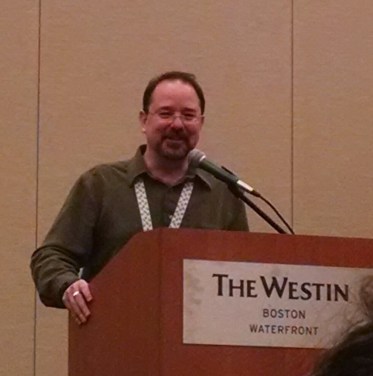
John Scalzi at his Guest of Honor reading.

Other random bits of awesome:

  • Hearing the geek-folk group Murder Ballads sing “The Ballad of Captain America’s Disapproving Face”
  • Listening to John Scalzi read hilarious excerpts from some cool new projects we’re forbidden to talk about, and then hearing him read “Raising Strong Women,” which is the part where I cried. (So did he.)
  • I bought one of Julia Burns Liberman‘s beautiful abstract story/watercolor paintings (looks awesome in my dining room!)
  • Saw an incredibly cool wood-turning demo by artist guest of honor Johnna Klukas
  • Got a great list of recommendations for places to read speculative poetry (and some specific poems/poets to follow) from the folks on the “Speculative Poetry is Awesome!” panel. You can find a bunch of those recommendations collated on Twitter under the hashtag #poetrypanel (though some of the tweets seem to have disappeared? If you click through to AJ Odasso’s individual feed, they’re still there)

So how did you spend your long weekend?


Uncategorized

Poem: “Winter is a Dragon Day”

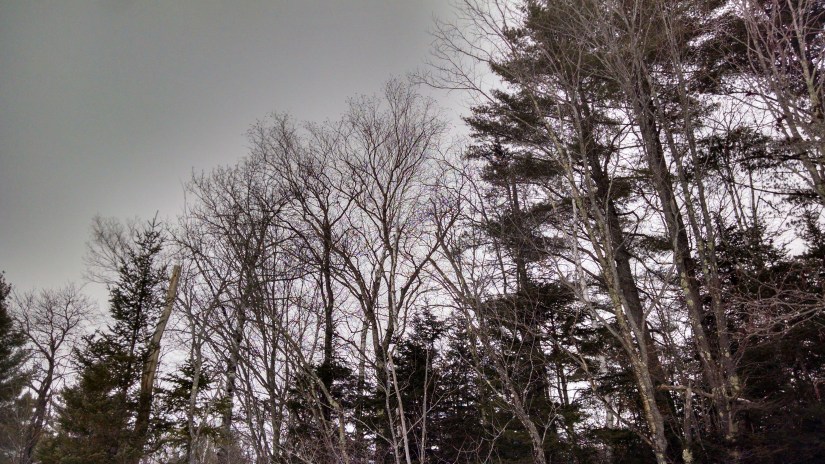
I have loved the several recent days of deep bright blue that is a sky color you never see in a hazy summer, but I have a certain affection for the fierce slate days as well.

Winter is a Dragon Day
By Meg Winikates

Gray clouds have teeth;
their bite bloods my cheeks
and my breath boils.
With every gust I prove I am alive.

jackson2015
Jackson, NH. Photo by Meg Winikates, 2015
Uncategorized

At home in a galaxy, far far away

The Force Awakens is everywhere! I promise this isn’t about to become a Star Wars blog (I know, Brain Popcorn has already felt the Force.) However, I have been a Star Wars fan for all my conscious life, so the past few weeks have been really awesome for me. I’ve watched the movie twice now, and have been enjoying the reactions, speculations, and energy exploding all over the internet, my friends’ and family’s conversations, and also my pile of Christmas presents. (It was a Merry Geekmas, indeed!)

james jeffers tfa illustration
Illustration by James Jeffers, http://jamesjeffers.tumblr.com

Why is Star Wars a story that so many people dedicate so much passion and attention to? Some of its appeal has to lie in the way the characters and the story fit certain archetypes, while telling universal stories of love and loyalty, curiosity and courage, hope and betrayal and redemption. In fact, in the first round of media coverage, a young Mark Hamill described Star Wars as “The Stuff Fairytales are Made Of.”

karen hallion padme leia
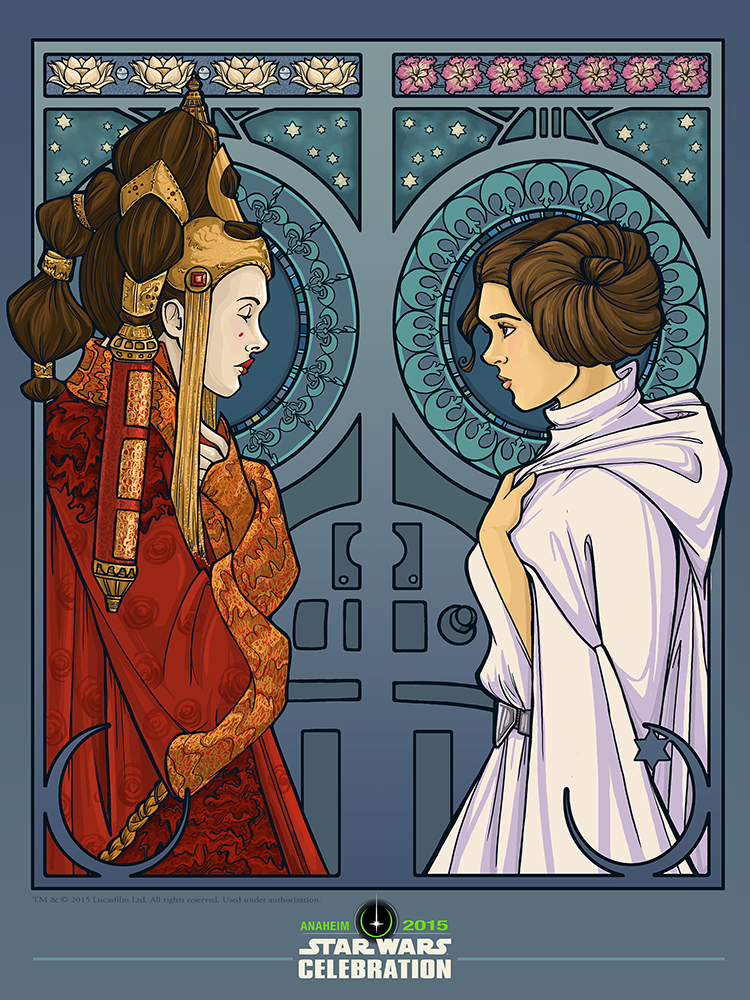
Illustration by the epic Karen Hallion, http://karenhallion.tumblr.com

As an avid fairy tale fan myself, I have to agree.  And in honor of the way Star Wars hearkens to some very old methods of storytelling, here is a poem I wrote for a high school English assignment (a long time ago in a galaxy approximately 35 minutes away by MBTA).  We were told to write an epic story using the literary style of Beowulf, including alliteration, assonance, and kennings. (We were also told that rhyme was unnecessary, but I was bad at avoiding rhyme in high school, so take it up with 15-year-old me.)

Any epic story would do, and therefore…

The Destruction of the Death Star

Now the dreaded Death Star drew near,
and the rebels, brave and bold,
fearlessly flew to fight their foe.
Luke Skywalker, our hero young,
was one of those who made the run
through narrow trench, with twists and turns,
escaping death from laser burns.

Though many tried, their fighters frail
could save them not from deadly hail.
In screaming-balls and flying-crosses
they burst in burning balls of gases.
Darth Vader, evil robot-breather
singled out Skywalker’s ship,
but Force-protected on Luke flew
pursued by Vader’s implacable ire.

Handsome Han Solo, sarcastic smuggler
spun vanquished Vader to space’s void,
leaving Luke alone to finally fire
the deadly blast to the dark-moon’s heart.
With the Death Star destroyed, the duo landed
greeted by lovely Princess Leia
giving them both due glory and fame,
the heroes of the new rebel era.

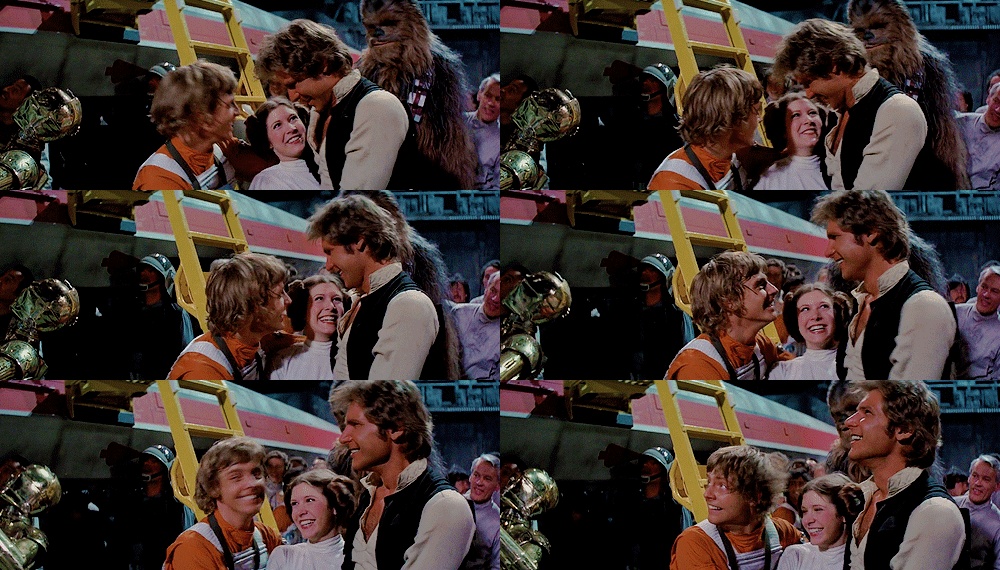
orig trio

What literary style would you use to tell the story of the new Star Wars cast of characters? Have you got a good kenning for BB-8? Share your best scavenger-meets-stormtrooper couplet below!

Uncategorized

In praise of the sound of crunching leaves

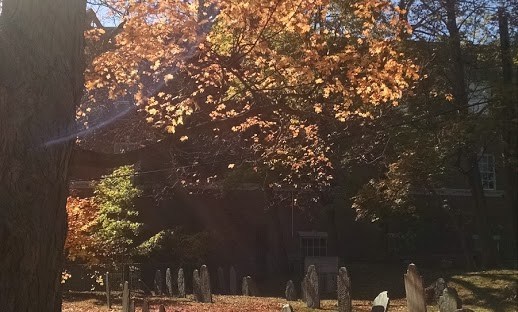
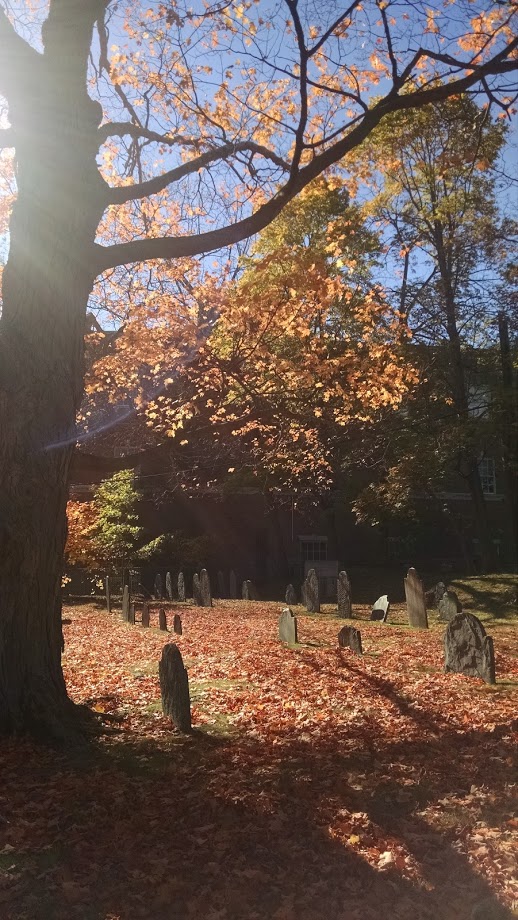
Graveyard, Arlington MA, October 2015. Photo by Meg Winikates

It’s autumn, and despite being an agreeably insane sort of busy right now, I had a chance to go out at lunch today and take in the seasonal delights. Peak foliage around town was actually probably the end of last week, but there’s still a lot of gorgeous to be had, and that brilliant invigorating bite in the breeze today is the sort that makes me glad to be alive.

And so in celebration of my favorite season, have a poem by fellow New Englander Emily Dickinson!

Besides the Autumn poets sing (131)
Emily Dickinson, 1830 – 1886

Besides the Autumn poets sing,
A few prosaic days
A little this side of the snow
And that side of the Haze –

A few incisive mornings –
A few Ascetic eves –
Gone – Mr Bryant’s “Golden Rod” –
And Mr Thomson’s “sheaves.”

Still, is the bustle in the brook –
Sealed are the spicy valves –
Mesmeric fingers softly touch
The eyes of many Elves –

Perhaps a squirrel may remain –
My sentiments to share –
Grant me, Oh Lord, a sunny mind –
Thy windy will to bear!

If you’re hungry for more autumnal poetry, you might want to check out this Wednesday’s Improbable Places Poetry Tour.  Imagined, organized, and hosted by poet and Montserrat professor Colleen Michaels, this month’s stop on the tour is at Green Meadows Farm in South Hamilton, MA, and a gathering of poets will be reading a selection of their works on the theme of “Harvest/Moon”– including me!

I’ll be there to listen, bask by the bonfire under the moon, and read one of my own night sky pieces.  Hope to see you there!

Uncategorized

Video: My reading at MassPoetry’s U35

I had a fabulous time a few weeks ago reading at the Marliave Restaurant in Boston, as part of MassPoetry’s U35 reading series. You can check out the videos of the other readers from that evening (Chen Chen and Sarah Tourjee) on the U35 site, as well as the bios for November’s upcoming readers.

Also, don’t forget that MassPoetry is accepting festival session proposals until the end of this month! If you have a panel, reading, or workshop idea, make sure to submit here before October 30.

Uncategorized

Find out what the bees know

Zip right on over and check it out!  "Bee Line logo" by SPUI at Wikimedia Commons
Zip right on over and check it out! “Bee Line logo” by SPUI at Wikimedia Commons

What’s the buzz, you ask? The summer issue of Window Cat Press is out, and in it are four of my poems, accompanied by photography by the ever-delightful Michele Morris. Check them out, and all the other goodies within here!