
Uncategorized

What makes a literary district?

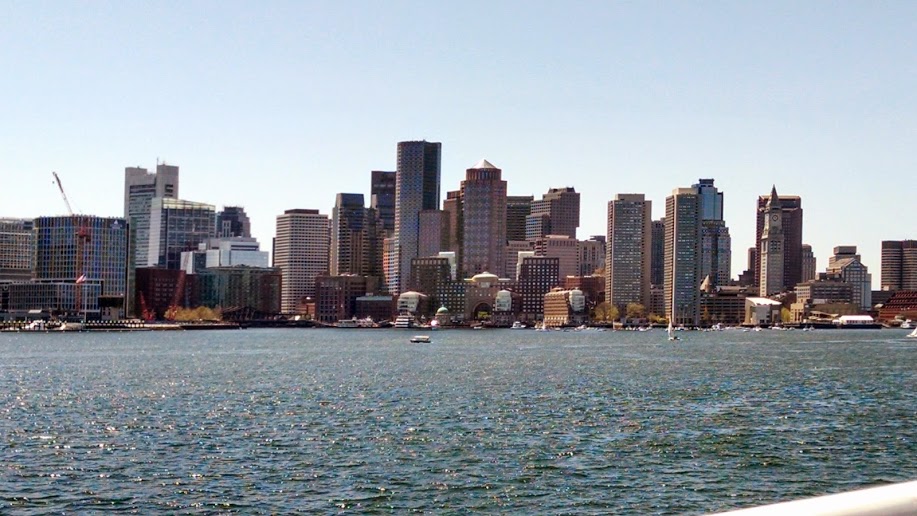
Boston from the harbor. Photo by Meg Winikates.

In August of this year, the Mass Cultural Council approved the creation of a ‘cultural district’ in Boston dedicated to the literary arts.  Cultural districts are a way of raising awareness about the various arts organizations and resources in an area, and are meant to have an economic impact as well, attracting businesses and creative professionals to a designated area.  There are currently 26 designated cultural districts in Massachusetts, and I find a lot to like in the definition the MCC provides:

It is a walkable, compact area that is easily identifiable to visitors and residents and serves as a center of cultural, artistic and economic activity. The Massachusetts Cultural Council recognizes that each community is unique and that no two cultural districts will be alike.

That seems like a set of very achievable guidelines, given that much of New England falls into the ‘walkable, compact’ category already, and the rest of the definition of ‘culture’ is left open to the strengths of the city/town that applies.
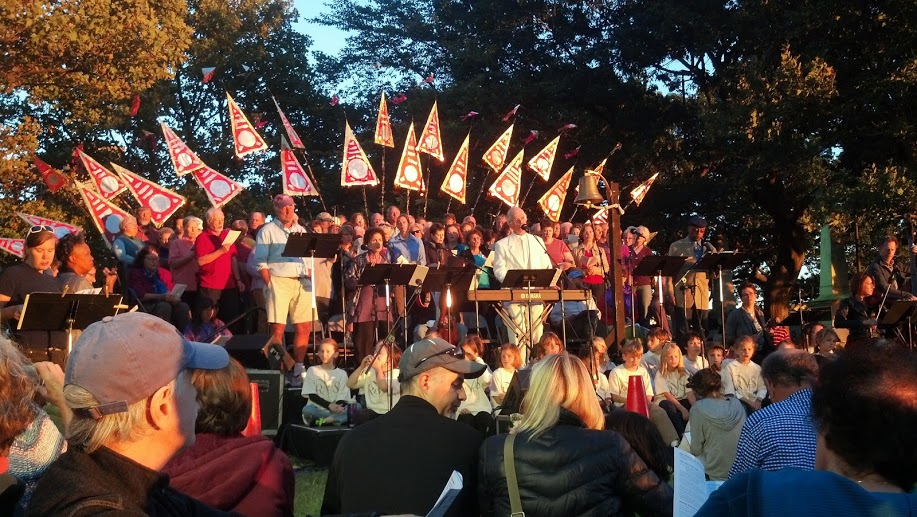
Revels' River Sing on the banks of the Charles.  Photo by Meg Winikates.
Revels’ River Sing on the banks of the Charles. Photo by Meg Winikates.  Many cultural districts seem to feature recurring music and dance festivals like this one, as well as the local waterfront, for understandable reasons. (Though the current Cambridge cultural district is in Central Square, up the road from where this celebration of the autumnal equinox occurs.)

So what makes the Boston Literary District (the only one of its kind in MA and the only district specifically geared to one arts discipline) fit the bill?

Mass Poetry recently interviewed Larry Lindner, the Literary District’s coordinator, who enthused about his hope that “the Lit District website becomes for Boston what Time Out is for people who go to London — a kind of what’s-going-on-in-the world-of-literature in Boston” and mentioned plans for an app to help explore the District in 2015.  And the physical district itself?  By making the sites and events more visible, accessible, and tangible, Lindner hopes to encourage timid readers as well as those already deep in the reading and writing world.  He also suggests that associate partnerships with organizations and businesses outside the District’s official borders can help their visibility as well, and bring some of the benefits of the district designation to other areas of the city that need it.  (Even events outside the city get a chance to be included on the District’s events calendar, such as a public art/poetry event in Newton earlier this month.)

The thing I love best about perusing the map of the district is the number of surprises it holds, even for someone who has lived all but 2 years of her life in and around this city, who has worked at a local literary/historical site (2 if you count the Paul Revere house and his own poetical connections), and who was an English major to boot.  For instance, did I know that E.B. White’s The Trumpet of the Swan was set in Boston’s Public Garden?  Maybe when I read it when I was nine, but I certainly didn’t remember the scene with Louis playing his trumpet on the actual existing bridge over the pond.  Nor could I have named even half the writers and poets listed as having ever been Boston residents.  (I love learning new things about my city!)

A few of the sites listed do seem like a stretch (there’s a small bookshop on the ground floor of the State House, really?) and some a bit vague (the Old City Hall listing says ‘Legend has it that that’s the setting for Edwin O’Connor’s novel The Last Hurrah‘) but on the other hand, one can choose to take that as a plus.  Some of these places had to really *try* to connect to the literary district.  It was worth the effort to find the thread, the history, the destroyed address that this modern building now stands over–and that’s kind of awesome, that people want to be a part of it.  I know next time I’m free to wander a bit downtown, I’ll be keeping my eye out for some of the literary landmarks listed.

Boston Public Garden (and Louis' bridge!).  Photo by Captain Tucker, used under creative commons license.  Click for source.
Boston Public Garden (and Louis’ bridge!)  Photo by Captain Tucker, used under creative commons license. Click for source.

And if you can’t make it to Boston to check out what’s going on on the bookish byways, take a stroll down Author Avenue  or Fantasy Street as you check out this virtual literary district at  My Independent Bookshop.  This site is a visually appealing compilation of people’s book recommendations which are then linked to independent bookstores.  I haven’t set up a ‘bookstore’ of my own yet, but it does look like a fun community and a fairly intuitive interface. (Don’t forget to scroll sideways as well as down, though!)

Uncategorized

Happy National Day on Writing

Yes, technically November is NaNoWriMo, which continues to look like a bad idea when one is working full time and taking two grad school classes.  However, for those of us with the spirit but also the time crunch, today is the first ever National Day on Writing, hosted by NCTE (Nat’l Council for Teachers of English), and signed into officialdom by a Senate resolution.

Educational Brick Letter W letter R letter I t45 letter e

The website, hosted by NCTE, invites you to submit your writing to a National Gallery of Writing, and also participate in the day-long webcast led by various authors, etc.   They’re also running all kinds of commentary, re-tweets, etc. on writing through Twitter, under #ndw.  I think this is all very cool–I just wish I had known about it sooner!  The first I heard of it was this morning, when I got my daily BU email, talking about all the cool writing-related activities going on at the student union. So I went and did a little digging.

Curiously, the mission statement on the NDW homepage reads:

Established by NCTE, the National Gallery and the National Day

  • highlight the remarkable variety of writing we engage in today;
  • provide a collection for research on whether writing today has risen to new highs or sunk to new lows; and
  • help us help others to write better.

I find this an odd assortment of goals.  Encourage people to enjoy writing? Showcase the many uses and forms and beauties of the written word?   Spread the word about ways to improve your writing?  Generally support the practitioners of what has often been deemed a ‘solitary craft?’  Great!  All good stuff.

But…provide a collection for research on whether writing today has risen to new highs or sunk to new lows?  This makes my critical-thinker’s brain sit up and say ‘really?’   Compared to what and when?  Are we looking at word-length, acceptable use of grammar, flights of metaphor and allusion, variety of vocabulary and reasonable spelling?  Logic, support, and originality?  Are we seriously looking at the efforts of a bunch of random people on the internet as compared to the letters of John and Abigail Adams?  As I didn’t see anything else related to that particular goal on the site, I’m just going to hope that the NCTE knows what it’s doing.  Certainly the proliferation of LOLspeak iz srsly scary, if also occasionally amusing.

And so, despite my intellectual question marks of the above paragraph, I am thrilled to see a day in celebration of writing.  Therefore, I say: Go forth!  Put pen to paper or fingers to keyboard or marker to whiteboard or pencil to post it note or stylus to clay tablet!  (No, seriously, why not?)  Twitter a haiku, send a letter to an old friend, drop some Shakespeare into your next staff bulletin.  Revel in the ridiculous rules of language, break a few, read a book, share some really really bad puns.  It’s the write thing to do.  😉

Uncategorized

Sorrow in the song for a three-dimensioned life

This morning was a Friday morning, and on Fridays I try not to let the news depress me.  On the other hand, it’s been a bad week, news-wise, for some of my heart-held causes, and the front page of The Boston Globe tipped me over the edge at breakfast.

Welcome to the library. Say goodbye to the books.

Excuse me? Cushing Academy is getting rid of all of their 20 thousand books in favor of 18 digital readers and a bunch of cubicles with power supplies?  They’re deliberating calling it a ‘learning center’ instead of a library?

Have they completely lost their minds?

In a week that has already had horrible news for the world of those who love to read (Reading Rainbow canceled after 26 years, a true heart-breaker for me, who grew up on public television, adored this show & LeVar Burton, and never grew out of loving read-alouds), this is just another example of how shortsighted people can be in the name of ‘looking to the future.’

I’m not even going to touch the (to the daughter of a librarian) extremely obvious issues about authority, editing, responsible use and citation, bias, and availability of certain kinds of information on the web.  The internet is not all-knowing, and it hasn’t got all the books in all the world.   Neither does a library, but they’re a heck of a lot better at getting them for you when you need them, usually for free.  I’m not arguing that there’s no place for digital resources–I use them all the time, and there are some incredible ones out there, like the CIA World Factbook that are an invaluable addition to the use of a standard atlas.  But the fact that books can be bulky and need dusting every now and again is not a valid argument for ditching them in favor of things that need power, cost more, and don’t necessarily last as long or work as well.

Ditching books, teaching phonics and mechanics to the exclusion of encouraging why and how to enjoy reading–Are we trying to make sure that in 20 years there’s no one left under the age of 40 who loves to read?  Have we let standardization and the all-powerful search button erase the pleasure of accidental discovery?

Reading a book of poetry isn’t just about reading the one poem you went looking for–it’s about how it’s laid out on the page, what poems are put on either side of it, the volume as a whole and what it says about the journey of the poet at that particular point in time.  Browsing Amazon.com is not equivalent to wandering the bookshelves of a library–‘viewers who purchased this book also looked at’ is not a substitute for a librarian’s assistance or the joy of coming across something interesting on your way to looking for something else.  Going directly to what you’re looking for is a bonus function of some electronic databases, sure, but the same goes for a card catalog.  And neither can replace the wonders of serendipity for a true reader, or for someone who has the potential to get there, assuming their library doesn’t get replaced by robots.

In conclusion, vivez les livres!

Exciting new technology: The B.O.O.K.