Uncategorized

Beta Readers and Your Internal Editor

Camp Nanowrimo has rolled around again, which means the corners of the internet I frequent are full of cheerleading and wordcounts and interesting snippets of advice from published authors.  As I am currently more in the editing stage of several projects as opposed to the frantic amassing of words, I thought I’d share some of the things that have caught my attention in the last week or two:

How to Train your Inner Editor by Mary R. Kowal

I watched this right before making notes for critiquing two pieces for my writers’ group, and it did really make me think about the kind of feedback I give, as well as the feedback I’ve gotten. I’ve done the beta-reader thing in several different ways, by email and in person, for strangers, acquaintances, and friends, and I do enjoy it, but now I get to appreciate it as a training exercise for my own writing in a way I’d never considered before.
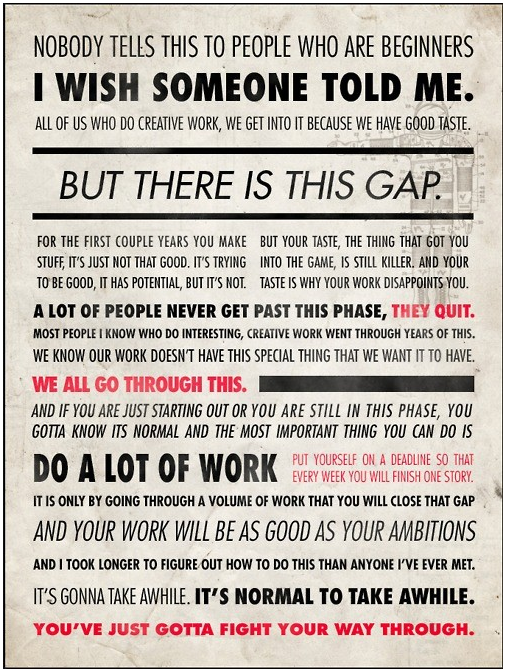
Quote by Ira Glass, Lovely layout by artist unknown.  If you know whom to credit, please let me know! (Google's reverse image search failed me)
Quote by Ira Glass, Lovely layout by artist unknown. If you know whom to credit, please let me know! (Google’s reverse image search failed me)

For a deeper look at that idea-to-editing-to-just-publish-already zone, Kowal and her fellow authors from the podcast series Writing Excuses have a new anthology called Shadows Beneath, featuring 4 short stories in first draft and revised versions, with discussions of the editing process.  I haven’t read it yet, but it looks like fun.

How Amazon and Goodreads are changing literary criticism – Do you write Goodreads reviews?  Do you follow book bloggers?  Whose opinions do you trust?  I had a bunch of books on my ‘to read’ list based off bloggers’ book reviews that were *panned* on Goodreads–so what now?  I moved them from my ‘buy if you see them’ to ‘see if they’re at the library next time you’re there’ list.  But I won’t ditch them entirely until I read the first few chapters.  How do you react to online reviews?

Slowing down the brain with calligraphic text messaging?  Since much of this post is about being aware of your writing as you’re writing, and being a more mindful reader/responder, I thought it would be fun to wrap up with this entertaining article from a woman who spent a week replying to text messages with hand-written photographic replies.

What do you do to make yourself a more mindful reader and writer?
Uncategorized

The Peculiar Discipline of Free Writing

Last week I had the pleasure of attending a workshop hosted by the folks over at Mass Poetry as a reward for supporting their Poetry on the T campaign.  (and I happened across some of said poetry just this week on the Red Line, which made me extra happy!)  The workshop was appealingly titled “Super Writing Fun Time” and was led by Jill McDonough.

I’ve been working on several projects recently (which is why I haven’t posted as much this month, oops!) and those projects have had me thinking a lot about editing, both prose and poetry.  One of the hardest things to do is look at a piece of writing and say, “You know, there’s really only one good line in that whole passel of words.”

Ouch.

Sometimes, though, it’s worth just hanging on to that one good line and rebuilding around it, and that was made abundantly clear in McDonough’s workshop.

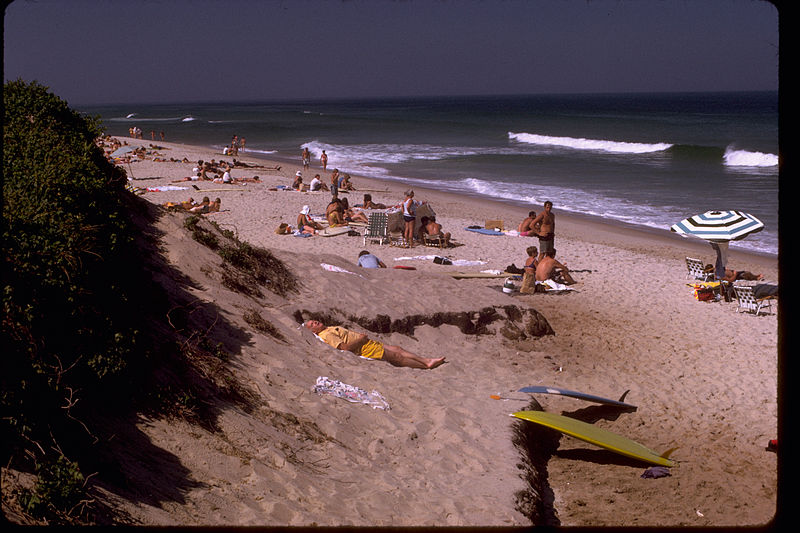
Cape Cod National Seashore, National Park Service (public domain)

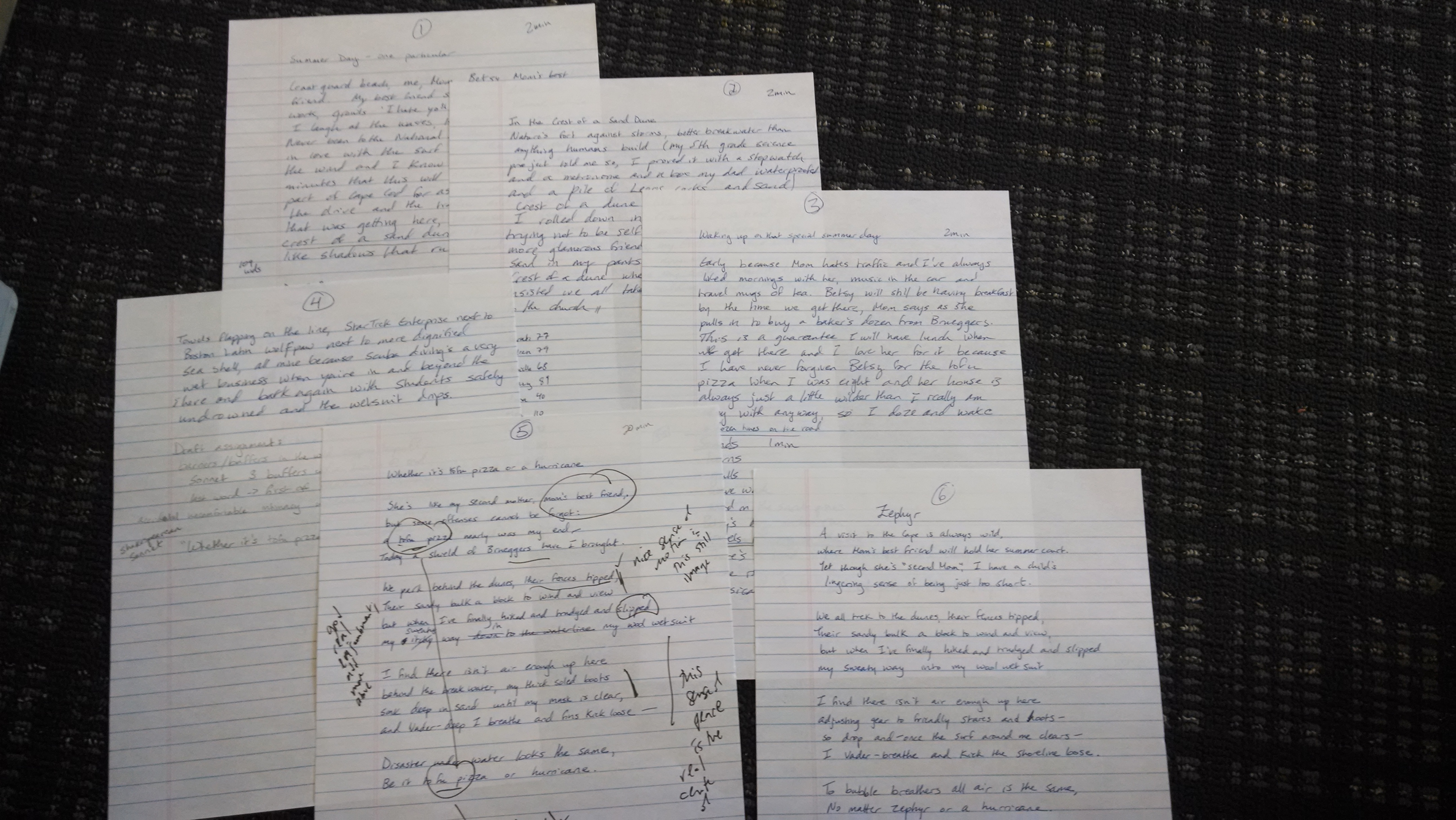
In a series of word-spilling sprints, she urged us to write about one particular summer day, read our result aloud, and then run on again from whichever phrase she highlighted as the most interesting part of our rushed verbiage.  After several iterations, we had to look back through everything we’d written and give ourselves an assignment to create a more thoughtful poem draft using themes or language we’d found in our earlier efforts.  Where we were stuck, she offered help by way of a format or a title or a direction, and then came around to ‘mess with’ our work if we indicated we wanted help/critique.   I ended up writing and rewriting a Shakespearean sonnet in about 25 minutes, and it was an enormously confidence-boosting evening.

A passel of words thanks to McDonough's workshop!
A passel of words thanks to McDonough’s workshop!

So why was it so effective?  Beyond McDonough’s humor and generous handfuls of Hershey’s kisses, she created a judgement-free zone.  Spilling all those words on the page in the beginning, without worrying about quality or phrasing overmuch meant it was easier to let those words go in favor of the best ones–and it’s a device I think I’ll adopt in future.  I’ve never been much of a ‘drafter’ by personal preference: I like spending the time and thought to feel like I’ve got it ‘right’ the first time around, but what works in an essay or a professional memo is really not conducive to the creative process, which is almost by definition iterative.  And carrying that mindset over from the workshop has been helping me edit the rest of my writing, as well.

If you’d like to find out more about McDonough’s process in her own words, I recommend this article: “Primary Sources” hosted over on the Poetry Foundation website.  Between that evening and this article, I’ve spent not a little time recently seriously entertaining the idea of going back to grad school, and then smacking myself on the back of the head, a little.  (Is there an Academia Anonymous?  ‘It’s been two years since my last graduation…’)