Uncategorized

“A hobby that swallows you up” – An evening with Billy Collins

The JFK Library and Museum runs fabulous and fascinating evening events, and last month I was thrilled to  go hear Billy Collins (former US Poet Laureate, a title he enjoys saying, apparently, and who can blame him?) read some of his work and have a conversation about poetry and writing and reading of same.

The introduction featured a fun bit of historical context on JFK’s associations with poetry, including a clip from Kennedy’s Amherst College speech honoring Robert Frost, which I’ve linked below:
NEA recording and transcript of Kennedy’s Amherst College speech regarding Robert Frost
Amherst College web exhibition “President and Poet”

And, of course, the view of the city and harbor out the windows behind the speaker was as stunning as always.
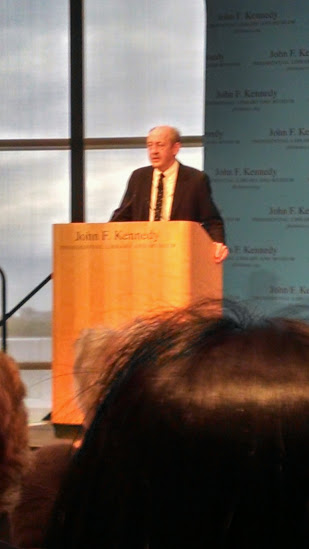
Billy Collins reads at the JFK Library, May 2014

Collins was entertaining from the very start, declaring that it was an honor to be mentioned in the same breath as Robert Frost, as “compared to Frost, my poems are like an unmade bed in a dorm room.”

Other highlights from the discussion–

  • On the surreal tone of some of his poems and how not to lose readers: “start in Kansas, but end up in Oz.” Start with an idea, set the tone, start out ordinary and develop into something interesting and strange
  • Domesticity is interesting, to start with a common experience and then dive ‘down and in’ to the more subjective point of view
  • To be alone with the reader is not the same as being lonely
  • When ‘finding the way through’ the poem, Collins looks at it like a map: ‘how does it move’ as opposed to ‘what does it mean.’
  • Collins’ writing ‘persona’ is very present in his poems – open, ready to be pleased (though not always succeeding), and with ‘little capacity for misery.’  According to Collins, all poetry needs/involves persona, which is not the same as personal – he denies any explicit autobiography in his writing.  (And, indeed, is not fond of overtly familial poems as reading matter, either)
  • One doesn’t exactly choose to become a professional poet, it is more like ‘a hobby that swallows you up.’

Want more?  Check out Collins’ Biography and large selection of poems on PoetryFoundation.org or one of the poems he read that night which I enjoyed quite a bit:  Fishing on the Susquehanna
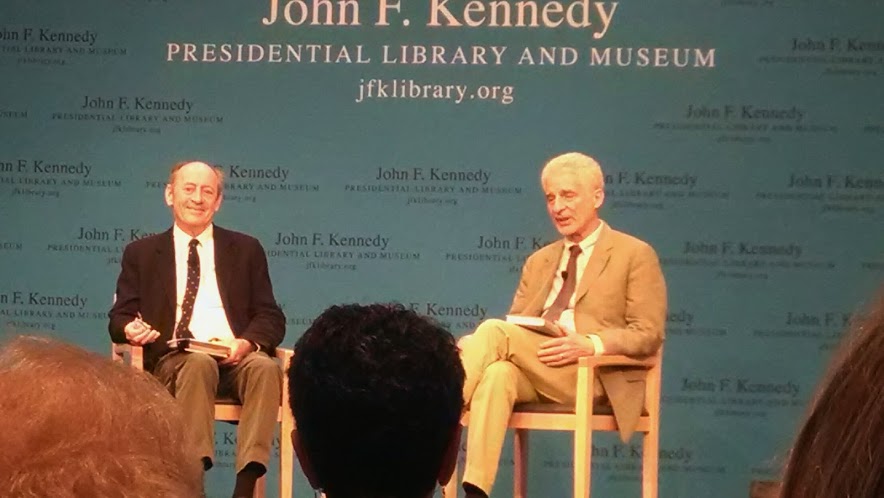
A genial conversation

Want even more than my highlights?  Hear it from the man himself:  TED Talk by Billy Collins

At the end of the evening, there was a little time for Q&A.  I’m not a big fan of getting up to ask questions in front of a microphone (I don’t mind public speaking, but public interrogation is somehow harder!) Since Collins was signing books after, however, I did get to ask him about one of his comments from earlier in the evening.  He had stated that the majority of poems (not to mention poetry collections), he doesn’t even read all the way through, so I asked which poets, if any, had writing which he did read all the way to the end.

His answer?  Charles Simic.

That’s a name I recognized, though I couldn’t put words to the name, so I did a little research and reading, and now know enough to put him on the list of poets’ names to scan for when I’m in a bookstore.

A few poems of Simic’s I’ve found appealing so far:
In The Library
Autumn Sky

What of Collins’ statements above ring true to you?  Any quibbles? (I have a few, but that’s what makes life and literature interesting, right?)
Uncategorized

Highlights from Boskone

Between holidays, snow, and work commitments, this was maybe  not the ideal weekend to go to a sci-fi/fantasy convention.  I went anyway.  Last year was my first con ever, and much as I had an immensely enjoyable time at Arisia, I’d heard Boskone had a lot going for it as well, so that was this year’s adventure in geekery. (So far.  It’s only February, after all.)

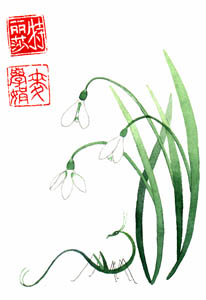
"Snow Drops" by Patricia McCracken, my favorite artist find from this year's Boskone. Click for source (and to order her lovely prints!)
“Snow Drops” by Patricia McCracken, my favorite artist find from this year’s Boskone. Click for source (and to order her lovely prints!)

One of the selling points of Boskone is the chance to have a close encounter with some pretty big names in the world of sci-fi and fantasy writing, and when I saw that this year’s guests of honor included Jane Yolen and Seanan McGuire, I was definitely sold.  I do, after all, have that thing about meeting your literary heroes, and I’ve been a fan of Yolen’s basically since I learned to read.  Though I only started reading McGuire’s Rosemary and Rue this week, I’ve been following her on Twitter and Tumblr for a while and have a lot of respect for the way she interacts with her fans and the way she stands up for inclusion and respect in geek culture.

Despite having an abbreviated stay at Boskone due to weather et al, I had a fabulous time.  It was as inspiring and entertaining as I hoped, and the worst part was that there were way more events I wanted to attend than I had time for.  These are some of my favorite moments from the weekend:

  • “Finish It!” panel on ways to cope with and defeat everything that gets between you and finishing your novel: best tips included setting yourself manageable goals like ‘write non-stop until the end of the playlist,’ and making sure to ‘touch base’ with your novel every day, even if that means writing up bits of background for minor characters or historical elements to your world instead of advancing the main story.  (With the bonus that you might get a short story or another book out of those extra elements later!)
  • “The Evolving Role of Heroes” panel on what’s beyond Joseph Campbell: lots of great questions raised about heroes outside the Eurocentric hetero male model.  Author Greer Gillman talked about how many of the female hero stories centered less on the ‘zero to hero’ trope and more on the idea of finding a way out of restrictive circumstances (labyrinths, castles overseen by older, dangerous people), finding a solution to a problem (and often rescuing a clueless boy as a side-project).  Others talked about how all heros’ journeys are about self-discovery–but some are about following the steps to taking power (Aragorn), and others are about being forced out of one’s comfort zone for the greater good (Frodo).  There was also a fun discussion of alien cultures and what would heroism look like in a collective society, what would our concepts of heroes look like to them, etc.
  • “The Light Fantastic” and “Humor in SF” panels each focused on recommending and supporting the happier, more humorous side of sf/f, and on the defense of escapism and humor as a teaching tool and cover for topics that are actually harder to take on in drama.  Bruce Coville was particularly entertaining in the SF panel, and in between admitting to having an 8 year old’s sense of humor and telling body humor jokes, handed out some great advice about emotional pacing and build-up (“three and a topper”), pleas for wit over thin parody, and ‘cute and fuzzy humor with teeth.’  Plus I got a list of new authors to check out, bonus.
  • Interview with Seanan McGuire pretty much had me laughing the entire way.  Not a lot of focus on writing technique, etc, but who knew reptile and raven rescue stories could be so funny?
  • Discussion group with Joshua Bilmes, literary agent, who took the time to answer lots of questions about networking, the search for an agent, what to look for in an agent, and to dispel myths about needing short story credits to query for a novel, etc.
  • Tea and Coffee with Jane Yolen! 45 minutes at a table with Yolen and 9 other people, in which I did not make a blithering idiot of myself and asked a few relatively intelligent questions about the market for recast fairy tales, got to hear about some of her new projects, her opinions on how authors should or should not try to tie in with the Common Core, and all kinds of other fascinating stuff.  I didn’t take notes because it was an informal conversation, but she was warm and funny and just so incredibly cool.  Definitely the summit of my con experience.

In short, chances are good I’ll be going back next year.

Uncategorized

A Month by the Pen

R2D2 mailbox from the 30th anniversary of Star Wars.  Photographed in Boston by David Heiniluoma, Jr.
R2D2 mailbox from the 30th anniversary of Star Wars. Photographed in Boston by David Heiniluoma, Jr.

Despite the eternal frustration that is slow postal delivery to my neighborhood in Salem, I really love getting snail mail.  There’s something really exciting about opening up the box and seeing a postcard or a letter that a digital inbox just doesn’t convey.  Maybe that makes me a temporal leftover, but apparently there are a lot of people that feel the same way, one of whom is an author I admire, Mary Robinette Kowal, whose Glamourist Histories I read with great glee.

A few years ago, she started the Month of Letters challenge, wherein participants mail one piece of actual mail every day that the post office is open, for the entire month of February.  It corresponds (ha!) perfectly with a month in which one would potentially be sending valentines anyway, and is a nice manageable month if one isn’t running February school vacation week programming.  (Which I am, but oh well.)  This year, she upped the game by offering to write a character letter back to anyone who wrote to either of her two main characters from the Austen-era Glamourist Histories, and that’s what made me decide to go for it.  I probably won’t manage a letter/postcard/package a day, but there are a few people with whom I do keep up a written correspondence, and I’ve owed a few of them letters anyway (looking at you, Devlin!).  Because who can turn down the opportunity for a letter from Jane, Lady Vincent?  Not I.

(This is a brilliant idea, by the way, and crazy generous of her time and attention.  I’m impressed.)

LetterMo2014square

So if you’d like a letter/note/postcard/light shippable curiosity from me, drop me a line here and let me know!  (If I don’t have your address already, you can leave it in the comments, which will be screened so it doesn’t go public.)

Uncategorized

“Saving Mr. Banks” and the enduring power of story

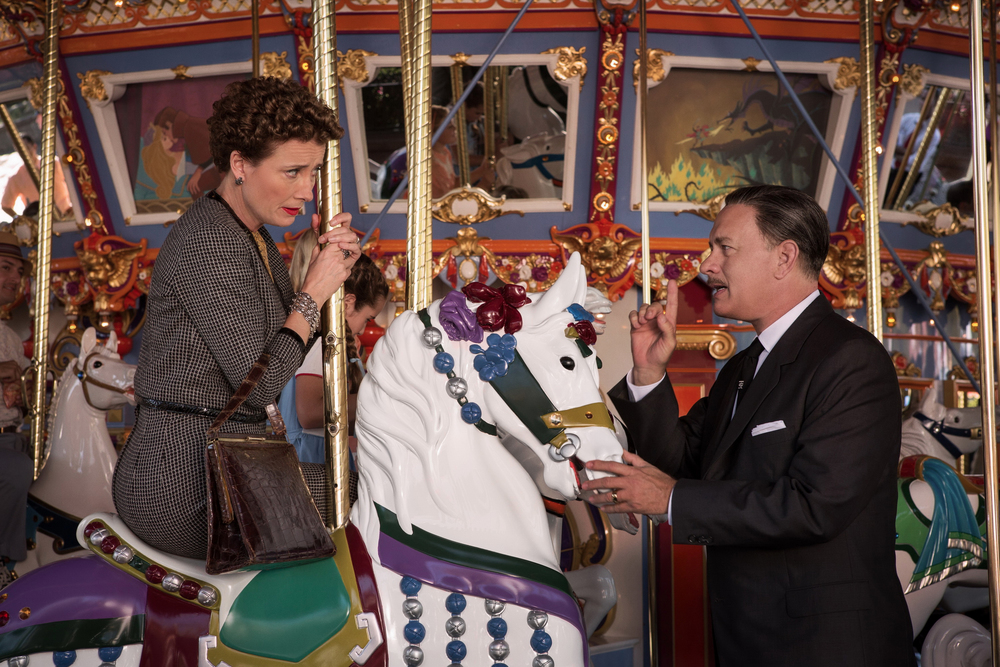
The carousel scene from Saving Mr. Banks

I’m too late on the carousel to offer a fresh perspective on Saving Mr. Banks–a good many people have written reviews already, and I have no inclination or need to echo what’s been said repeatedly (but yes, fabulous acting by the entire cast start to finish, and I’m not sure I’ve ever been so happy to see Bradley Whitford on the screen [too long since I’ve seen The West Wing, clearly]).

However, regardless of historical accuracy or good acting choices or mildly amused acknowledgement of a certain sort of self-interest in Disney producing this story in the first place, what made this movie so powerful was the way it got me right where I live.   Yes, this is an amazing story about families, and a little about keeping some of the magic that’s crucial to childhood into the way you survive adulthood too, and a lot about the clash of two intense personalities, but it’s mostly about the enduring power of story.  Tom Hanks’ Disney doesn’t win over Emma Thompson’s Travers until he not only talks about the value of story and of story tellers, but he actually puts himself out there *as a storyteller.*  She’s only really seen the actions of the business man, heard lip-service to his role as father, and bore witness to his constructed public figure–and it’s the story that finally gets through to her.   Hanks’  Disney tells the audience he’s been in her shoes when trying to protect ‘the Mouse,’ but even if we believe he has the best intentions towards her characters, she can’t see it until he offers her something real in return.  It’s brilliant, and even if I had gone into the movie with as much reluctance as the on-screen Mrs. Travers (I didn’t, I was prepared to be charmed from the first), that moment would still have gotten me.  As it was, it knocked the breath out of me instead.  Story matters, and if it matters to each of us a little differently because of who we are and where we come from, in the end it still helps us understand each other, even if we can’t agree on the dancing animated penguins.

I now have a serious (serial?) case of needing to a) rewatch Mary Poppins, b) read the original books, c) go back to Disneyworld.

…I’d call that effective story telling.  *laugh*

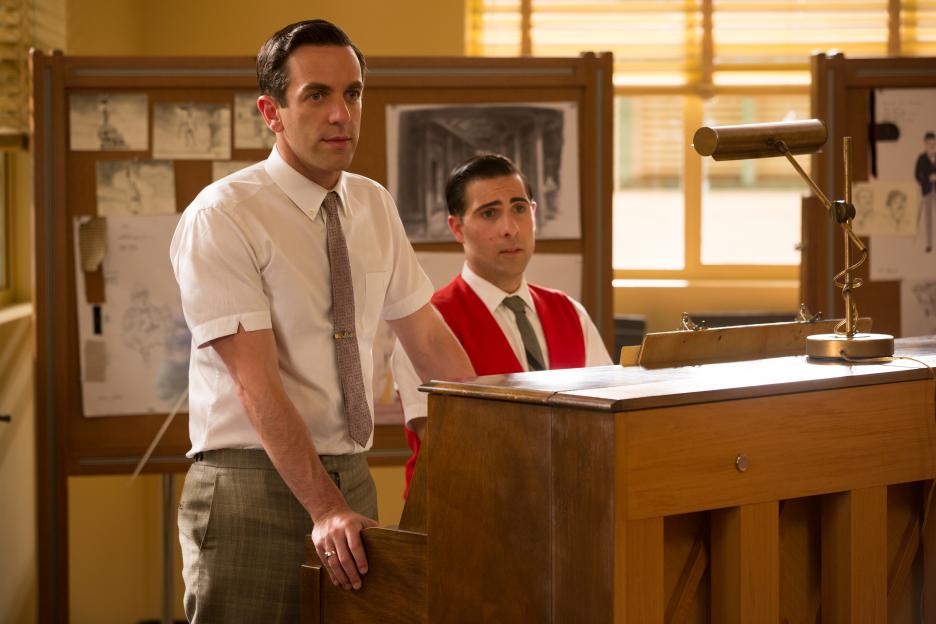
Also? I totally loved these guys.  I am always appreciative of music's storytelling power, and these two played their parts to the hilt.
Also? I totally loved these guys. I am always appreciative of music’s storytelling power, and these two played their parts to the hilt.


Uncategorized

Why meeting your literary heroes matters

All of us, at one point or another, have answered that question about having dinner with any three people from any point in history.  My answer is always Abigail Adams, Jane Austen, and some rotating third figure depending on my mood.  Sally Ride, maybe, or Eleanor Roosevelt, or Princess Leia (what, you didn’t mean *Earth-bound* historical figures, did you?  Well in that case, Michelle Obama).

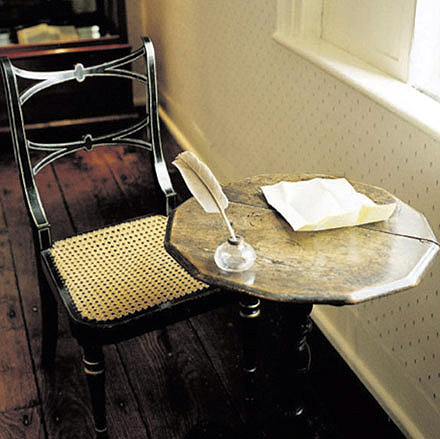
Of course, when you can't meet them, you can go stand by the window where they sat and absorb the genius vibes, instead.  Jane Austen's writing table, Chawton.
Of course, when you can’t meet them, you can go stand by the window where they sat and absorb the genius vibes, instead. Jane Austen’s writing table, Chawton.

The point is, most of us answer that question with the names of people we have no chance in this reality of ever meeting, death and the Secret Service generally being no-nonsense sorts of barriers.  It doesn’t change the fact that meeting people you admire can be an amazing kick-start to your own sense of self.

A number of years ago now, I went to a panel on ‘why write fantasy?’ hosted by the Cambridge Public Library, featuring a discussion between two of my literary heroes, Susan Cooper and Gregory Maguire.  I spent the entire two hours or so pretty much vibrating out of my seat with joy, most especially when Susan Cooper said she writes fantasy because ‘that’s just the way [her] brain works.’  She wants to write a Shakespearean historical fiction, or about Nelson and the Napoleonic wars, they turn into time travel stories.  It was among the top five most validating things I’ve ever heard in my life, and she wasn’t even talking to me.

(Mind you, when I did get a chance to talk to her, I babbled something probably incoherent about how much I love her writing and how I reread The Dark is Rising every time I need a reminder about how pacing works.  I was so not smooth.)

And then this past Sunday I had the opportunity to hear Naomi Novik read during Geek Central (Cambridge, again! Why do I not live there?).  I’ve loved her Temeraire series since the beginning, with much wailing and gnashing of teeth at the same time (dragons and Napoleon, why didn’t I think of that!?).  I’ve been to one other reading of hers, which was much more crowded, and though I felt bad she had a smaller audience this time (most of us who were there were blaming the RI Comic Con) I appreciated the fact that it meant we got to have actual conversation with her.  She read us the opening to a new fairy-tale inspired piece, and talked about finishing up the Temeraire series, what’s next after that, and who inspires her and why.  She even asked for input on potential titles for her new work, which made me grin.  (Titling is hard!)

And when it was my turn to get my book signed, I managed not to sound like an idiot (progress!).  We talked about her dragons-in-ancient-Rome short story, and discussed how cool her Anglewing dragons were, and even though I said absolutely nothing to her about being a writer myself, I came away inspired and heartened.  Because she’s not so different from me, and she reads authors I read and writes things in the genres I write, and my first drafts don’t sound so much rougher than the piece she read us all.  And since our brief conversation on Sunday I’ve managed to write over 6K words of my own current project.

So it matters, meeting the writers you admire, because while it’s easy enough to throw up your hands and say “I don’t know how they do it!” the next step is to bring those hands right back down to the keyboard.